WILD SURMISE
OCTOBER 1986 #9
AN ALMOST ANONYMOUS INFORMAL NOTE
Up
It is folly to try to design the perfect airplane, because the perfect airplane was designed and built many years ago; it fought through World War II. It was the Lockheed P-38 Lightning, called by the dismayed Germans who confronted it, "The Fork Tail Devil." Admittedly, the Germans called all fighters "Devil Airplanes," inspired no doubt by Medieval painters, so the name may be more a tribute to Teutonic sense of poetry than to aeronautical engineering.
It has always been my favorite airplane for the simple reason that I could always recognize it. It had a short fuselage in the middle of a single wing. To either side was an engine. From the back of each engine extended a boom that went back to a small vertical stabilizer, and the two booms were connected by a rather long horizontal stabilizer. The general effect was a square rather than the T-shape that was characteristic of most planes of the era. So for me the Lockheed Lightning was one plane whose name I knew. That made it a friend. Alas that over the years I learned that many of tshe planes I thought of as Lightnings were, in fact, Black widows, Twin Mustangs, and even Flying Boxcars. I resolved the paradox by liking them all.
Any airplane, of course, is designed for a purpose, generally with indiyidual conflicting goals within that purpose. It attempts to achieve the purpose through a set of compromises. And the only reasonable way to judge any plane is to ask whether it accomplishes its purpose. Most do.
The purpose of the Lightning was to be a high altitude pursuit plane, which could climb to 20,000 feet in six minutes, fly at 360 miles an hour, and fight other airplanes. It could do these things and more. For one thing, as fighters go, the Lightning was a big plane, really big. Most fighters to this day have a single engine; the Lightning had two. Given two engines, it could carry a lot of guns. I once picked up a hitch hiker, who turned out to be a Lightning pilot. He said, "A Lightning could shoot a Jap apart just like that, *!'! as he snapped his tough weathered fingers. A big plane, loaded to the gills with rockets it had the fire power of a Navy cruiser firing a salvo of six inch guns.
Since the engines were out to the sides, the machine guns and cannon could be placed in the nose of the fuselage. That made them easier to aim, and it concentrated their fire. Someone has said that the Japanese Mitsubishi "Zero" could sustain only six seconds of fire froin a Lighting before falling apart, thus approximating the estimate of my hitch hiker. They say the heavily armored Hellcat would survive on average until it had had its own weight in bullets shot at it. The record, I think, is supposed to be the wild duck, which will not come out of the sky until hunters have pumped its weight in lead into the air fifteen times over. I do not know how long a duck can stand up to a Lightning.
A second advantage to having the engines out to the side was that there was room in the nose for a wheel. Most fighters of the day filled their nose with engine, so that the third wheel was in the tail. That left two problems. While taxiing around on the ground, the engine stuck up so far in front of the pilot that he couldn't see out forward. He had to maneuver his craft by looking as well forward as he could out the side. That was dangerous under any conditions and particularly so when the pilot was distracted by the fact that he was in combat. The other problem concerned landing the plane.
Under ordinary circumstances, as a plane flies, the wings develop lift and drag. The lift pulls the wing up, the drag slows it down. The "angle of attack" of the wing is the angle at which it meets the air. If the nose is high as the plane moves forward (right side up) the angle of attack is high. Up to a point, increasing the angle of attack of the wing increases both lift and drag. (If the angle of attack goes beyond that point, the wing is said to "stall;" it develops drag but no lift - just like a brick.) In order to maintain reasonably level flight, as the plane moves slower, it must increase its angle of attack. It would seem that common prudence would dictate that a plane ought to keep an airspeed that is higher than the stall speed (or more strictly1 an angle of attack that is less than the stall angle of attack) by some reasonable margin, particularly when the plane is close to the ground.
But suppose you are coming in to land in a plane with a tail wheel. You fly down to the runway at a good, safe, controllable speed, with enough air speed to spare so that some little flaw in the wind doesn't drop you like the proverbial turtle. Your main wheels touch down just fine. But you are going just a little bit faster than you meant to and coming down a little harder. Momentum carries your tail down. Your nose goes up. Your angle of attack increases. Your lift increases, and you find you are going back into the air just when you thought you had landed. No good in putting the brakes on now; your wheels are off the ground. No good in lowering your nose to gain airspeed; you will hit the ground first. If you have bounced very high, you might add a little power. Otherwise, all you can do is keep your nose up, keep all the power off, wait for the bouncing and crashing to stop and then add up the damage.
Ah, but what if you have a nose wheel instead. Now when the main wheels land, the nose comes down with the momentum. Your angle of attack drops. Your lift drops. And gravity welds you securely to the welcome earth. The Lightning had a nose wheel.
For another thing, the Lightning was fast. It easily surpassed its original design speed of 360 miles an hour, and late models went up to 420 in level flight. So in steep dives, the machine approached the sound barrier. Ordinarily air, struck by a moving object, is compressible enough to bunch up in front of the object and then go squirting around the sides. At the speed of sound, the limits of compressibility of the air are exceeded, and the air is thrust bodily aside as wood is forced aside by the advancing point of a nail. The resulting shock wave moves away at the speed of sound. If a part of the rapidly advancing plane moves into a shock wave produced by another part, it meets a force irresistible. As the trailing part of the plane reacts to the force, the leading part changes its angle, and the shock wave itself changes. The plane becomes as a rag in the teeth of a puppy.
It took about two years to figure out how to install a dive brake that would get the plane to behave itself in a steep dive. In the mean time, it seems, any weak spots in the construction of the plane were discovered during the the incessant hammering against the sound barrier, for the Lighting was a very rugged plane. My chance source, the hitch hiker, described handling one in combat. One hand was for the control stick and the other held both throttles. The Zero could maneuver much better than the Lightning and would swirl away just as the bigger plane closed in. Then the P-38 pilot threw out the rule book. stomping the rudder pedal, yanking the controls, killing one engine while over gunning the other with a single twist of the wrist to throw the craft into a screaming sideways skid, the pilot tried to bring his guns to bear, oblivious to the stresses on the machine; and the machine took it. Perhaps it was that, or perhaps it was the second engine, that won for the P-38 the most endearing nickname of any combat aircraft: "Two way Ticket."
Another fact about the Lightning that gave it drarna was the world it entered, particularly in the Pacific. The Pacific was dominated by one man and one machine. The man was Admiral Isoroku Yamarnoto of the Japanese Navy. He had spent time in Washington D.C. before ww II, and gained a reputation there among the Navy brass as a formidable bridge player. It was Yamamoto who masterminded the surprise attack at Pearl Harbor that left the American Navy number two in the Pacific. Some say it was a dastardly act; some say we forced them into it and were merely upset that they did such an effective job; some say it would not have been so tragic if the American medical people hadn~t been experimenting with a new anesthetic agent, that accounted for half the deaths. It was Yarnamoto who directed the battle of the Coral Sea. Yamamoto who led the Japanese at Midway.
And through all those battles swirled the ever present Mitsubishi Zero. They devastated the American fleet at Pearl Harbor. They mauled the Americans at the Coral Sea. Fast, long ranged, with great fire power and uncanny maneuverability, they almost put us out of the war at Midway.
On paper, Yamamoto should have won that battle. He wanted to have a platform from which to crush the Americans at Pearl. He would have been just as happy to meet the American Navy anywhere for a fair fight. So he planned to take Midway. A major invasion fleet was assembled and approached Midway from the west, while Yawamoto took his fleet of aircraft carriers around to the northwest. He would send his planes over Midway to knock out its air defenses, and then the invasion would proceed. If the American carrier fleet showed up, so much the better. He would have reconnaissance planes out looking.
The Americans knew something was afoot. The intelligence boys had intercepted a lot of radio transmissions that mentioned a pair of map coordinates which the Americans took to be the Japanese objective. Then they overheard a pilot mention the same pair of coordinates, and since they thought the pilot was probably near Midway at the tire, they figured the Japanese were after Midway. Well these boys were Scotch Irish, it seems, and not above a little creative intelligence gathering. So it was arranged that a message be sent in the clear from Midway to Pearl saying their fresh water supply was in trouble. Sure enough, pretty soon a Japanese message was picked up saying that the place in question had trouble with their water supply, and Yamarnoto's goose had reason to worry.
Well three fleets converged on Midway, one American and two Japanese. The Mitsubishis knocked everything American out of the sky over Midway and reduced the runways to rubble. The Americans had lots of reconnaissance planes out, and they found the invasion fleet just fine, but no Yarnarnoto, no Japanese carrier fleet, and pretty soon nothing on Midway left flyable to go ~ooking with or place to take off frorn if there was anything flyable. The American carrier fleet sent some planes out to where Yarnamoto should have been but wasn't, and one of them, by inspired chance, took a dogleg back to his own ship and found the Japanese along the way. Yamamoto's goose was decidedly in peril.
The Japanese reconnaissance still hadn't found the American fleet, which was under orders from Admiral Nimitz not to get itself sunk if it could help it. The first wave of American torpedo planes set out to have do with the Japanese Admiral. They found the fleet. The Zeros found them and shot them all down. In fact, that seemed to go on for most of the day. Arnerican planes would find the Japanese fleet and get shot down by Zeros. Then in a final effort, they sent out one last flight including their only Douglas Dauntless dive bombers. Nobody expected the old Dauntlesses to be very effective, but they were about all that was left. They chugged over to the battle and dived out of the sun. Within minutes, so many Japanese carriers were sinking or in flames that the invasion was given up and the Japanese Navy was never again in a position to eliminate or even face the American presence. It has been a near thing, and but for a number of lucky breaks Chad a wandering plane not found the Japanese carriers, or had the Zeros noticed the dive bombers before their bombs were away), the United States might have lost California as a consequence of that day, but instead, Yamamoto's goose was noticing things had turned decidedly warmer.
But in all this, there were still no Lightnings.
Still, getting. a lucky break against a man is not the same as having him vanish, and even after Nidway there was no doubt that Yamamoto was still a shrewd, capable, level headed, awesomely effective leader. Then ten months later, the intelligence boys picked up a message that said, "Prepare escort for Yamamoto arriving Kahili" at such and such a time. And Yamamoto's goose was well and truly cooked. The way the lads figured it was this: If Yamamoto is ordering an escort in, he won't have an escort the whole way. If he doesn't have an escort the whole way, it's because the distance he is coming from is about the range of a Zero or greater. But it can't be greater than the range of his transport. The only air base they have that is about the right distance from Kahili is nabaul. ~e know how fast they will fly. We know where they are coming from. So we know where they will be the whole way, and we know they won't be escorted in the middle.
When Yamamoto got to the half way point, there was an airplane there that shot him down. The timing had to be correct within about three minutes. No wonder he hated Americans.
There is another side to the story. The Americans used Lightnings, eighteen of them, stretching the limits of their enormous range, churning the whole distance at wave top level through the morning heat and glare to avoid radar detection, easing stealthily up to intercept the flight, crashing through the escort that turned out to be there after all, but in the end achieving the objective.
It took more than killing Yamamoto to stop the Japanese. It took more than amassing the greatest military force that has ever been seen in history. It took nuclear war. The Lightning could never have done it alone.
There have been other war planes. They say the late model Spitfires and Nustangs were faster than the Lockheed Lightning. In fact, there was an Italian plane called the Macchi c.202 Lightning, or "Folgore," which was faster and more maneuverable than any of them until late models of the Spitfire and ~ustang. But the ultimate fighter, although nobody~s favorite, is the F-19, stealth fighter. If one is to believe the military, (and who does?) the plane doesn't exist at all. They just skipped a number when naming fighters (F-l7,~F-l8, F-20) and left it to everybody's heated imagination to invent the missing machine. They fenced off a mountain in the West, where one of the mythical beasts is said to have crashed, and you can even buy plastic models of it in California. Well, nobody can deny that it~s a cost effective idea; let them think you have a secret weapon that doesn't exist and then let them try to find it. (Maybe there 5 one parked in your driveway right now.) But who can love a plane like that?
Let us try to design an ideal airplane. We will exclude military craft, since the needs of such a machine change quickly with political realities. We will exclude raw speed as a goal, since modern designs for hypersonic craft already promise trips to Australia in a couple hours. We will exclude comfort and luxury as goals, since the house has already been invented. We will exclude total lifting power as a goal since they already make transports that carry so much that it is easier just to go where that stuff is than to have them bring it to you. Vertical take off and landing are handled nicely by helicopters, although I find it odd that most helicopters look as if they were streamlined front-to-back instead of top-to-bottom in the direction of the major air flow.
For noise reduction, it is hard to improve on a helium balloon. For low price, it is hard to improve on the inodern ultra-light air craft.
I do think it is a pity that no one has invented a really convenient, slow, docile, corrosion resistant flying boat. The flying boat is still made although brutally expensive and from insurance figures still rather tricky to handle. of all air craft, those that land on the water seem to be the purest forms, moving between two fluids. There was a time when the highest speed, the longest rango, the greatest pay load, were all the province of the sea plane.
If you could transport yourself stiddenly and magically to some earlier era of the earth and could take with you only one form of transportation, you could do worse than take a sea plane. It would let you cover vast distances at great speed, and most of the places you would be interested in landing would probably be near open water. Fuel would be a problem, of course, but less of a problem than with almost any other kind of transportation except locomotive and sail boat, one of which would leave you hurting for lack of track and the other for lack of current charts and aids to navigation.
The ideal plane must be one you power yourself.
we now live in the age of true flight. Flying an ordinary plane doesn't "feel like flying," according to M, who always tells the truth. A motorcycle feels like flying. Sailing feels like flying. Skiing feels like flying. Horses feel like flying. Running feels like flying. Swimming feels like flying. Music feels like flying. Various forms of dietary excess feel like flying. Swinging in trees feels like flying. But flying doesn't feel like flying. Because it isn't REALLY flying. Really flying is flying by oneself, and only few people have done that so far, although one did manage to cross the English Channel.
So we will try to design an ideal human powered plane. One that will be easy enough to pedal to be fun. Mind you, this is not a suggestion to go out and build such a machine. Flying is inherently dangerous, and a lot of people got killed figuring out how to do it. People now know one way of doing it safely. Doing it any other way must be assumed to be perilous. So assuming you have promised not to build it, here goes. (If you MUST build an airplane, for goodness sake, chose one of the many fine proven designs that are available commercially.)
For the sake of discussion, we are going to ignore air friction; that is, we will assume that a surface with air flowing over it quite parallel with the surface causes no drag. This obviously is not true, and a realistic design would make compromises to reduce the amount of such surface.
First, consider the power plant. That's going to be a person, of course. we will let him pedal on a bicycle pedal, since that seems like a good way to get energy out of a person. In fact, the best way to get energy out of a person is to get him to run on a treadmill. The righting reflexes that are wired into his brain will keep him going past more pain than he will endure pedaling. Our goal is not to maximize punishment but to get adequate power out at a level that can be sustained for some time.
Next consider position. An upright person presents maximum resistance to moving through the air. A sitting person does little better. A person lies comfortably on his side only if he is allowed to curl up into a ball. A person lying on his face puts pressure on his chest and abdomen and compromises his breathing. So we must start with our person lying flat on his back.
But now he cannot see, so we must tilt him slightly. If we tilt his head up, we tend to close off his airway. Heat rising from his body will tend to come up to his face. And further, air moving along his body will bring with it whatever water vapor and smells it has accumulated. So we will tilt his feet up. His face now has first chance at any moving air and his airway is wide open. of course he has to look at where he is going upside down, but as he travels head first, at least he can see.
Starting out, we ought to have some kind of landing gear. So we will have our pilot lie on a little frame with some webbing over it - sort of like a part of a lawn chair - tilted up slightly and shaped so he can drop his head back and look forward. There should be shoulder braces so he doesn't scoot off the end of the frame, and he should be free enough to curl up into a ball if disaster strikes. So far, it should look something like this:
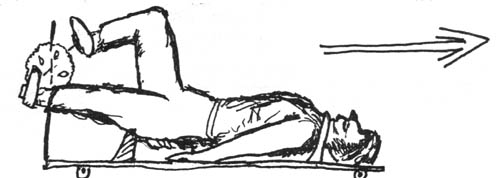
Then the whole mechanism so far is enclosed in a strearnlined envelope. The front and back of the envelop have windows to let air in and over the pilot. Both of these windows will produce substantial drag, but they serve the supreme purpose of keeping the pilot alive.
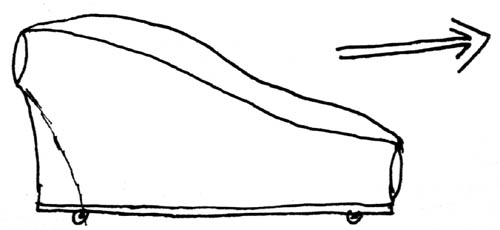
Now we need to have a way to push the machine forward. Ideally, the air behind the craft should be as undisturbed as if the craft had never passed. That means we want to push gently on the air. We will use a big ducted fan, the bigger the better. Assume that we will use a fan that is eight feet across in the middle.
Now let us take some numbers out of the air. Let us say that our craft will travel at 20 feet per second. To get that, let us say that our ducted fan must push air back at 30 feet per second relative to the craft or ten feet per second relative to the still air. The fan is turning over once per second, so that the speed of the tip of each fan blade is moving at pi times the diameter of the fan, or 3.141 times 8 feet, or 25.128 feet per second. It is biting into still air, which is approaching at a relative speed of 20 feet per second, so the angle of the leading edge of the fan blade must be the angle of 25.1 feet against 20 feet. Thus:

The trailing edge of the fan blade will be parallel to the direction of motion of the craft; we assume that the air is all caught and accelerated until it is moving right along with the fan blade. The curve between the two angles is a parabola. Thus:
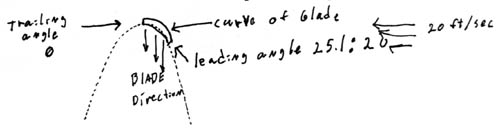
The distance from front to back of the fan blade depends on the viscosity of the air. It doesn~t make any difference to the advancing surface of the blade, but the retreating surface must not drop away so fast that the air cannot keep up with it. We will assume that a 10 toot per second breeze can turn a little over forty five degrees in one foot without becoming turbulent. A standard airplane wing asks lots more of it than that. In order to take advantage of all the air that is coming by, consider that the blade is one foot from front to back. The wind through the fan is going at 30 feet per second, sp there should be 30 blades in order for all the air space to get swept through once. Most fans you are familiar with turn much faster and have fewer blades.
Modern design calls for very few blades turning very fast. This produces the highest efficiency for a bare propellor. However, after the propellor tip speed reaches about twice the wind speed, the efficiency tends to level off. Since higher speeds call for stronger heavier material, we are choosing more blades moving slower. By using a ducted fan, we avoid some of the problems of a slow turning propellor. Still, it might prove better to take some of the blades out and turn the fan faster.
Half way between the center of the fan and the rim, of course, the fan blade is moving through a circle that has a radius of four feet. Now the advancing edge at this point travels a distance of pi times 4 feet or 12.6 feet. So the angle it should enter the air is less steep: 12.6 feet against 20 feet. Thus:
By now, of course, you know why propeller blades are twisted. We do the same calculation for the entire leading edge of the blade and each time choose a parabola that will bring the air into motion parallel with the motion of the craft.
Of course, the air is not only accelerated toward the back of the fan. It is slung outward toward the edge of th6 fan. If you watch an ordinary airplane propellor on a wet day, you will see lots of moisture being thrown off the edge of the propellor, going out as well as back.
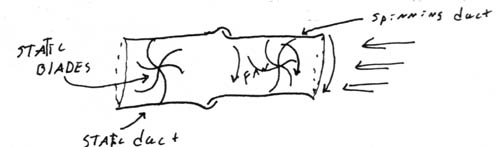
Our fan is in a duct, a kind of tunnel that doesn~t let the air escape around the tip of the blade. In ordinary use, the tolerances of the duct are very tight; more than a little space between the blade and the duct, and you might as well have no duct at all. we can do better than have it close. We can fasten the edge of each blade directly to the duct and spin the whole duct. We are spinning slowly enough so that a very light duct can stand the forces.
Now, of course, we could just dump the air out the back, where it would trail in a long power-wasting corkscrew behind. Instead, we can recapture the part of the energy that has been used in just spinning the air. We will put fixed blades in back of our fan~ Consider the leading edge of one of the fixed blades at the outer rim. It is cutting into air that is moving backward at thirty miles an hour. (Aha, you thought the air was being compressed by the fan, but it is being rarified. There is a relative vacuum in the center of the fan area, where air has been slung away, and extra air is scooting out the rim, but on average, the air behind the fan is a relative vacuum. Ever notice how cool air from a fan feels?) Air at that point is spinning around at 25.1 feet per second. So the angle is thirty feet against 25.1 feet. Thus:
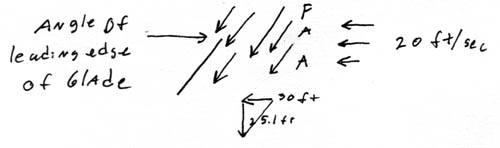
And of course, the blade is curved so that the air loses all its rotational component before released. Thus:

The more rarified air going through the second set of fan blades is moving faster than the air entering the front. Instead of adding more blades to this back set, it would make sense just to continue them back a few more inches in order to have a chance at all the air.
Of course the rear set of blades is fixed in its own duct. Where the spinning duct meets the fixed duct, is the most difficult piece of engineering in the whole craft. Having the two pieces touch and slide against each other would produce too much friction, and a ball bearing eight feet across would be a feat to rival the high dam at Aswan. Perhaps we could get the two ducts to interlock thus without loosing too much energy:
By now it's time to test the thing. Take the machine and hapless pilot to some crowded street (I'm not sure, but I think they do it in this town all the time.), and set him to peddling. If he can't get twenty feet per second out of it, the time to start redesigning is now, before the wings go on. Tell him skate boards steer by leaning, he doesn't have any brakes, and if he hits anything. his head will get there first.
Then there is the matter of wings. Wings, the very spirit of flight. Wings, the romance and beauty of flight. Wings, the stuff of dreams.
Of course, flying doesn't really require wings. A balloon flies very nicely, as does a helicopter or autogyro. Angels have wings but have no real need to fly, as they seem to be able to materialize where they want to be at will. They are reported to use wings for such odd things as covering their feet- Birds are more beautiful than cats and bats uglier than squirrels, largely because of wings. They say people have always yearned to fly. I think rather people yearn for wings. Flying was just an excuse to have them.
Pursuant of this, I once designed a motorized unicycle. Part of the control was a pair of wings worn by the rider to help him with balance, steering and stopping. I will spare you details.
Despite the usefulness and attractiveness of wings, people seem to play them down. Yet the Lightning has deceptively large wings. The spitfire has very beautiful and quite distinctive wings. of the flying machines built around the first of the century, you can in retrospect pretty much tell which ones flew and which didn't. If the wings were grotesque, fanciful or short, the machine was not likely to work. By contrast, the wings of the Wright brothers flyer are long, spare, sober and invoke the sense of classic beauty that an albatross does.
So for our craft we will want as much wing as we can get. Those pedaled craft that have actually flown a bit have had wing spans up to about one hundred feet. We will think of about 120 feet of wing span. Think big. Then, on top of that, we will make it a biplane - two wings, one above the other, on either side of the fuselage.
Of course those great long wings represent tremendous levers. In flight, turbulence may produce stresses on the wings in any direction. There are three common ways of dealing with these problems. The wings can be made short. They can be made very strong, and hence rather heavy. Or they can be supported with a lot of external wires and braces, which greatly increase wind resistance.
The short strong wing is rather the standard, with plenty of power carried to make up for the lack of lift. Under powered craft tend to go in for external bracing and make up for air resistance by going slowly. But the Cessna 172, odds on the most popular airplane ever built in terms of actual number produced, and the closest thing to a family car an airplane ever was, uses external struts to brace the wings. The result is a wing so strong that it is virtually unheard of for it to fail.
There is another approach. As you stand at the front of a biplane looking at it, you look at two parallel wings, one above the other. Now imagine the upper wings angled down slightly and the lower wings angled up slightly. The wings now meet at their ends. The result is two long thin triangles lying on their sides. This is a very substantial structure, able td take far more stress than either wing could alone, and it is accomplished with no external bracing. Well, perhaps a little bracing. As the wings get very close together, the lift of the lower wing might begin to interfere with the lift of the upper wing. So we will give the last few feet of wing a neutral shape that does not produce lift. In that sense, the wingtips are no longer wing, but bracing.
Another advantage of having the lower wings angled upward (having "dihedral") is ground effect. when a wing is close to the ground or to water, it gives more lift than when the same wing is high in the air. It has to be very close indeed. But with our design, a few inches is quite close enough. Now suppose the craft, in taking off or landing, begins to tip over to one side. The pilot will react to correct that. But in addition, if the wing comes down very low, the ground effect will tend to push it back up and stabilize it.
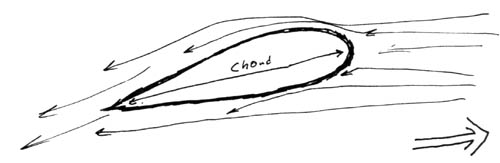 Now let us design an air foil. As you no doubt know, having seen a bird, or an airplane or a picture of one, a section of a wing taken front to back looks a little like a tear drop.
Now we will need two technical terms. The "chord" of the wing is the distance from the leading edge to the trailing edge. It is a purely geometrical term, being the longest distance. It does not depend on the air flow around the wing.
The second term is "Bernouli's principle." This states that air moving past a surface exerts less pressure on the surface than that air would if it were standing still.
I fear that I find that last statement terribly hard to believe. "why?" would seem like a reasonable question. If you think of the airplane wing, you can sort of explain it by saying that air going over the top of the wing is thrown upwards, and that this air keeps on going up by inertia. By going on up, it leaves a partial vacuum behind it, and that produces the suction that lifts the wing. By the time the air comes back down, the wing has gone on, and the air cannot, now, push on it.
That may seem appealing, but consider this: you can make a fairly good vacuum pump by taking a T-shaped pipe and blowing air through the cross piece. A vacuum will be created in the vertical part. I know of no way to explain this using the idea of air being thrown upwards.
Then remember ground effect. If high pressure air is being caught between the wing and the ground, that air ought to move faster, and the ground effect ought to pull the wing down, not boost it up. Please don't start screaming and breaking things. I don't understand it either.
Accepting, as I fear we must, Bernouli's principle, it is easy to see how an airplane wing works. Air going above the wing has to travel farther than air below the wing. (All right, it is the wing that is traveling, but consider the relative motion of the air.) Since it goes farther in the same time, it must travel faster, so air goes over the upper wing surface faster and, by Bernouli's principle, produces the suction that gives the wing its lift.
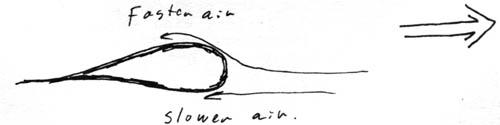
Of course this shape was shamelessly stolen from some bird. The bird did not have much choice of the shape of his leading edge. It bad to be blunt, because feathers are rather soft. The leading edge could have been almost any shape. You see, leading edges are not that important in air flow generally. If there is any flaw in the leading edge, air will pack into it and smooth it over. But in this case, the blunt leading edge does serve another purpose.
Suppose you tip the wing up slightly. The trailing edge is still about the sarre point on the sharp back of the wing. But the leading edge is no longer the same. It is lower on the wing. So the length of the effective chord of the wing is not static. You cannot define it just by looking at the wing section; yon have to know what direction the wing is moving in as well. As you tilt the wing up more and more, the leading edge goes lower and lower. As it does so, the distance air must travel over the top of the wing increases and the distance the air must travel over the bottom of the winy decreases. The air thus goes faster over the top, slower over the bottom, and the lift of the wing increases.

In other words, by tilting the wing up a little, usually done by tilting the whole plane up a little, you effectively change the shape to the wing to get more lift. In doing so, however, you are accelerating the air more. This costs you twice. In the first place, it increases drag. The wing is moving through the air more fat-wise and less thin-wise. A bigger area of wing faces the air, and of course, is pushed back by that air. The second cost is that there is only so much acceleration that air is capable of before it begins to become turbulent. Once the air moving over the wing becomes tnrbulent, drag increases enormously. At the sarne time, the air stagnates over the wing, loses the speed that was producing the lift, is able to press down on the wing very nicely. and the wing drops like a stone. When the wing does this, it is said to "stall." This has a tendency to happen at just the worst time, since it is the time when the pilot is asking more lift of the craft than the craft can actually deliver at that air speed.
There is one other catch to the conventional Wing. Let us imagine that a shape exists for the section of a perfect wing. This shape cannot be a circle, or the wing produces no lift unless it is spinning. Let us take this perfect wing shape and change it by tilting it up slightly. (Pemember, we call that, "Increasing the angle of attack.") The section now has effectively a new shape. The new shape isn't the same as the old shape, since the section is not a circle. Thus the new shape is not perfect. So the conventional wing is a set of compromises over different angles of attack.
So let us try to make a perfect wing. First, consider the bottom surface. We want to get the most pressure from this, so we want the air to move by as slowly as possible. The bottorn should be a flat as we can make it. Next consider the top surface of the trailing edge. We want to have the air glide off the back of the wing as smoothly as possible, so that surface should be flat and the edge be as thin as we can make it.
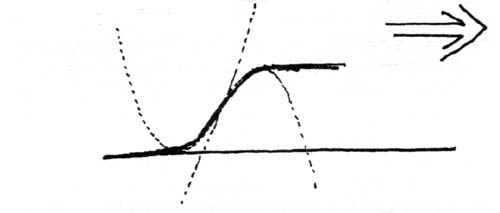 Well, the wing must have some thickness, so let us now consider air that has just passed over the top of the wing. The air must accelerate downward. In so doing, the fastest it can drop without producing turbulence is defined by a parabola. The steepness of the parabola is determined by the viscosity of the air and the speed of the wind. At the kinds of speed we are talking about, we can use a parabola that will fall away by about three inches over three inches of horizontal travel. The same parabola upside down will bring the air to a stop, ready to slide cleanly from the back of the wing.
Now designing the leading part of the upper surface is easy: it should be the same shape:
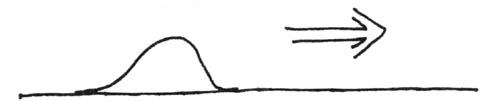
This is the shape that should give us the most lift for the least drag. It does pose a problem. With sharp leading and trailing edges, the ratio of the speed of air over the wing and speed of air under the wing is constant. Increasing the angle of attack will increase drag but not lift. That could be very handy in landing, but it is not very good in maintaining level flight.
So the way to change the lift of the wing cannot be to change the angle of attack. Instead, the length of the effective chord of the wing can be changed by moving the place where the rising curve of the upper surface is located. Or the length of the wing can be changed. Or the wing can be made to swing forward and back, changing it's effective length. Or the thickness of the wing can be changed.
Consider the way the air foil is developing lift: Air rushing over the top of the wing has a lower pressure. fly increasing the area over which the air moves faster, more lift is generated.

Of course, the same purpose is achieved whether it is the rising surface or the falling surface that is moved. The stress on the rising surface is one of pressure; the stress on the falling surface is suction. The part of the fabric of the upper surface that moves is obviously going to have to be flexible. Since one area of the wing may need to be adjusted for high lift and a nearby area not, the fabric is going to have to be elastic. Fabric can be made that is elastic along one direction but not along another. (The elastic band in a man's underpants works that way.) And thin plastic battens can be made into the fabric to keep it from wrinkling. Even so, it will be easier for the fabric to stay smooth under pressure than under suction, so it should be the rising surface that is changed.
By increasing the effective chord of the wing, we have increased lift, but we have also changed the center of lift. We have moved the center of lift on that particular part of the wing slightly forward. That is a problem. Suppose at some rate of travel, the plane is in perfect trim. That it is taking no force on the controls to keep the craft in straight and level flight. Now suppose the pilot decides to go a little faster. He pedals harder. The craft starts moving forward faster. The lift over the wings increases. The craft starts to gain altitude. The pilot responds by altering the shape of his air foil to reduce the lift and maintain level flight. In so doing, he moves the center of lift back. The craft now tends to dive, so he uses his controls to lift it back into level flight. He is now straight and level at the constant speed, but he is out of trim. He is using control pressure, which of course is going to use up energy that he would just as soon use to move the craft forward.
The solution to the trim problem is this: instead of having the wings extend straight out from the sides of the craft, have them start toward the back and then extend way out and around forward to end well in front of the rest of the craft. Now, by choosing what parts of his wings he want to give high lift to, and what parts he wants to give low lift to, the pilot can trim the craft the way he wants to. By putting more lift on one side, he can correct for a tendency to rbll one way or the other. fly putting the lift farther forward or back, he can correct for a tendency for the front of the craft to go up or down.
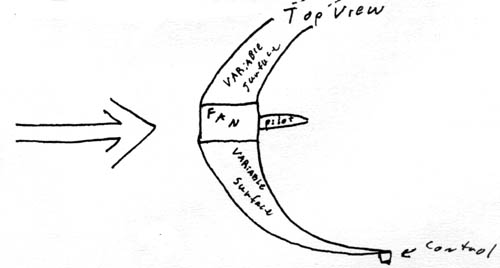
Before leaving the wings, we should talk about wingtip turbulence. The air under a wing is under higher pressure than the air over the wing, and it generally tries to relieve that pressure by flowing around the tip of the wing to get on top. Since the wing is moving forward, the flow around the wing tip produces a corkscrew flow of air that trails behind the craft on either side. This turbulence wastes energy
Now in the end, there is really no way to get rid of all turbulence in a heavier-than-air craft, since the craft must push on air in order to get anywhere; air is very soft and always responds to being pushed by swirling. You just want to put the swirl where it will do you the least harm. Trailing off the wingtip is not that place. Generally, the place where the most pushing is needed is in lifting the craft. So you will tolerate a single swirl trailing behind you, perpendicular to your path. The bigger and slower the swirl, the better. Ideally, it should be a tapered scroll, getting smaller toward the ends and biggest in the middle. One way to do this would be to have a two-bodies airplane with a single main wing between the two bodies and a smaller connecting wing toward the back. That way there would be no wing tips and no wing tip turbulence. I have seen this proposed but never seen it done.
The way we handle wingtip turbulence is to produce no lift in the wingtips themselves. Higher pressure air where the wing is making lift cannot curl around the wingtip to get to the top of the wing, because the neutral wingtip is in the way. Also, by swinging the ends of the wings forward, we do not let air curl around over the ends of the wings. It can only curl up behind the wings, which is what we must allow it to do anyway in order to get any lift.
Like any standard aircraft, this machine has five degrees of freedom. It must move forward. It must move upward. It must be able to pitch its nose up and down. It must be able to yaw its nose left and right, and it must be able to roll its rightwingtip-up-left-wingtip-down and left-wingtip-up-and-rightwingtip-down. We will not expect this machine to be able to sidestep like a helicopter.
We have already discussed how the thrust of the ducted fan moves the machine forward and the lift of the wings moves it upward. The wings can also be adjusted to trim for pitch and roll. But we need to be able to make quick brief adjustments in pitch, roll and yaw.
One reason that people avoid long wings where possible is that long wings are very sluggish. It takes them a long time to respond to a command. Roll is particularly slow. This is less a problem at slow speeds, but at moderate speeds in light turbulence, it is good to be able to correct any abnormal attitude (nose too high or too low, wingtip too high on either side) of the craft quickly.
In order to wake our long winged craft as agile as possible, we will put control surfaces on the leading edges of the wingtips. Since the wingtips are far from the axis of roll, they can be very small and still control the roll of the craft. Also as, say, the right wingtip control is deflected upward, its first effect will be to lift the wingtip. This twists the whole wing slightly and tends to make the roll ever faster. In fact, at anything but very low speeds, using leading-edge control surfaces requires faster than human reflexes or the craft will be too unstable to fly. We expect that it will work out just about right for us.
Similarly, while the craft can be rolled by tilting either control surface up or down, or tilting one up and the other down at the same time, the craft can be pitched up and down by moving both control surfaces up and down together. The same considerations apply. The first effect will tend to twist the wings, making the response very fast. Also, by beinq far forward of the axis of pitch of the craft, the control surfaces can be small and still control the pitch.
And of course we need to be able to control yaw. This requires a third control surface. (Don~t feel bad. A standard airplane has seven: two flaps, two ailerons, two elevators and a rudder.) We will use one rudder. It should be in the midline of the craft, either far forward or far behind for leverage.
Placed behind, the rudder is in the slipstream of the fan. This gives the rudder maximum effectiveness when the craft is going very slow or even dead stopped in the air. The "hammerhead" aerobatic maneuver consists of taking an aerobatic airplane straight up until it runs out of momentum and stops for a moment. Just at that moment, full rudder deflection is given and the machine rotates 1800 around its yaw axis. Less dramatically, but more importantly, the rudder can be used to prevent a spin. As a standard plane enters an unintentional stall while in a turn, one wing is moving slower than the other. The slower wing stalls first. If the pilot is very present minded, he can stomp on the rudder hard, pulling that wing around forward and getting it flying. Fe should, of course, take other steps to prevent going into a stall again.
On the other hand, placed directly in the slip stream, the rudder produces maximum drag. In our machine, drag is something we very much want to avoid. Hammerhead maneuvers are beyond our present ambition. And I hope the craft would never approach a stall or spin. 0, the wing will stall, all right. Just give it too much angle of attack, and it will stall just like any other wing. But while in an ordinary airplane, the pilot way increase the angle of attack for the perfectly laudable purpose of increasing lift, in this craft, there is never a reason to increase the angle of attack except for a panic descent or panic stop on landing. At al] other times, the angle of attack is kept strictly neutral.
Since we expect drag to be a problem, but not stalls, we will mount the rudder in front, on long booms in front of the fuselage.
This whole contraption can be held in shape with nine rigid members. The first member is the upper rudder boom, which should be light weight pipe, extending from the top of the rudder to the top of the ducted fan, and running along the top of the ducted fan to the very back of the craft. The second mewber is the lower rudder boom, running from the bottom of the rudder to the pilot's back support, under the pilot and along the bottom of the ducted fan to the back of the craft.
The first vertical support is the rudder post itself. The second is a vertical post that runs between the pilot's legs from top boom to bottom boom and supports the bearing for the sprocket that the pilot will pedal. The third vertical support connects the back of the top boom to the back of the bottom boom.
Then there are four long curved oblique pipes. The first runs in a long arc from the point where the top boom meets the rear post outward, downward and forward to a point that lies level with the center of the rudder post. A second curved pipe runs from the point where the bottom boom meets the rear outward, upward and forward, to meet the first. The same arrangement holds on the other side.
There are then five major guy wires. One runs from the connection of the two left hand oblique pipes to the top of the rudder post. One runs from the same point to the bottom. The same holds on the other side. The fifth guy wire runs from the top of the sprocket post to a point on the lower rudder boom that lies in front of the pilot~s head.
The axle for the ducted fan runs between the sprocket post and the back post. The static duct behind is fastened along its length to the top boom and the bottom boom.
The bottom wing surface is a flat surface. It should be fabric stretched over a frame. The flat surface should lie under the oblique pipe. If it can be glued firmly to the pipes, it may not require much in the way of external braces and guy wires.
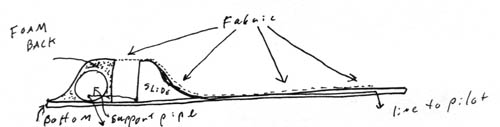
The trailing edge of the air foil can simply be carved from polystyrene foam, with large sections cut out of the middle to save weight. The pipe is contained within this foam.
There is a sliding support for the leading edge of the air foil. The back edge of this slide should match the front edge of the foam support of the trailing edge of the air foil. The bottom edge should engage two little guides that are glued to the bottom wing surface. These two guides keep the slide upright, but let it slide frontward and backward.
The front and top surface of the slide has the S-shape of the leading edge of the air-foil. It is the same double parabola shape as the trailing edge. The slide on the front-top surface engages a guide glued to the fabric of the top wing surface.
The slide is pulled back and forth by a little monofilarnent line that runs along the wing in a long tight loop, going back to the pilot. He moves the slides one-by-one by pulling on each individual monofilament.
As rnentioned before, the fabric of the top surface of the wing is flexible. It is not elastic along a chord-wise direction (front to back), but is stiffened by thin battens in that direction. In a span-wise direction (left and right, or in-board and out-board), it is slightly elastic.
The wing section then looks a little like this:
Choosing light and strong enough materials will be something of a challenge. The pipes can be made of magnesium or carbon fiber in epoxy. Diost of the fabric can be an ordinary synthetic. The ducted fan is a problem, but could be made of fabric stretched over a carbon-fiber frame.
The biggest weight problem is likely to be the slides in the wings; even made of magnesium, they will probably be very heavy. The fabric of the upper wing surface would probably have to be specially woven with a woof of some elastic inaterial and a warp of non-elastic fiber. What materials are used will largely determine whether it has a chance of flying.
Briefly consider what our hopeful pilot is able to see. Remember, ha is traveling upside down and backwards. As he looks forward through his window, he is able to see the ground. He can see his rudder, which he controls, say. with a stick in his left hand. In the other direction, the stick controls the wing tip control surface on that side. Although the control surface is out of sight beyond the wingtip itself, he needs to know at all times what the control surface is doing. The control surface needs an indicator attached to it that will be in clear view of the pilot. The same holds for the other side.
Also, unless the craft is very very rigid, he will have to know whether each wingtip is twisted upward or downward. To do this, he should have a low-power laser attached to the frame shining at a target on each wingtip. That will let him know what his wing is doing as well as his wingtip.
He will also need air speed indicators on each wingtip, an angle of attack indicator, an attitude indicator, a turn-and-slip indicator, altimeter, a clock and a compass. Might as well give him a chance to stay oriented, anyway.
One unusual indicator he will need is some indication of what his wing surface is doing. Each of the four wings has a number of slides. Each slide is controlled by a string that runs past the pilot. All that is needed is to attach a little object to each string within reach. The object should be large enough to let him get a good hold on it so he can use it as a handle for pulling the string up and down to pull the slide back and forth. A glance or a touch of the finger will be enough to tell him where the slide is. with four banks of strings to work with, he will be in the position of trying to play four harps at the same time.
Of course, since he will have to take his hands off the standard controls in order to play the strings, the standard controls should lock into place when he lets them go. Since the craft is expected to be rather lethargic, he should have time to adjust a few strings and then get back to the controls before disaster strikes.
There is one more thing the pilot needs to see; he needs to be able to see behind himself, that is, out the back of the craft.
The reason for this is that he may find himself having to land in a wind that is greater than the speed of flight. No pilot will willingly land pointed down wind. Imagine you are a pilot landing with the wing at your back. In the air, when you put your right foot on the right rudder pedal, the craft turns toward the right, because the rudder goes to the right. Usually, on the ground, when you put your right rudder pedal down, the plane turns toward the right because the nose wheel turns to the right or the brake on the right main gear is applied. However, with a strong tail wind, there is a period of time when the plane is moving slower than the wind, so that the rudder works in reverse. Right rudder may make the nose go LEFT unless the nose wheel is firmly on the ground. So the rudder may reverse itself twice while the plane is rolling out to a stop.
Similarly, the elevator will reverse itself. of course, the elevator will only reverse itself once, but the time when the elevator reverses itself may not be the same as the time when the rudder reverses, since the elevator is not affected by the steerable wheel connected to the rudder pedals. And of course, if the pilot guesses wrong about when the elevator is reversing, he may lift the nose at just the moment he wants to nose down, and that is when he is getting into trouble with left and right control. Also, the ailerons will reverse. Of course, the rudder and elevator are in the slipstream from the propellor, so they face a different wind situation than the ailerons, and you can be quite sure that the ailerons will reverse at yet another time. ~hile getting the rudder wrong nearly means a trip off into the grass, getting the ailerons wrong may mean having the plane try to turn over and lie on its back. Just as often, they all get mixed up at the same time.
The prudent pilot does not land down wind. He doesn't do it, so he doesn't have any experience doing it, so he doesn't do it. But he does have a much better chance to live long enough to have some other experiences.
Obviously, in a cantankerous human pedaled craft, the pilot is not about to undertake a landing that a standard airplane would shun. So he will always be pointing upwind. But, unlike a regular pilot, he may find that he is landing in a wind that is blowing faster than he can fly. only a light breeze needs to spring up for that to happen. In that case, assuming he has a usable landing zone downwind that he can get to, he will turn his craft around backwards and pedal into the wind while the wind blows him backwards onto the landing area. He will need some sort of periscope to see where he is going.
The appearance of the craft landing would be very similar to that of a more ordinary craft simply landing down wind. Think about it: the pilot is traveling feet and face first. He has a propellor in front. He has swept back wings. He has trailing control surfaces and a rudder behind him. The leading edge of the air foil is generally thicker than the trailing edge. In fact, in still air, the pilot could fly the machine backwards simply by pedaling backwards. He could even enter backwards flight in midair. All he has to do is go into a very steep climb and then start pedaling backwards as he comes back down again. Try that in your ordianary aerobatic aircraft.
Booty
Editor's note:
Wild Surmise is an occasional newsletter on speculative matter. Next month, Booty and N will collaborate on a drama on the life of Saul. The following month, Booty will attempt to design a sail boat.
Something happened while Booty was working on his reversible aeroplane. The reader, of course, will have noticed that Booty puts everything in the aeroplane backwards. That has something to do with his notion that the universe is running in reversed time. Fe tries to think about everything in both directions to make sure it works both ways. While he was at it, M and the beautiful Wild Surmise official laboratory assistant came in frorn board sailing, all bronzed and covered with Troglodyte Tanning Oil. M like board sailing because the people who do it are so friendly. We tell him that it's just because he is so much less threatening when he's trying to sail. He says he doesn't think he's threatening anyway, and indeed he wouldn't hurt a fly, but we tell him that he reaches new heights of being non threatening on and falling off a board. Well, this afternoon Dl was elated because the astonishingly beautiful (even when tanned and back from sailing) laboratory assistant bad noticed a sail with an M on it. Booty told him it didn't have anything to do with him but was a trademark for the "Mistral" company; in M's case, it would be "Nistrial. Dl said there weren't any sails saying "Booty" on them. Booty told N he had "grandiose" ideas. N laughed until he got hiccups and said if he was rnore grandiose than Booty, he had to be the most grandiose person in the whole world. Needless to say, with egos like that around here, we are still trying to remain anonymous.
Ed
copyright August, 1986 WILD SURMISE
MISSING AT HOME
Those of you who have been following Wild Surmise know that we have had an interest for some time in the question of the survival rate of veterans of the Vietnam War. According to the best figures available about two years ago, it looked as if roughly one million soldiers of the roughly ten million who served during the war years returned from the war only to die within the first few years of coming home. Since this number was far greater than the actual number of combat deaths -- indeed, approximated the number that entered combat at all -- the implication seemed to be that combat is dangerous, but coming home is ten times more dangerous. Indeed, whether one survives combat may be almost irrelevant. This would be a very important thing to know.
Right now, a careful study has not yet been published, to the best of our knowledge, but two are in the works: one by the Veteran 5 Administration, that is undertaking a comparison of veterans who saw combat with age-matched veterans who did not see combat, and one by the Communicable Disease Center in Atlanta, where a very extensive follow up study has been done, to see what has become of the veterans. We are expecting both these studies to be published this fall, and will let you know the results as soon as we can. The first clues from the CDC suggest that the picture is not so bleak as we initially surmised.
MILD SURPRISE
While my parents were away in Europe, I had the use of the house. I also had the opportunity to stroll about with a look of souci, as if I owned the place and was afraid something might go wrong. One day the postman (We didn't say postperson in those days.) hailed me.
"Looks like you got a dead tree."
Looking earnestly at the trunk, "Looks all right to me. "The needles are mighty brown."
Indeed, the mighty pine was no longer evergreen. It was dead as a doornail. "Maybe I'll let my folks take care of it when they get back."
"Hope it doesn't land on the house."
After he left, I considered my options. If I waited, the dead tree might come down on the house. If I tried to cut it down, I might bring it down on the house and myself both. Or I could call the tree surgeon.
We made the arran9ement on the phone. They would take down the tree, carry the brush away and cut the trunk into fireplace length hunks. I could spend some time during the next few weeks splitting it up into fire wood.
Well, the crew arrived and did an elegant job of taking the top out. I decided things were going well, and went back to doing other things. presently, the foreman banged on the door, announced they were through, and accepted a check. I wandered out to review the dead wood. Great twenty eight inch pine logs lay scattered all over the lawn, including an upright length that had been the bottom of the trunk. I stared dolefully at the stump.
When the postman came by, I was still staring. I had rolled the rest of the trunk back to the woodpile. My thoughts were not happy.
"Got yourself a stump, eh?"
"Mmmhmmm."
"You know they got a stump eater they can put over that thing and chew it right up."
"Yes, they told me how much it would cost when they agreed to take the tree down."
He left. I got a shovel. The first foot was easy. There was enough roorn to work. I had six large radiating roots uncovered and one chopped in half by the time the postman came back the next day. He asked.
"Digging it out," I said. "But it's kind of hard. I think I'll just dig down far enough so I can light a good fire and burn it out."
"City ordinance against burning garbage in your yard, you know."
By the next time he showed up, I was through the first layer of roots and working to uncover the layer below.
"You know," he said. "A lot of times they saw those things off at ground level, and you don't have a stump."
"Not this crew," I said gloomily. Must have wanted to let me pay them to use their stump eater."
By the time the postman returned the next day, I had exposed that layer of roots and found I didn't have enough room to chop, so I had gone back to chop more out of the top layer. The old axe went dull quickly, biting into the sand.
"Chopping it out, eh?"
"I think I have it weakened enough; Itm going to see if I can get some dynamite and blow it out."
He looked meditatively at the house. He had a way of speaking out of the side of his mouth, as if he were nibbling a straw or smoking a pipe. "Lot easier to stop before you put the stump through the living room window than after."
I started chopping again. Despite many sessions with the file, it did not go well. There wasn't enough room to swing the axe after the second layer of roots. So after I got the third layer exposed, I went and got out the saw.
When the postman came by, I was making slow progress. In order to move the saw, I had either to throw myself against it or throw myself back and yank on it.
"Sawing it out, eh?"
"Yes," I hissed. "Sawing."
"You could get that saw sharpened, you know."
"Nobody does that kind of work. They just want to sell you a new saw.
By the next day, there was nothing visible of my work but a big yellow cone like a volcano with an occasional shovel full, about as much dirt as you could hold in both hands, being lobbed out the top. The postman climbed up and squatted down to hand a slip of paper into my grimy gritty hand. "He's from up North. Retired. He'll sharpen your saw."
I looked at the address and made a noise.
The Yank took the old saw and looked as if he would weep. Said he'd have it in a day. I said no hurry and went home to spend the time soaking in the bath. At the appointed hour I returned.
"Now if you don't mind me inquiring," he said, "It looks like you have been sawing pine."
"Oh, well, yes and no. You know. Just sort of sawing generally."
"I've sharpened it and set the teeth wider to get a better grip on the softer pine fibers. But look here. You have rosin on the saw." Indeed. There was hardened rosin with imbedded sand on both sides of the blade. "Get yourself a Coke bottle and fill it with kerosine. Stick a rag in the end and use it to wet down the blade." He made a wiping gesture with his finger above the fouled metal. "Then it will go easier.
Back home, I found some spirit of turpentine and put in in a narrow mouth bottle. I tried wetting the saw blade. Sure enough, it went better, and after a root or so, it went better still, as the abrasive surface of rust, rosin and sand came away. That layer of roots went well and so did the next.
After that, there wasn't enough room to saw, and it was back to pecking with the axe. There was nothing left but a big tap root, and that I had cleared for a length of eight or so inches. Fly hanging upside down among the roots, I could barely get close enough to chip away. From time to time, I would stand on the hill and look down at rny foe.
"Tired?" asked the postman. I nodded.
After he left, I began to think how unfair it was. All the tree people needed to do was to cut it off at ground level, and I would have been happy to have left it there. No one would get hurt tripping over a stump cut flush with the ground. Sticking up, it was dangerous. I shouldn't have to be doing this~ But I did have to do it. It would have been so easy for them. Presently, I lost that tranquility of manner that is so becoming for a man, lost that steadiness of temper that is his banner, that musical tone of voice that is his badge. It was foolish. It was rash. It was ugly. I screamed a series of participles and monosyllables ending with the word "stump" and, standing on the remnant of a root, kicked that stump very hard.
The stump flew off and tumbled far down into the excavation.
They had cut it off at ground level after all. Just cut it off and left it sitting as if they hadn't cut it off. Numb of hand and mind, I lifted it and carried it back to the woodpile. Then I came back and looked at the root system, which stood like some nightmare octopus, far to big, far to strong, with far too many legs, emerging from long captivity in the earth.
In the end, I never did get it out. In another day, the tap root was severed. I broke a couple ropes trying to pull the root system out of the hole with the car. Then I got an old pair of tire chains out. The chains held, but the mass of roots simply wedged against the sides of the hole. Eventually, I took to wrapping the chains around the roots so they would roll up the side of the hole. Again and again, in the rear view mirror, I would see, just as the chain came unwound, the grotesque thing perched on the edge of the hole, tentacles flying, and then have it scuttle back down. One time when I checked it, I realized it was a good deal deeper in the hole than when I had started.
Deeper. Deeper? Then it was no longer even near the surface. I hastened to make an end of my labor. I filled the hole and covered the root system. No mortal has disturbed it since.
M