
A QUIVER OF TIMES
Before building a time machine, we should have a general notion of what time is. Perhaps we will have a better idea after we see how our machine does or does not work.
Western man believes that when he dies he will stay dead forever; he will never return to the familiar round of daily life. He is convinced of this beyond reasonable hope of persuading him to the contrary, even though the evidence on forever is not in yet. The conviction fills him with dismay close to despair. Content neither with accepting it as inevitable nor with deciding to believe something more pleasant, he struggles against his doom. One of his hopes is that by living a proper life according to the teachings of his religion, he may be spared.
Eastern man believes than when he dies he will be reincarnated; he will forever return to the familiar round of daily life. He is convinced of this beyond reasonable hope of persuading him to the contrary, even though the evidence on forever is not in yet. The conviction fills him with dismay close to despair. Content neither with accepting it as inevitable nor with deciding to believe something more pleasant, he struggles against his doom. One of his hopes is that by living a proper life according to the teachings of his religion, he may be spared.
Do the two sound a little similar? The odd thing is that there are people who try to reconcile the two. Well at least there is broad agreement between the two that there is such a thing as living a proper life, and that when faced with a really big question, one goes to the Top.
You may decide that any one person can think in linear time at one time and in cyclic time at another, or you may accept the two paragraphs as definitions, "Western man" being a group of real people, and "Eastern man" another group. In that case, the Third World must be the rest of us. A motley bunch we are, of Zoroastrians, savages, fundamentalists, animists and at least one "Scientific Atheist."
H. P. Lovecraft, pulp writer, in his own life characterized himself as a scientific atheist. Yet in his writing he made a forceful, if crude, case for the proposition that the universe has undergone fundamental restructurings in the past and the universe still faces fundamental restructuring, an event that would belie both Eastern and Western mental sets. It was Lovecraft who wrote, "That is not dead that can eternal lie; and with strange eons, even death will die." The past is indestructible. The past contains creatures of a greater vitality, of a higher order of abstraction than ourselves. In the description of the return of such creatures, Lovecraft found his art.
The Third World man believes in a. fragile reality. Whatever devils and superstitions he carries about may frighten him more than the Very real possibility of sudden premature death. These superstitions are a reflection of a profound mistrust of the steady reliability of time and reality.
They used to say "Backwards Nations." That was all right. At least it emphasized a different concept of time. M says he has seen a man with a hand held knife cut about a half acre of deep grass in a single day, leaving a mown lawn. The man did not move fast, he simply never looked up from his work except for a twenty minute break at noon while he sharpened his knife in the shade. Yet give the same man an appointment, and he would likely be an hour late. Such behavior suggests a person mistrustful of change.
Then they started saying "Emerging Nations," and persisted in the term long after it was obvious that many were emerging backwards if at all.
Then they started saying Third World. Yet Western science suggests (although you need not believe it) that there was a time when the ancestors of Western peoples were more like the modern Third World than like the modern West. In other words, the term should be First World. Names change too frequently. Ceylon, Siam, Madagascar, Constantinople, St. Petersburg, the Congo; those were all perfectly good English names for places that still exist. Why not keep them? We say Rome, Athens, Venice, Munich, Gothenburg; beautiful names for beautiful cities, even if not the native names. But if they must change Third World again, I hope they call it First World. Not that it bothers most of the people in the Third World. They always thought Western ideas of the time were strange.
There is a widespread belief that something needs to be DONE about the Third World. They need to get with it, raise cash crops, get industrialized, make capital investments, have a Western style government, dispose of their belief in devils; energetic individuals are told they should emigrate to wherever they make more money. So we see a Third World that raises cash crops only to have the cash used to buy arms to support or overthrow this almost Western dictatorship or that. We see an enormous Third World debt. Tell a Third World audience they need not fear their devils, and it is like telling a Western audience they need not fear God; you get a lot of attention real fast but not always the best results in the end. And the Third World brain drain draws too many of their bravest and best to the West. Perhaps what needs to be done about the Third World is that they need to be made as independent as possible against the chance that East and West go down together by war or plague. Such a catastrophe would be unthinkable for the West and rather expected in the East. Only the Third World would be prepared to face it for the truth; an authentic permanent change.
I am told that there are people for whom time does not exist, people who live in a sort of eternal present. Such people would be free of fear and free of superstition. They would make no plans and have no regrets or pride of past achievement. Most of us would include them as members of the Third World, yet by rights they should be the Fourth World. I have never met them. Thus far we have four kinds of time; linear in the West, cyclic in the East, frangible in the Third World and nonexistent in the hypothetical Fourth World.
In the old days, if you asked Western man, "What is time?", he would point triumphantly at the sun, meaning linear time.
Eastern man would say, "Quite so. Cyclic, is it not?"
Third World would say, "How true. And you must always be ready to beat on pots and pans, or a devil will eat it during an eclipse."
So Western man invented the bell. Then he invented the clock to ring the bell. After several centuries, he designed a clock so accurate that two of them would agree with each other more closely than either agreed with the sun. Then he found that sending one of his clocks around the world in a jet plane would, by virtue of the Theory of Relativity, make the moving clock move slower than a stationary one. But there was still no evidence for cyclic time; no evidence for discontinuous time. It was all very gratifying. Western time is clock time.
A time machine is a machine that resets a clock.
A big, but very inconvenient natural clock is the universe itself. If you look closely at the nearest major galaxy to ours, the nebula in Andromeda, you will find it is on a collision course with us. With luck, it should arrive before we have totally exploited our own galaxy. Away out there, though, galaxies seem to be rushing away from us. Light that comes from them is redder than light from nearby. It seems that the wavelength of that light has been drawn out by the motion of those galaxies away from us, for all the world like the sound of a train whistle going away from us comes at a lower pitch because of the motion of the train.
The speed with which distant galaxies are drawing away seems strictly proportional to their distance. No matter which galaxy cluster you study, it is going away at a speed that suggests it was very close to right here some time between ten and twenty billion years ago.
One obvious inference to draw is that all the matter of the universe was in a big lump that exploded ten to twenty billion years ago and that it is still expanding. There are some advantages to such an idea. To begin with, Sir Isaac Newton pointed out a long time ago that a bunch of lumps of stuff scattered in space should eventually pull themselves together to form a single lump. If all the pieces are flying apart, that may never happen. More recently, Einstein's theory of relativity predicted that the universe must either expand or contract; if it is expanding, well enough. For a third thing, micro-wave background radiation has been discovered coming from all directions of space. It seems most reasonable to suppose that this is the light from the explosion, the Big Bang, now red shifted like distant galaxies, only much more so.
There are problems, too. The first class of problems has to do with such things as the fact that the universe is very homogeneous and doesn't have a lot of anti-matter in it. A simple Big Bang should produce a very inhomogeneous universe with lots of anti-matter aboard. Fear not, good people are working on such problems.
The second class of problems has to do with the Western concept of time. Western time is linear. A universe starting with a Big Bang is a fundamental restructuring of reality in the past. In order to avoid such an idea, people have invented such monstrosities as 1) The steady state universe that creates matter steadily of nothing, so it only SEEMS like there was a Big Bang. 2) Einstein's "cosmological constant" that prevented the collapse of the universe in an early version of the Theory of Relativity. 3) An infinite series of Big Bangs, in which the universe contracts after each expansion.
You see, if there was a restructuring of reality in the past, the same thing might happen in the future. The basic rules might change. It might, for instance, no longer be possible to be sure one is going to stay dead. Go tell Western man that he can't depend on staying dead, and you will very likely not be popular. Imagine saying to Third World, "You know those devils I told you not to worry about? Well, it may not be quite as simple..." Now imagine having to say the same thing to Western man.
There is a third kind of problem with Big Bang theories, which we will get to soon.
Assuming that we are in an expanding universe, what happens next? One theory, the Open Universe, is that the universe just keeps on expanding, growing cooler and rather less interesting as it goes. There is an article in ASTRONOMY magazine, 625 E. St Paul Ave. Milwaukee WI 53202, Jan 1986, with the title "Deep Time" by David J. Darling. He includes a very fine description of the universe that expands forever. This is a sort of lopsided reality, of course. In one direction is has a Third World flavor and in the other is strictly Western.
Another theory is that there is enough matter in the universe to pull it all back together as Newton suggested. Such a Closed Universe would require, at the present size of the universe, more matter than anyone has seen in the form of stars and dust. The hunt is on for the "missing matter." There are hits that it is around because of the way galaxies behave (Stars in the rim of a galaxy move as if there were more matter beyond them.) and the way galaxies move away from us (They adhere too strictly to the rule that the rate they are moving away is proportional to their distance from us.).
One of the best candidates for the missing mass is the neutrino. The neutrino was invented to account for some mass (or energy it's the same thing) that seemed to be missing when an atom underwent radioactive decay. When they added all the pieces up, something was missing. Rather than giving up the conservation of matter or E=MC2, they just said, "The rest escaped as a neutrino, but we can't find it." After a long time, they found neutrinos, and by now, they have a notion of how many there are in the universe. I guess that means they can track them with something like a cloud chamber and know how many come from the sun. Now days they are saying, "There are so many neutrinos that if they have any mass, there may be enough to close the universe." Well I thought the mass some neutrinos was known before one was detected. How did they forget?
Darling points out in the ASTRONOMY article, for the first time I have heard, that a closed universe would be a black hole, a place of such great gravitational force that nothing, not even light, can escape. Darling has a description also of the universe collapsing, of the galaxies rushing in, and thus becoming blue shifted. In that case, the universe winds up with more mass at the end than at be beginning.
You see, Einstein pointed out that mass and energy are forms of the same thing. Others have pointed out that energy and information are forms of the same thing. As a fixed amount of matter expands in an expanding universe, the total amount of information needed to specify its location must increase. If you take the same universe and now make it contract, you must make some arrangement to dispose of the excess information, otherwise, you wind up with more matter than when you started. Darling's universe doubles in mass and doubles in life expectancy every time around.
It is a nice theory with something for everybody: linear toward the future over all, catastrophic toward the past over all, and cyclic along the way.
Another recent closed universe theory is one by Steven Hawking, the same who first said that Black Holes must eject tiny bits of their contents over time. (This is written up in the March ANALOG article by John Gribbin, "Before the Big Bang.") It seems that according to Hawking's latest, the collapsing phase of the universe is accompanied by a RED shift. Everything runs backwards. Light doesn't flow from the star to the instrument that measures it, but from the instrument to the star. Thus it is red shifted so as to be in synchrony with the star when it arrives. By this theory, everything in the collapsing phase runs backwards. People living in such times would think they were living in an expanding universe. And large pieces of matter fall INTO black holes, only the inhabitants see it as popping out.
Advantages of this theory are that it will cycle forever in either direction. It gets rid of the catastrophe at the moment of the Big Bang. (Gribbin says that in such a universe going through the Big Bang is no more of an anomaly than going over the Nortri Pole; it is just a matter of defining your coordinate system right.) But. now Hawking runs into trouble at the moment things stop expanding and start coming back in. The very mathematical tricks that took care of the poles leave a problem at the equator.
The collapsing phase of a cycling universe that is red shifted while it collapses has one other remarkable thing about it. It escapes from the third problem with all Big Bang type universes. The problem is that nothing gets out of a black hole. Nor, if the black hole is very large and all its matter close to the center, does anything come close to getting out or move far in that direction.
The simplest model that would escape this problem, is, of course, to assume a collapsing universe in which time is running backwards from the way it is perceived.
So much for the universe as a clock. It tells time of a sort, but it is only accurate, so far as we can now read it, to plus or minus five billion years. And it isn't all that clear whether it is running backwards or forwards. (In order to tell the difference, one would have to find a Black Hole and see whether large pieces of matter were falling in or falling out.)
For a super accurate clock, we must turn from large things to small things. We enter the world of quantum mechanics.
M called his smarter younger brother the other day. They had a conversation that M assures me did NOT go like this. But this is the way I imagine it might have gone.
"Hello smart younger brother." "Hello M. So glad you called."
"How's the weather up there in Chicago?"
"So, I've been reading about Bell's inequality. Have you read the COSMIC CODE by Heinz R. Pagels? He's a physicist himself."
"Any robins up there yet? (And why live so far away anyway?)" "They took a positronium source and put it between two radiation detectors. Then they put a polarizer on each side of the positronium source. Positronium decays into two photons that have equal energy, go off in opposite directions and have an identical polarization. You can think of the photon as being a vibration that vibrates in some plane. A polarizer is a filter like a grate that only lets photons through if they are vibrating in the same direction as the bars on the grate."
"Ok. (No robins, eh? I like robins.)"
When the two polarizing filters are lined up in the same direction, every time a photon goes through one on the right, one goes through one on the left, and each one is detected by the radiation detector on that side. When the right hand detector reports a photon, so does the left.
"Er." Then they rotated one polarizer just a little. Now most of the time they still got two photons at the same time, but from time to time they would get a photon one one end but not the other; they called this an "error."
"What about mockingbirds? Any mockingbirds in Chicago?"
"No. Next they rotated the polarizer some more, just the same amount more. So they should have got twice the number of "errors," or maybe not quite twice the number. After all, any photon that got st.opped by both polarizers wouldn't be recorded as an "error." But instead, they got MORE than twice the numbers of errors. It was as if going through the polarizer on one end caused a high degree of polarization of the photons going the other direction, just, I suppose, as if the two polarizers had been on the same side.
"They then conclude that either the photons are capable of mental telepathy or that nothing has any reality until it is measured. I think that's presumptuous. I think they just don't know how that photon is getting through the polarizer."
"Now wait, younger brother. You're telling me a man went into a laboratory and did an experiment."
"Actually Bell did it as a thought experiment, but was later vindicated."
"And he didn't get the results he expected."
"Actually the results were just as predicted by quantum mechanics, but yes there was a paradox."
"So he decided either it was magic or the world didn't really exist."
"Not until he measured it, anyway."
"Oh."
Such is the strange world of quantum mechanics.
In this world, nothing has reality until it is measured. This is as opposed to the world of classical physics, in which there is a solid reality out there that we need but measure to know what it is. There are some intermediate positions possible. The most intuitively appealing is that things are real but indeterminate until measured. Another is that some things are not totally real until they touch something else, and they then become more real whether the thing they touch is measuring them or not.
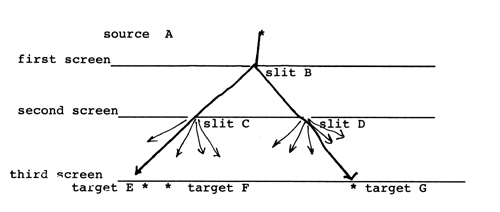
Here is an example of how such puzzles arise. Suppose you take a source of electrons and put it in a cloud chamber. A cloud chamber is a little box of air that is very humid. Suddenly decreasing the pressure on the box cools the air, and little droplets of moisture condense on any particle of dust or ion. (An ion is a molecule or atom that has had an electron knocked off or added.) A fast moving electron leaves a little trail of ions. The trai.l is made visible by little water droplets forming along it. So your electron source gives off little lines that are visible in the cloud chamber. The electrons are particles. Now suppose you do a diffraction experiment with electrons. You take a source of electrons and send the electrons through a slit in a screen. Then you let them go through a second screen with two slits. Then you catch them on a third screen that is fluorescent, that glows at any point where it is hit by an electron. The arrangement looks like this:
If there are a lot of electrons coming out of source A, they will arrive at the third screen in a pattern of evenly spaced parallel lines. (On the diagram, that would look line a pattern of evenly spaced spots.) By this reasoning, the electron must be a wave. We can even calculate its wavelength; it is the wavelength of the photon in Bell's experiment.
It would seem a nice thing to do to drop the whole diffraction experiment into a cloud chamber. Then we ought to see a beautiful set of lines coming from source A, being scattered by slit B, being scattered again at slits C and D and making a beautiful criss cross pattern as they make a set of spots all the way along the third screen. If you stand atop the coliseum in old Rome and look down at the traffic, you see a comparable pattern, cars from many avenues pouring together, merging, then separating into departing streams all in one unbroken flow. O sometimes a fender gets bent, but rarely.
Alas, electrons are not such good drivers as Romans. When you put the diffraction experiment into a cloud chamber, the diffraction lines vanish. Electrons still get scattered at the slits, but instead of forming a pattern on the third screen, they turn up in two blobs, one at target E and one at target G, just as if they were particles. In quantum mechanics, you cannot measure a particle and find it to be a wave and a particle at the same time. It may be one or the other, but never both.
So the question as to whether an electron is "really" a particle or "really" a wave, is a very difficult one. To borrow an old analogy from benzene chemistry, consider the rhinoceros. Is it "really" a unicorn or is it "really" a dragon? Well, it has some of the attributes of each. Single horn like the unicorn, armored like the dragon. Yet the rhinoceros is real and unicorn and dragon are myth.
Real waves are waves of matter of some sort, water or air. Real particles are particles of something that can be piled up and held in the hand. Both are myths as applied to quantum events.
Perhaps it is not much of a surprise that we cannot carry out the diffraction experiment in a cloud chamber. After all, we are asking each electron to bully its way past a countless number of ions and still remember enough about its own history to act in harmony with other electrons from the same source. But suppose we asked a little less of it. Suppose we just put a little puff of water vapor near slit C. We still ought to be able to figure out the whole path of the electron and still let it make a pattern on the third screen.
But no, even if we introduce only enough of a disturbance at slit C to tell whether there is an electron there at all, the whole diffraction pattern vanishes. With quantum mechanics, you cannot see an electron as both a wave and a particle.
So much for the standard view, it still seems that something odd is going on. How does an electron at C know whether the slit at D is open or not? As M's younger brother suggests, there is something very strange about how the photon (here the electron) gets through the slit.
Suppose (and I have not done this and don't know what would happen) you put a little puff of water vapor out near target F. Any electrons hitting that water vapor must leave a track and thus be seen as particles. What happens at targets E and G? If all the electrons are acting as particles, all should arrive at E and G, and none can come to F, so F can't affect them. So they will act like waves, in which case they will arrive at F, where they will be seen as particles, which can't be, because they are supposed to be waves. Intuitively, one would expect that the wave pattern would be partially degraded but not destroyed by a localized disturbance at F, and you would never see an electron track through a cloud at F, but if anyone has checked that, they haven't told me.
Of course if you run time backwards, it's easy: electrons on the third screen, if they can "see" two slits will jump toward both (B and C, C and D or B and D) just as the photons leaping from your eye to this page will then jump to your lamp if they can "see" it.
Another experiment I should like to know about is this. Suppose you close the slit at D. That destroys the diffraction pattern. But when? Assume we are dealing with light, not electrons. The fastest a signal can travel is at the speed of light. So closing the slit at D cannot make a change at target F until at the soonest light has had time to go from D to F. Otherwise we have a faster-than-light telegraph. But is the time lag the time for light to go from D to F or from D to C to F or from D to B to C to F? And when using electrons, how fast does such a signal go? What kinds of track do you see in a local cloud chamber in any one area while the signal is in transit? What kind of pattern on the third screen do you get while the signal is in transit?
Because of the dual particle-wave or dragon-unicorn reality of the photon or electron or any other quantum mechanical event, physicists have resorted to saying such things as "It has no reality aside from its measured reality " I would say rather, "It has incomplete reality until it hits something." The reason is, of course, that the universe is expanding. It takes ever more and more information to specify the state of the universe. On the scale of photons and electrons, that information is simply coming into being. Of course they can't predict what some particle will do at a finite time in the future. The information does not yet exist. That does not mean that the particle does not exist now, only that certain of its properties are unknowable, except within certain limits.
In fact, modern physics does a very good job of measuring quantum events. The clock more accurate than the sun is, so I understand, a metal box just about the size of a photon that a radioactive cesium atom emits. The photon rattling around in the box is the equivalent of the pendulum of the clock.
We can now talk about the mechanics of a time machine. We need something that will set a clock back. The obvious way to do it is to grab a hunk of universe and make it contract rather than expanding. Then we can put our clock in it, and the clock will run backwards.
Notice that this is different from the time machine of fiction. In fiction, one enters the machine and travels to a different time say a century ago, while one's own proper time is unaltered. Such a machine would be compressing the entire universe. That would be a daunting engineering undertaking. Further, although one might accurately reproduce the 1800's down to the last detail, there is not the remotest chance that the 1900's when they arrived would at all resemble the 1900's we now know. The 1800's did not have enough information in the universe to specify the present. There was a large element of chance in history and there is no need, nay a near impossibility, that chance work the same way another time. Further, one might well find that upon stepping outside the universe one would discover that it was already collapsing, being a Black Hole, and that time was running backwards already.
So the voyaging type time machine must go along with the perpetual motion machine, the circle squarer and the angle trisecter as inventions that cannot be made and that nobody would want anyway.
Instead, let us try to get some small part of the universe to shrink and thus to run backwards in time, say a volume the size of a breadbox. We do not have many forces at our disposal. Those we have are: gravity, strong nuclear binding force, weak nuclear binding force, gauge fields and electro-magnetomechanical.
Gravity is awkward. Assuming that the universe is not a collapsing black hole, we could reverse time by building a small massive object so massive that it became a black hole. Then we could drop a clock in. If we built our black hole so it was spinning as it collapsed, we could drop our clock in and maybe get it back out again. According to some theories, we could even get our clock out before we dropped it in; that would be a very close approximation of the voyaging type time machine. Unfortunately, unless the size of the black hole is truly heroic, tidal forces would smash anything close to it. Before setting out to build such a time machine, be sure you figure out a good mathematical model for it. Nobody else has ever been able to.
The strong and weak nuclear binding forces do not work on things as large a bread boxes.
The gauge field force is a little obscure, but it seems to run like this: consider two indistinguishable particles. Each has some uncertainty about its location in space. If they stray close to each other, the configuration is more likely than if they stray apart, because close together each can be ambivalent as to whether it is itself or it is the other one. The more likely configuration is expressed as a force pushing the two together.
Right: won't work on bread boxes.
That leaves electro-magneto-mechanical. Consider a telegraph pole beside the railway track. The sleepers are perpendicular to the rail. The rails are perpendicular to the poles. The poles are perpendicular to the sleepers. The three are mutually perpendicular. Now hold your left hand so your thumb, your index finger and your middle finger are mutually perpendicular. "For any conductor, force, the flow of electrons, and the magnetic field will orient themselves so that if force is in the direction the thumb points and the index finger points toward magnetic north, electrons flow in the direction the middle finger points." This is the "Left Hand Rule." It will work for any static field.
To begin with, we might try to get a clock to run backwards by squeezing it in a vice. I haven't tried that (so many basic experiments that have never been reported) but I guess it would smash the clock. You see, the compressing mechanical force would express itself as perpendicular electrical and magnetic forces on the bonds that hold the clock together. These would then be expressed as further perpendicular mechanical forces and so forth, resulting in a ruined mechanism. What we want is a way to put force not on the clock but on the space that contains the clock. In order to put a force on space itself, look at the left hand rule again. It starts "for any conductor." All right, we will treat space as a conductor.
Consider an electric arc: two wires close to each other in an atmosphere, high voltage between the wires. The voltage accelerates ions, which crash into air molecules making more ions. The ions conduct the electricity. Blow on the arc and you can blow it into a shallow arch. (Careful.) In fact, look at it, and you will see that it tends to form an arch upward as the heated gas tends to rise. Hence the term "arc."
Now pass the arc through a magnetic field, and, if it is a direct current arc, it will again bulge; the left hand rule puts a force on the arc just as real as your breath. This is the force we want to harness.
Consider that the atmosphere is really just supplying the ions to carry the current. In that case, purely for the sake of the argument, let us say that the force is not on the ions themselves, but on the space that contains the ions. After all, the ions are not conductors; it is the presence of ions that makes the space a conductor.
What we need is an arc that is not a single strand but a whole sheet. In theory, this should not be hard to do; like charges tend to repel each other. Take a single strand of tungsten. Heat it by focusing light on it or just by passing a current through it. As it glows, it will tend to release electrons from its surface. Facing the glowing wire, arrange a set of anodes (electrodes to which electrons travel). Each anode is thin, like a pencil, and each is fixed to a little electromagnet and a spring. The spring pushes the anode toward the wire, the magnet pulls it back. Now then run whatever current flows through any one anode through the electromagnet that moves that anode.
One anode should look like this:
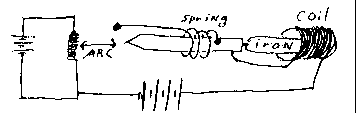
You see, as the current drops, the spring pulls the anode closer, so the resistance decreases, so more current flows, so the electromagnet pulls harder and the anode moves out again.
 A whole array of them should look like
this:
A whole array of them should look like
this:
Now before going any farther, let me make clear I don't suggest building this contraption unless you are an expert on such matters. Otherwise, get expert help. An electric arc puts out x-rays; also it can blind you, electrocute you or burn the house down. This is no high school science project. On the other hand, if granddaddy can line up a good electrical engineer to help you.
All right, given we aren't going to do it, there are some more things to think about. In order to get arc to come off the whole cathode (that's our hot wire giving off the electrons), we don't want it to get too hot and we do want enough current to flow from the cathode to anodes to strip off just about all the available electrons. On the other hand, the more voltage across the arc, the greater the x-ray output.
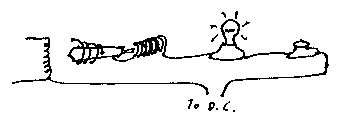
Next, consider that at the moment we turn the machine on, the electromagnet is off, the spring hold the anode against the cathode, resistance to flow is nil, flow is infinite and the whole thing heats up and melts, unless we were clever enough to put in a fuse, in which case only the fuse melts. We take care of this by putting a resistor in series with each anode thus: (I used a light bulb when I did it.)
Next, of course, we need a lot of power. We can use batteries or use wall current. Wall current is alternating current, and it has to be turned into direct current by using a full wave rectifier. You can build one or just buy a DC welding unit, which also has a lot of safety devices built in. (But is still as dangerous as all get out.)
Now then, if all goes well, you should have a nice sheet of arc. Now you need a good magnetic field. Old bar magnets used to magnetized along their long axis. Modern alloy magnets are stronger and are magnetized along the short axis. That perfect for us. Set up magnets on either side of your arc. will want an iron yoke to run around the back side of the arc carry the part of the field you aren't using, thus:
 This is a force generator. The force
is now straight at you. Notice, however, that the magnet parallels the course of the arc.
Modern magnets are very strong and tend to explode when abused, so take precautions to
keep the arc off the magnet. Now then, you will want to build six of these things and set
them facing each other, top-top-bottom, left-to-right and front-to-back. Or, as I did, you
can place them at the faces of an equilateral pyramid. (I confess that I was unable to get
the sheet-of-arc going myself and had to be content with a simple arc between magnets.)
This is a force generator. The force
is now straight at you. Notice, however, that the magnet parallels the course of the arc.
Modern magnets are very strong and tend to explode when abused, so take precautions to
keep the arc off the magnet. Now then, you will want to build six of these things and set
them facing each other, top-top-bottom, left-to-right and front-to-back. Or, as I did, you
can place them at the faces of an equilateral pyramid. (I confess that I was unable to get
the sheet-of-arc going myself and had to be content with a simple arc between magnets.)
What you have now built (I trust you have not, and do not intend to) is a device that encloses a space. From each direction, looking out from that space, one would see a sheet of electric current moving in one direction and a magnetic field perpendicular to it. All right, there ARE the corners. Ideally, you want to wrap the current AND the magnetic field around your contained space in such a way that there was no break or seam. If you can figure out how to do that, please get in touch with the fellows at the Tokamac nuclear fusion generator at Princeton. They'd be interested, I'm sure. On the other hand, they didn't lend me their fusion reactor for my experiment, so forget them. So I built it as best I could. In full swing, the baby drew about two kilowatts and put out a marvelous crackling of arcs, smell of ozone and flickering of light bulbs. Into the center, I inserted a standard wrist watch made by the Timex people. It was the classical mad scientist against the staunch little wrist watch.
Would the watch run backward? In fact, it didn't even slow down. I figured those magnets at least would foul up the works, but it sat blissfully undisturbed by lethal electric arcs and vicious magnetic fields all about, ticking off the minutes as faithful as could be. Perhaps, of course, if I had been able to get a good sheet of arc going...
There is another test.
Take two of these force generators instead of six. Place them a couple yards apart facing each other. Run the light from a laser through a beam splitter, making two beams. Send one beam along the line connecting the two force generators. Bring the beams together and have them make an interference pattern. Turn the force generators on. If you are really compressing space, the pattern should shift steadily. Don't expect it to shift fast, though; maybe one band width every six thousand years, if you are squeezing just enough to balance the expansion of space.
Well, there is another theory of time altogether. This is the white sky theory. Since the sun is pretty much white and the night sky pretty much black, we take energy from the sun and radiate it to the night sky. Under a black sky, everything should run down as energy is dispersed. In ordinary life, energy is received as short wave length, high energy radiation and released as long wave length low energy radiation. That is inescapable under a black sky.
But the sky is not really black. Nor does everything run down hill. We seem to be able to make progress at least in certain directions. Technology has advanced. World food output has increased. Healthy children are born. These are anomalies in a universe that seems one-way headed toward dispersion of energy and organization. The sky is not really black, the sky is microwave. Remember the micro-wave radiation that lent credence to the Big Bang theory? That radiation is the "color of the sky." Now perhaps at that wavelength, things can run uphill. Perhaps at that wavelength we take in energy at low energy levels and give it off at high. This would be very difficult to measure in nature, but we can do an experiment.
The experiment is to create a chamber into which we put microwave radiation and then drain the excess energy off at the shorter wavelength of ordinary infra-red. The beautiful official Wild Surmise laboratory assistant and I undertook the experiment.
First we got the use of old Money Bags' big house by the sea for the afternoon. Next we needed a source of micro-wave radiation. There, in the kitchen, sat the old boy's micro-wave oven. I explained to the lab assistant that I was going to have to cut holes in the side of the oven in order to pass cooling coils though. The cooling coils would carry away the heat of the oven while the Klystron tube pumped in the micro-waves. It was going to be dangerous, because altering the design of the oven would mean risking letting micro-wave radiation out of the carefully shielded enclosure.
But it had to be done. After all, we couldn't just drop a watch into a tub of ice and put that in the micro-wave.
Then she said, "Why not?"
Since it would have taken much too long to explain, I decided we'd do it her way just to show it didn't work and then get down to serious business. We dug a couple digital watches up, set them to the same time, wrapped one in a plastic bag, packed it in ice and popped it in the micro-wave. After ten minutes we opened the oven. The ice was gone and the watch face was blank. We apparently had poached it, but in a few more minutes, it reset itself and we started again. This time we added more ice after five minutes. After ten minutes, the watch that had been in the oven was a minute behind the one that had been outside. Incredulous, we tried it again. Again, the watch under ice and in the micro-wave lagged a minute behind the control on the counter. Somewhere along in here I got so enthusiastic I started taking notes myself instead of leaving it to the beautiful laboratory assistant, so of course it is almost impossible to reconstruct what happened.
We decided that perhaps the digital watch was somehow sensitive to micro-waves, so we got a mechanical watch and tried it. Same deal. The watch in the ice in the oven ran slow. Before it was over, we had run out of ice and were using frozen steaks. So we wrapped up the afternoon by grilling the steaks on Money Bags' charcoal grill.
Of course, there are a couple of controls that fairly beg to be done: for one the experimental watch must be compared with a watch in the oven but not in ice as well as to a watch in ice but not in the oven. For another, the internal temperature of the watch needs to be measured.
Another thing to bear in mind is that it is a long ways from getting a watch to run slow to getting a watch to run backwards. Notice that the effect of the two time machines, if they could be made to work, is different. Either should make a watch run backwards. On the other hand, the electric arc machine should make All contained reactions run backward, since it purports to work by squeezing space itself. The micro-wave machine should only affect things able to absorb micro-wave. Either could turn a chick back into an egg, but only the more general one could straighten a bent fork.
Either could turn a person with certain illnesses into a healthy person, but the electric arc machine would do so at the cost of wiping out his memory of everything that happened after a certain point in his life; the other might not. One wonders what the subjective experience would be like.
Either device might prolong youth or even restore it. And although either might, in the extreme, be able to resurrect a person, neither promises immortality in a physical sense since the universe is not immortal - will not stay in its present state forever.
Stewing watches in the micro-wave should be safer than building the electric arc machine. And since neither version is proven, it would seem most unwise to let oneself get blown up.
Booty
Editor's Note: WILD SURMISE is an occasional newsletter on speculative matter. Some readers have pointed out that I have been getting the return address wrong. Members of the staff have been most supportive. M says, "Well we are trying to remain anonymous, aren't we?" The beautiful laboratory assistant says, "But you didn't mean to make a mistake." Cooter, our loyal artist who does the drawings, photos, diagrams and makes the little copyright "c", says, "Box 217 Largo 34294-0217 shows such poverty of design. It repeats three digits. 34294-0216 is so much more vital." Money Bags says, "See. It's a good thing I don't pay you. Now I can't dock your pay." Booty blames it all on the universe running backwards.
M's mother came by and announced she was off the Australia to dive the great barrier reef, trek the outback, tour the vineyards, explore Ayers rock, rise at dawn to see Haley's comet, throw a boomerang, drink from a billabong and shop for leather goods. Cooter went pale and said, "Tiger snake!" M said, "White shark!" Booty said, "Taipan!" Esteemed benefactor said, "Spending money!" The mouth wateringly beautiful official laboratory assistant said, "But there will be cute little wombats." So they all took heart and we will skip the April edition for the trip.
The writer Mark Teich talked to us recently and is planning to mention WILD SURMISE in the "Anti-Matter" column of OMNI magazine. If you want to catch the article, check the May or maybe June OMNI (1965 Broadway, NY NY 10023-5965).
WILD SURMISE is entered at the Clearwater post office as a first class letter. PO Box 217, Largo, Florida 34294-0217.
copyright March, 1986, WILD SURMISE
MISSING AT HOME
(letter)
Dear Mr. ________,
March 4, 1985
Your recent letter to Secretary of Defense Casper Weinberger regarding the change in the official number of Vietnam era participants was forwarded to the Veterans Administration (VA) for response since the VA is responsible for the preparation of the estimates of the veteran population.
The first estimate of the total number of Vietnam era participants was made in mid-1975 after the era had ended. This estimate was arrived at by adding the estimated number of living veterans who had served between August 5, 1964, and May 7, 1975, the number of deaths in service, the number of deaths in civilian life, and the count of active duty personnel with Vietnam era service as of mid-1975.
The number of living veterans was arrived at through an accumulation of data on separations from the service as obtained from the Department of Defense (DOD), with adjustments made for mortality. However, the manner in which the separations data were reported to us led to an overstatement of the number of living veterans. Specifically, the discharge information we received contained several categories of separates who were not actually entering civilian life. Foremost among these types of separations were active duty personnel who had completed a tour of duty and immediately (within 48 hours) re-enlisted. While these people were carried by DOD as separates for administrative purposes, they were not appropriate for inclusion in our statistics. The inappropriate counting of these individuals over an extended time period led to a sizeable overstatement of the living Vietnam era veteran population as of mid-1975, and hence, to an inflated participants figure as well.
The 1980 Census of Population and Housing was the first opportunity to check the reliability of our previous estimates. After the Census results had been fully analyzed, and after a full discussion of this matter with representatives of the Department of Defense, we revised the number of participants in the Vietnam era. Let me assure you that this was not a capricious action. The estimates of various segments of the veteran population are used by the federal government, state and local governments, and by the private sector. It is therefore important that these estimates be accurate, reliable, and consistent.
I hope this answers your questions with regard to this matter.
Sincerely yours,
Robert W. Schultz, Director
Office of Information Management and Statistics
(What an odd way to find out how many men and women are in your army. Imagine a Senate finance committee meeting.
General: We need a billion dollars to build tanks. Senator: How many tanks did you use in the last war?
General: That's hard to say. After all, what is a tank? Sometimes you have to take them apart, you know. How do you count a tank that is dismantled?
Senator: Well, how do you count them?
General: We thought we'd put a question in the next Census. "Were you ever a tank driver?" Then we'd get the VA to do some arithmetic for us.
just to give you a feel for the size of the problem compare it with AIDS. The total number of Americans who have been exposed to AIDS is probably on the order of one or two millions. The total number who saw service in the Vietnam era is on the order of ten million. Deaths by AIDS number in the thousands. Veterans vanishing between the time of discharge and the 1980 census number (unless Mr. Schultz's guess is right) in the hundreds of thousands. If both counts, the VA's count at the time and the census, are right, it is as if we had 100 AIDS epidemics going on at the same time. Ed.)
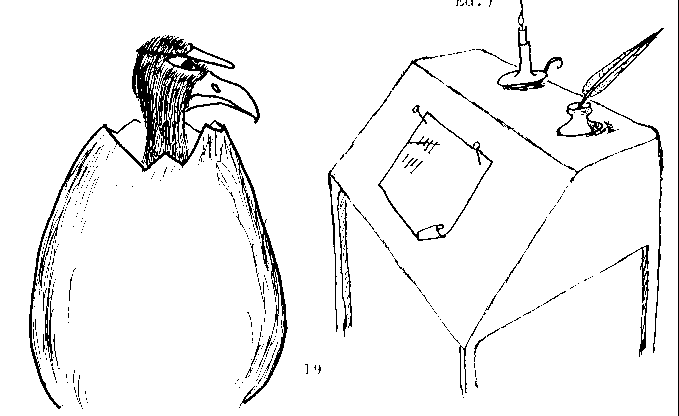
Nick once said there is a well in the desert with a pump. On the pump is a bottle of water. You don't drink the water. You use it to prime the pump. A simple pump will not draw unless its chamber is already full.
Three boarded the train at Saloniki, old Thessalonica. Polly was a lean American girl with straight yellow hair and a kind of waxen beauty to her face. Her face was not symmetrical. It was as if a warm hand had been placed against one side and it had softened. But both sides looked lovely, and she had also a kind of horse-lover's vitality that charged the air about her as if an aliquot of Western mountain air from her home had followed her across the ocean. She had besides a young Swedish boy in tow, who spoke little and imposed less. I had joined them for the trip as far as Ljubliana.
We settled into a compartment, tossing our back packs onto the overhead rack. It was a hot, dry, dusty day. We had lots of room.
Before we reached the border, we were joined in the compartment by two short swarthy men with enormous suitcases, which they dragged rather than carried in. After we crossed the border, they wrestled one of the cases onto the seat on their side and opened it. It contained furs and little tape recorders. I got the distinct impression that the tactful insertion of these things into the rich industrial nations to the north was no small part of the purpose of their trip. They got one of the recorders going, and we had wild Greek music playing counterpoint to the iron wheels on the iron rails. They dug some strange object out of a little net the carried and sliced it up to be handed around. Like the music, it was strange but tolerable.
Some railroad official came to the compartment and spoke briefly with the two smugglers. He indicated the suitcases. What he said did not seem to make them very happy. Well we couldn't spend the whole trip with our feet up on their luggage. After the guard left, I made gestures that I would park their things on the overhead rack. They seemed to think that would be all right. Besides, it would attract less attention up there.
I took the handle of the larger and lifted. It rose some eight inches and then settled back to the floor. Now I am sure that properly dressed and warmed up, with plenty of elbow room, I have cleaned and jerked a barbell heavier than that suitcase. I just can't remember when. Here in the confines of the compartment, because of the size of the handle, I would have to clean it with one arm and jerk it with the other. I laid hands on it and listened to the rollicking wheels going over the expansion joints. I listened until I could feel the rhythm of the train in my bones and could tell from the sound of the clicking wheels of the car ahead what our car was about to do. It would all be a matter of rhythm.
Right elbow high, knees bent, right hand on the handle, I started. Part way up, I flexed my knees again, pulled the case over toward me and get the heel of my left hand under the center of gravity. Main force carried it overhead, where it hung for a moment balanced between weight and the bonds between masses of actin and myosin molecules. The train surged and the whole thing overbalanced, the luggage rack sliding sweetly under the bag.
The next bag was not much heavier and didn't take much more trouble getting into place. I looked up at the luggage rack with new respect. I would never have thought it was that strong.
The weather became cooler, moister, softer. We climbed among hills, wide stretches of empty country surrounding the train. The dust of Greece seemed, for not to be far behind.
The train began to fill up. People were standing in the aisles. One sturdy young Croatian pushed his way into the compartment and claimed the empty seat. He sat with arms folded staring straight ahead. Sure of his rights.
"Communist," explained the smugglers serenely. Believed in sharing rather than free enterprise, no doubt.
I dug in my pack and found a bottle of cheap, yellow, turpentine laced wine. I made gestures to the smugglers that it would be most convenient to have a cork screw. One of them made a gesture to the effect that corkscrews were artifacts from another planet. The other only rolled his eyes.
Presently the two looked at each other and a glance passed that could only mean, "Go for it." One of them took the bottle.
He crossed his left ankle over his right knee, turned his heel up a little, and then but the bottom of the bottle against the heel of his shoe. He started pounding the but of the bottle against his heel. After a while he conferred his friend. Then more poun.c3ing. After a bit the other took over.
slowly, as if by magic, the cork began to move. Somehow, the pounding was driving gas out of the wine. At last, to cork had come out so far that they could pull it free easily with the fingers.
We passed the bottle around. Our "communist" companion declined. apparently sharing did not extend to the point of trying to choke down retsina.
Rights the Swedish boy curled up on one corner while Polly curled up in the other. The smugglers slumped together. The Croatian sat rigid with his arms folded. Sure of his rights. I slept on the floor. I would rather have slept on the luggage rack. I knew for sure that was solid. But it seemed undignified. They were careful not to put their feet on me.
Sometimes the track would coil through misty mountains and the air was sweet and wet. Polly and I would go to the platform between cars and lean on the door. People working in the fields had time to look up at the rattling train and to smile at us, imagining adventures according to their own desires.
We saw men in uniform working on a parallel track two miles away across the rain fresh valley. They downed tools and waved with both hands. One chased after the train with high springing bounds, heedless of the hazards at his feet, running and waving as long as we were in sight.
One night, we had stopped at a fairly large station in what must have been a rather large town. For some reason, we had pulled up on a track far from the station house and platform. It was routine, for those who wanted to board had already come out to the side of the track before we arrived. More boarded than disembarked. We were headed in toward the big cities of the Dalmatian coast, and the train was getting more and more crowded.
Moving along the aisles was a matter of squeezing past and stepping over inert bodies. It was hot. There was no more water in the cooler, and the passengers seemed despondent.
Presently everyone who needed to had boarded. Their well-wishers had taken the long walk across the weed choked yard, across the many rusty tracks and bits of strange discarded machinery to the platform. It was time to move.
But move we did not. Polly and I stood at the compartment window and looked out at the hot tedious night. There were still lights on in the station house, and some people were there. But nothing seemed to be happening.
Then I saw the pump. It was about twenty yards north of the platform. The light was difficult, but it was clearly a big old iron pump, all by itself, with a big wheel attached to it. It was much too far to see if it was padlocked. An idea began to form.
"I wonder if that pump works."
"What if the train starts and they leave you?" "Don't worry. You'll get to Austria all right." "That wasn't what I was thinking."
"Well that's a pump right over there." "We're ready to leave."
"I won't be long."
I would make my bid for freedom.
I dug a green plastic canteen out of my pack and went into the aisle.
The aisle was so crowded that the thing to do seemed to be to get off the train right away. I got to the end of the car and jumped down. The pump lay at about a forty five degree angle north. I set out at a steady dog trot, eyes fixed on the pump, feet finding their own way over the broken tracks. I had no idea that the whole train was watching.
Away from the train, the air was cool again and fresh. And it was wonderfully silent. Aside from the hissing of the engine, and a few human noises from the direction of the platform, the night was a velvet hush. No traffic. No air conditioner. Mostly the sound of the air in my own throat and the scuffle of my own feet.
By the time I was half way there and nobody had told me to stop, I broke into a canter. The ground was a little clearer. Moments later, I was at the pump. One hand slapped the canteen to the spout. The other made the great iron wheel whirl. It squealed in rusty iron protest.
At that moment the engine gave one chuf and the whole train pulled forward the length of a quarter turn of a driving wheel. It was a signal to return. I suppose somebody was afraid that the sight of water coming out of the pump would empty the whole train and people would never get back on.
I started back, this time at an all out run. No angle, just ran for the nearest door.
As I jumped aboard, it seemed the whole train cheered. The engine started again, chortling along on the business of going places.
On the way back to our car, people would ask with look, gesture or unfamiliar word. "Any luck." "Did you get any water?"
I shook my head no. The pump was not primed. It had been too long since anybody used it.
But in fact, there were three swallows of water left in the bottom of the canteen from before. Perhaps that would not have been enough to have primed the pump. But at least I could have tried.

The Lorelei will eat cabbage, but they much prefer spinach.