WILD SURMISE
January 1990 #20
AN ALMOST ANONYMOUSE INFORMAL NOTE
SPLITTING INFINITIVES AND OTHER HAIRS
The English language is flexible to the point of being polymorphous perverse. This flexibility has its advantages when there is new material to be considered. There are disadvantages when there is danger we will not understand each other.
The letter C sometimes sounds like K and sometimes like S. If you take those as a group, you should include 7, which S sometimes sounds like, too. Proceeding by this logic, you will eventually include every letter of the alphabet.
There once was a riddle, Why is the wind blind? The answer ran, "The wind is a zephyr, zephyr (a trade name) is yarn," eventually ending, "An attachment is love and love is blind. Therefore
..'',It seems idle to try to attach every word in the English language to such a tree. what would be more fun would be a little parlor game. Two words are selected at random and each team tries to prove by the shorter path that they mean the same thing
Often I receive a phone call from a person who does not recognize my voice. There is a perfectly good set of words he should use for the occasion: 'who are you?" There is a less direct approach: "Who is that?" But what I get is, "Who is this?" To which I routinely answer, "Ah, this may be difficult, but if you really don't know I'll try to help. What's you age, sex and build? Any identifying marks? Maybe you could go through your wallet and see if you've got a driver's license..."
They don't hang up nearly frequently enough.
On word more malleable than most is "to." It has homonyrns aitwote and is well enough behaved, meaning twain. There are some nice puns on "two." My favorite is too too twain, which is baby talk for train and can be written two two twain, meaning "two" after two "two's."
"Too" can be used to mean '9a1so11 with an pun on ~ "You think so, and I think so, too," can be rendered "You think so, and I think so and that makes two." "Too" can also mean "excessively" as in "too thin and too rich." The Romans, by the way, did not have a word for that. They used the equivalent of very. If one tried to say, "We ran away because there were too many barbarians," it came out "We ran away because there were very many barbarians." "He looks like a pig because he eats and drinks too much" would be .. . because he eats and drinks very much."
The use of "too" in this sense, is inherently judgmental. It suggests someone is being-a fool or a rogue or in certain contexts that circumstances have conspired to free a person of responsibility. A person 'night be expected to fight many barbarians, but if there are too many, there is nothing to do but run.
Little "to" has a host of meanings. Generally it is used as a preposition meaning "toward" or "until" as "We are going to town, and we will be there from one to three." sometimes it is hard to say just what it is doing as in, "?ull the door to" and "What is he up to?"
The other, totally different use is to indicate the infinitive form of a verb. The infinitive form of a verb is sort of the native, elemental form. We use the word "ran" and understand it to be a form of "to run." The "to run" is the infinitive form, the truest form of the verb.
The verb in turn is the strongest part of speech. The guttiest. The form that really carries meaning. When you use a verb, you are committing yourself on what you mean. It is at the opposite extreme from the interjection, which carries attitude but no real meaning. An interjection weakens a sentence. "Gosh, two and two are four!" carries less weight than "Two and two are four."
close behind the interjection in puniness is the adverb. An adverb is used to describe a verb or to describe an adjective which in turn describes a noun. The adverb is a mincing, mealy mouthed little mutter, little needed in bold and lucid prose.
The infinitive is the pure form of the strongest kind of word. Time out of mind it has been thought improper to let a sickly adverb insinuate itself between the "to" and the rest of the wholesome infinitive. 'fle tried to carefully choose his words" is an affront to the alert ear.
There are so few rules in English that one hates to give any up without a fight. splitting infinitives in the American form of English has become so widespread as to be nigh standard. Here is why.
For several years there was an enormously successful television series called "Star Trek." Its introduction included a space ship ripping along through the hard vacuum of deep space making a wonderful roaring sound. It even bad a Doppler shift. The pitch of the roar dropped as the craft passed.
There is no sound in a vacuum. There is certainly no Doppler shift. while your ear was grappling with this gross imposition, the captain's voice said in thrilling tone something like: These are the voyages of the star ship Enterprise. It's five year mission: to explore strange new worlds, to seek out new life and new civilizations, to boldly go where no man has gone before.
Wait a minute. If the show is a dramatization of a history, it should go "where no man HAD gone before." By moving events from the past into the future relative to the time of narration, the introduction imposes on you once more.
Then, and this is the genius of it, this is a narrated introduction, not a written one. The last line could just as easily be interpreted: :too boldly go where no man has gone before. There mission was to over do it.
The parallel construction, of course, hides the second meaning. But the ear picks it up all the same. · 'Be too bold. Be too daring." It is at once dismissed as inconsistent, but it is heard none the less.
Any time you use the word "too" (unless you mean "also") , you are judging someone to be a rogue, a fool or irresponsible.
The bold adventurers are thus potentially seen as irresponsible, foolish rogues. Had the line run, "... to go boldly," there would have been no ambiguity.
Splitting the infinitive reverses the meaning.
Star Trek was a comedy and a dazzlingly brilliant one at that. It was quite proper in that context to use a split infinitive and muddle the meaning. And if one is writing humor, that remains a good usage.
But splitting the infinitive virtually always carries an echo of a meaninq that mocks the specific thing being said. "He tried too carefully chose his words," draws a snigger.
Yet people will split infinitives when talking about subjects that have no business being laughed at. It is one thing to maintain a pleasant tone. It is another to hold your best ideas up to undesired ridicule.
What is to be done? For once this is a problem with an easy solution. If you notice a writer has split an infinitive, just stop reading. There are lots of other things around to read. If he took no care with it, why should you?
And on an entirely different subject ....
I don't much like diving boards. It probably has something to do with having a big head and sensitive ears. I have spent a life time looking lugubiously at diving boards and trying to decide just why they were exactly wrong.
Ugly, but much of life is ugly. Useless, but again The trouble with diving boards is that people dive from them sometimes a diver comes down on the board. That hurts. I have also seen a very good diver bound so high and hit the water so cleanly that she hurt herself on the bottom of the pool.
But far the worst thing about diving boards is persuading people that going into the water head first is a good idea. It is not.
The head is not expendable. Break the head off a person and you do that person irreparable harm. Even if the head remains attached, breaking the neck has a strong chance of severing the spinal cord. If that happens, the brain and the body cease to communicate.
The person is trapped inside his body, awake, able to see and hear but unable to feel or move below the neck. If the injury is high in the neck, it may be impossible to breath without assistance. If the injury is lower in the neck, there may be some use of the shoulders.
Under some circumstances, similar things can happen to people unavoidably. But diving is a sport. It is done for fun. Nothing that entails the risk of such terrible injury should be done for fun or encouraged.
A racing dive from a pools edge is, of course, safer than a dive from a river bank into uncharted water. But that is a quibble.
The truth is that there is no place for diving among humans. Leave it to lemmings and pelicans.
If you must race swimming, start everyone in the water. It is an equal handicap for all. The racing dive start may be a crowd pleaser, but if so then swimming is a blood sport along with cock tights and boxing.
The next dangerous thing about a pool is the edge. Children slip off the edge and strike it while falling in~ A swimmer doing the back stroke will often strike the edge with his head harmlessly but painfully.
The technology now exists for containing water in something other than a concrete pit. It is called a water bed. Water beds used to have hard wooden sides to contain and support the water mattress. Newer water beds now have soft sides, with inner spring mattress covered with plastic to contain the water mattress.
If it can be done for a water bed, it can be done for a swimming pool. The edge of the pool can and should be made soft.
A third dangerous thing about the pool is the deep end. There is no point in having one if one is not going to dive. Make the center deep if you like, but there should be a ledge all the way around that an infant could pull himself up on. Given a ledge or two all the way around, and there is no need for ladders. The ledges, too, can be made soft. Yes it will slow down racing turns. No there is no harm in that.
Fourth dangerous thing about the pool is the deck around the side. People run on it and fall and get hurt. Make it soft, like a water bed again.
Fifth dangerous thing about the pool is the chlorine. Chlorine levels are kept high to kill germs. Sometimes the levels get high enough to bother the swimmers. It goes without saying that the levels should be kept under strict control.
It might be possible to sterilize the water by pumping it through a device that exposed it to intense ultra-violet light. At least it might be possible then to reduce the chlorine levels.
The final dangerous thing in the pool is the water. Now any water is dangerous, but fresh water is more dangerous than salt. Inhaling salt water is not good. Inhaling fresh water brings the water into the lungs, into the air sacs of the lungs and into osmotic contact with blood. The red blood cells rapidly absorb the fresh water, swell and burst. This releases potassium, which stops the heart quickly and very painfully.
Yes, you can drown in salt water. But it only would take a little salt to make the water a lot safer. And if you really want to make it safe, there is a class of chemicals called the perfluorocarbons that might be safer still. Apparently these fluids can not only be breathed but can supply ample oxygen. Might be more expensive that water, of course.
And now the good news ....
You know something? Eating dirt is not all that bad.
All right. All right. I admit dirt has germs. All sorts of germs. Avoid eating it if you can.
But lots of people eat dirt. Mud actually. clay, if you want to call it that. Some people have a favorite place to go dig up their clay. Some people buy it at the drug store as a treatment for diarrhea or constipation. Usually there is some additive to the basic clay. But it's still dirt, don't you know.
The medical profession has a name for it: pica. There is a kind of feeling that it is wrong. Bad for the blood or a sign of some kind of mental problem. But no one I know has ever quite put his finger on just what that problem 'night be. Apparently pica is pretty harmless. Lots of folks get away with it.
Back in the 1950's, there was a magazine called LIFE. It was a picture magazine and like a lot of commercial publications, made its living by getting people's attention. Pictures of folks getting hurt were a crowd pleaser.
Apparently looking at pictures is a blood sport.
One day they produced an issue on the slave trade. Freed by the lack of any photographs to work with, they embarked on an adventure of fantasy. They backed it with some research. And photographs can be false or distorting. But there is no way that a painting a century after the fact is as authoritative as a contemporary photograph.
This was a set of paintings in a magazine that had hitherto and was subsequently primarily a photographic journal. The forum gave the paintings the clout of documentation.
It was a popular magazine. It has been revived and again is a popular magazine. The paintings focused the American mind on the question of slavery. They spoke forcefully and persuasively and of course weren't really photographs.
One picture stood out from them all. It was dramatic, poignant. It was a line of slaves in Africa being marched off to a ship to be carried to America. The day was bright, but the road was cruel. The line of slaves seemed endless, stretching back to the happy plains they had wandered and reaching forth to the dread ships. The drivers were reduced by perspective to mere pipsqueaks, dwarfed by the misery in the foreground.
All quite valid, I should think. A fair picture of any one driven to migrate, to give up his home whether because of economic need or main force.
And in the center of the panorama, a woman was committing suicide, choosing death rather that the horrors of leaving her home. Her companion was looking on in horror. The woman killing herself had her face averted in token of the death she sought. The companion faced straight toward the viewer, her face twisted in an ecstasy of pity, revulsion, anguish and kinship.
Good stuff. A fine painting. That one face fixed the attitude of a generation of Americans. There she stood, a slave, watching her friend commit suicide.
By eating clay. Yep.
Eating clay. That's how she was doing it. The caption explained that many of the slaves committed suicide by eating clay.
Only you can't
There was another picture of a slave committing suicide by jumping overboard from the slave ship. And that would work. But not by eating clay. So the bad news is that you can't believe everything people tell you.
The good news is, its not that dangerous to eat clay. But I wouldn't believe it if I were you
Finally, how do we respond to the THANK YOU challenge in English? We don't do it very gracefully, do we?
There are two magic words in English: "please" and "thank you." The are magic not because they accomplish a lot but because they actually have rules that govern them that work.
If you would like something you say please, meaninq, "Do if if it pleases you, but do not do it on my account if it does not please you." As is "please take your foot off my toe." Graceful, clear, it is almost as good as not having to ask at all.
"Thank ~ou~" literally 'I thank you." I acknowledge what you have done, and I want you to know you have made me happy. Quick, pellucid, it is exactly the right thing to say. In fact, it is too good. It makes the other seem like it is his turn to say something, to pass it off as a trifle.
There are two categories of response: yes and no.
The "yes" category includes such responses as, ~Of course" or certainly or "You're welcome." These are instances of irony. Literally, one is saying, "of course you thank me. You are so deeply indebted to me you have to thank me. only a churl would fail to do so." "Certainly" means the same the same. Of course this is, in form at least, a churlish reply. By being rude, the giver relieves the recipient of any further need to be polite. Still, it is not very graceful.
"You're welcome," means the same, but is a little more obscure. It is properly the greeting for a quest. "Come in out of the cold and wet. nest your weary butt on my furniture. Warm your coagulating flesh by my fire. Feed your scrawny face at my table, and then kiss my wife and daughters." To you I am opening my home, the pleasures and treasures of life.
If you borrow a pencil and say "thanks," and if the lender says, "You're welcome," he is using irony. He is making a bigger deal out of it than both know it is. Again, except when the gift or favor justifies it, it is~a churlish reply.
Then there is the 'no" category. ~Not at all," 'Don't mention it," "It was nothing," "My pleasure," "No problem," "Don't give it a second thought," "please." This last, of course gives rise to a potential impasse. The conversation goes:
"Please."
"certainly."
"Thank you." "Please."
"certainly. I' "Thank you." "Please."
And you are right back. where you started from.
The trouble with the "no" category is that it is another request. It also has a weary sort of continental air about it. One supposes that the French, the Germans, the Italians, the Spanish, the Greeks are all begging not to be bored by each others gratitude.
Which leaves the exception, the most churlish of all. The giver does not give the recipient a chance to say thanks. It is sort of a combination of both the "yes" and "no" categories. The exchange goes like this.
"Please."
"There you qo."
"Urn, er, uh thanks ~ I guess."
"There you qo" is short for, "There you go again, fawning, groveling and abasing yourself. How many times to r have to tell you not to embarrass me with your cringing pusilanimous gratitude? stand up and look me in the eye."
The swedes, the true masters of courtesy, have evolved a graceful response. It is "Tak tak," or "Thank you for thanking me." It has not found its way into English.
Booty
Editor's Note:
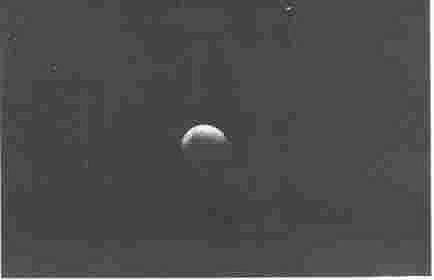
WILD SURMISE is an occasional newsletter on speculative matter. The night of the lunar eclipse, cooter was not available so the dazzlingly beautiful official wild surmise laboratory assistant took pictures. While the eclipse was occurring, Booty explained to M that the shadow passing over the moon was our own. So M stuck his hands up and tried to make a dog's shadow on the moon. That didn't work, so he threw a popcorn box up to try to make a shadow. That didn't work. So he asked if Booty were sure.
Some day soon, we hope to get a collection of M's work or Booty's work published commercially. We'll let you know if it happens. Who knows? Maybe at that point we'll reveal our secret identities.
Ed
copyright January, 1990, Wild Surmise
Things Going On in Europe
The great stirrings on the continent leave one looking around for general principles by which to understand them.
A few are obvious. To begin with, communism does not work. Freedom does work, since it is its own reward. Freedom also produces more material comfort than communism. Communism is interested only in material comfort. Since it does not provide that, it provides nothing.
Second, contrary to popular belief, the voice of nationalism is the voice of freedom. The great multi-ethnic powers, Russia and the U.S. have stood flabbergasted as small nations with one or a few ethnic groups have demonstrated courage, resolve, imagination and decisiveness, have grasped freedom the instant there was a chance.
Third, look at things on the broad scale. World War one started basically by accident, was a war no one wanted. Germany lost that war and was punished by the peace that was imposed. Then Germany sought by force the justice she had been denied in peace. She went too far with that force and found herself at war again. Lost again. Punished again.
We, the rest of the world, have been fighting or punishing Germany for almost a century. It's time we stopped it. If they want to reunify, let them. East Germany is a third the size of West and far less prosperous. It will not upset any balance of power.
Fourth, I think that there is a general principle that any sizeable group should be able to secede from any larger group it is a part of. Georgia in Russia has declared its desire for independence. Hope they get better treatment than Georgia in the United States received for making the same bid.
Fifth, it turns out that leaders do matter after all. Mr. Gorbachev seems to be the star of the show. He has unleashed tremendous forces and maintained his poise while they have led to changed far beyond anything he could have imagined. For the sake of headlines, it would have been nice if he had arranged for Russia the same free elections now promised for most of Eastern Europe. He did say, "I think a way will be found." For now, he chooses to hold the cards a little longer. There are still people to be fed and warmed through winters. The man can put them before his own place in history~
His American counterpart Mr. Bush also is showing the poise and patience needed in a great leader. If the presidency were filled with one of the flamboyant egomaniacs it seems to attract, you may shudder to think.
Finally, before World War One, someone said, "There are lights going off all over Europe. We will not see them lit again in our lifetime." Well those lights are going back on again. These are great days.
MILD SURPRISE
How the Shepherd Boy Saw It
I remember the night you are asking about. It must have been thirty five - forty years ago, so I was little more than a child. I have wondered about it often. It seemed so different then. I will try to tell you about it as best I can.
Sit down in that bush over there and listen to an old shepherd's story. Just sit in the bush as if it were a chair. Don't worry about ruining your fine clothes. The bush will do them less harm than the ground would. Even a strong young shepherd does not listen to tales standing up.
Today is hot and bright, but it was a bitter chill that night. The sheep were cold for all their winter wool. The grass was brittle under our sandled feet. Our words hung in vapor in front of our faces when we whispered.
We worried about the flocks. As it grew dark, the boys were sent home, all except me. I got to stay up.
We had eaten at sundown. It was wasteful to light a fire. Besides, we needed our night vision to keep watch on the sheep. So we huddled together on a hill side, high enough to see a long distance but low enough from the top to be sheltered from the wind. As the night drew on, the sheep gathered about us.
My cousin Dan joined us just when it was time to eat. He was also first to talk.
"Strangers came from the North today. I saw them on the road from Jerusalem and hid in the rocks and watched them. There was a man leading an ass and a pregnant woman riding.~'
"Down from Jerusalem?" someone asked.
"From farther north. Jerusalem is but five Roman miles. These had the dust of as many days upon the road."
"Why did you hide?"
"'There was one that followed after them. He was tall and unnaturally pale. He seemed to be watching over them. I was afraid and ran away .1'
A thrill ran among us. The same voiced asked, "Was it a leper?"
"I could not tell. His face was as white as fleece, but he seemed strong. If he is a leper, it has not taken his strength yet."
You can imagine how we were afraid outside in the cold and dark. Each of us thought about leprosy. You catch leprosy from a person with leprosy. Before it kills you, it so changes your face that anyone who looks can see the disease upon you.
The leper is pushed out from the company of people, living off begged food but unable to beg companionship. He stays near people both to be able to beg and because he still yearns for the warmth and companionship he can never have again.
People are afraid of lepers and do not look at them. It is as if they were almost invisible.
Another voice asked, "What else could it have been?"
"I fancied it might have been a ghost or a devil."
Now that made us crowd closer together in the night. Zebulun, the oldest among us, spoke slowly. We listened to him with respect.
"I sailed in my youth to many foreign lands and heard many tales of devils and ghosts. It is rare to see one that does not know you see him."
I had heard of such things as ghosts as a child, but had paid them no mind. Now at once it seemed important to know more.
"What is a ghost, zebulun?"
"A ghost is the spirit of a dead person who has not gone to the proper place of the dead in the earth. Some strong feeling still holds him in the land of the living. He may want to protect someone he loves or take revenge on an enemy. Or he may have some great secret he must tell.9
There were murmurs of agreement. One or two of the others offered some brief example he had heard of.
teAnd what is a devil zebulun?"
"A devil is a spirit who has never lived as a man. A devil as as old as creation itself. His place is among the dead, but he too can leave and come among the living. He can live in an animal or take possession of a living person."
"And why does he do it?"
"No one knows the purposes of a devil. only God seems to have purposes, and God's ways are mysterious enough. A man possessed will scream and rend his clothes. He will say the most blasphemous things. He will neglect his friends, his family and his body. He will be deceived by what he sees and who he is and what his own body is doing."
"Are there any good ones?"
"The good angels? I have heard of them rarely. But it is so hard to know good from evil even in a person."
Zebulun fell silent. The night seemed more dangerous than ever. Not only was there the cold and the wolves that threatened the sheep, but there were dangers the sheep were not concerned with-
Timothy stood to stretch his legs and look out over the flock. He spoke as he stood.
"It is a hard life. If you escape starvation and leprosy, the Romans conquer your land. If the Romans do not crucify you and no devil possesses your body, you die and go dwell among the devils in the land of the dead."
No one disagreed with him. The he whispered, "Someone comes."
We looked. At the bottom of the hill was a man walking toward us. He stopped and hailed us from a distance.
"Timothy! Zebulun! Is it you?"
"Seth!" called Timothy.
"Come to us."
Seth crowded among us shivering. It was getting colder.
"Have you eaten?" asked zebulun.
"At the inn. I left the two sheep for their use tomorrow. They are very crowded and all the guests are both hungry and rich."
"Were the three from Jerusalem rich?" I asked.
"There were no three from Jerusalem."
"What did happen?" asked Seth.
"As I said. Lots of rich travelers there to pay their Roman tax. Seems every rich man in Judea claims to be descended from David, so of course they all have to come here at tax time. Serves them right. There was a fight among the Roman solders. One of them almost knocked over the old man with the preqnant wife."
"Who?" asked Zebulun.
"Came in late, after dark actually. old fellow, not that old but got this real pretty wive who's pregnant. There wasn't any room, so I don't know what became of them."
"It'll be all right," said Timothy. "Her lover will take care of them."
"What?"
"Dan here saw the two on the road and there was this tall pale fellow following them at a distance. With two strong men they ought to be able to fix up a shelter and fire."
Now we have all heard. But I will tell you over the years there is more than once I remembered Timothy's words and wondered it the tall stranger were really the father of the child. Not polite to mention, of course, but I am a shepherd. It is part of my work to think about such things.
Then someone mentioned maybe it was a thief who was going to rob them. And somebody else said it was a sad day for bandits when the old man and pregnant woman made it safely to the inn and left the thief somewhere beside the road. At least it was better than talking about ghosts.
Presently zebulun said that because of the cold we would have to move the sheep in the morning. We needed to find out how many the innkeeper wanted the next day so we didn't have to move those ones and then move them right back again. I was the youngest.
When I entered the inn door, there was the smell of people and food and wine. It was not warm, but a lot warmer that outside. A platter of fresh rolls stood on a trestle table. The innkeeper was a very fat man who usually had a terrible temper. This time he was in a happy mood.
"Meat?" he said when I asked. "No we won't need more meat. Keep the sheep for wool. These people eat more meat than is good for them anyway."
Between me and the door was a table with a half finished meal. Whoever had paid for it had left a nice morsel of bread in his bowel. I could see a little oil on it. As I went by, my fingers slipped out and snatched it. At the same time one enormous fat hand of the innkeeper caught me by the hair, and the other caught the hand that held the bread.
"Ahal" he said. "Row many times do I have to tell you not to take stale bread from the table?" T gave him the crust guiltily. "Take fresh bread." Re grabbed a fresh roll and put it in my hands, laughing as he did.
An instant later I had the bread tucked under my clothes and had run out into the cold. I rounded a corner and stood panting in the dark. The roll was hot against my chest and still smelled of yeast. I said very quietly, but out loud, "Timothy is right. Life is hard. Life is dangerous. And there is no more happiness after death. If you are lucky maybe you get to eat some hot bread along the way."
A voice beside me said, "But did not God promise it would all be right some day?"
I turned. A tall person was standing near me. I opened my mouth to scream but nothing Caine out. I shook my head to try to get my voice working.
"no not stand too close to me," he said. am."
His voice was very still and calming- I opened my mouth to say, "What are you?" Instead I said, "Would you like some bread?"
I could not see the face but somehow I could feel the smile.
I tore off a piece and threw it to him. He took it and held it close to his face.
Then overhead, lights began to turn on in the sky. They were red, mostly, but with blue and gold and white. And as they moved sounded like voices in the wind, almost like human voices sighing.
"The dawn of the north," the stranger said. "It is very rare to see it this far south."
And then he told me many things, so many I could not make you understand, for I am only an old shepherd. But he made me understand. And he told me it was happening right there in the stable. What was coming was what all people had wanted throughout the years.
"Can I go look?"
Again the smile I could see.
"Could you tell my friends?"
He thought he could get a message to them.
"You do not know what I
M