WILD SURMISE
FEBRUARY 1989 #18
AN ALMOST ANONYMOUS INFORMAL NOTE
THE PUMP-THE BOARD-THE BOW-THE LUMINARIA
Occasionally humble articles are designed on the basis of humble ambition. Common wisdom holds that the paper clip contributes more to civilization than does the space shuttle. More money is spent improving the shuttle. In this article we will try to suggest mild improvements on four humble objects.
A pump, on ordinary air pump serves simply to push air from one place to another, usually from a place of lower air pressure to a place of higher air pressure. simplicity itself, it consists of a chamber and two valves and means for changing the volume of the chamber; say there is a cylindrical chamber with a piston and a petulant boy pumping the piston.
The piston goes up. One valve admits air to the cylinder. The piston goes down. The other piston delivers the air to the bicycle tire. In real life, a lot of it leaks, but ignore that.
You know of course that things cannot be so simple. First, when the piston goes down, the pressure in the cylinder rises to the pressure in the tire and then a little to overcome flow resistance. As the pressure rises, the volume decreases. So the pump does not deliver the full volume of the cylinder to the tire. Any one who pumps tires knows that. when the tire is about full, only a little sniff of air at the end of the stroke actually inflates the tire.
There is another problem. As the pressure of the air in the cylinder rises, the temperature rises. The reason is simple. Think of air as a bunch of little balls bouncing around. The balls are perfectly elastic and travel without friction. Each time one hits a wall, it puts just a little pressure on the wall, depending on the ball's speed and its mass. Obviously if you put twice as many balls into the chamber, they would press twice as hard on the walls, assuming the average speed stayed the same. But if you take a chamber, like a cylinder with a piston, and compress the balls, those that bounce off the advancing piston face will recoil with a higher speed. It would be like throwing a ball at the front of an approaching train. The final speed of the ball may be greater that either the speed of the train or the initial speed of the ball.
The speed of the moving air molecules is known as the temperature of the air, so the air in the pump is both heated and compressed by the piston face. The rise in temperature resists the advance of the piston, since all those little balls are bouncing off harder. The little boy has to pump harder.
Pump harder he does, at last filling the tire with hot air. of course after the air gets into the tire, it transfers its heat to the tire wall, whence it travels to the atmosphere, to the black sky and at last to the vacant corridors of the expanding universe. And the tire goes limp. And the boy has to keep pumping.
In other places, this is not tolerated. When old Moneybags gets behind the wheel of his preposterously powerful Buick and hits the accelerator, the turbocharger compresses the air and then, before admitting it to the engine, passes it through an "intercooler,TM a sort of radiator that cools the air down and thus makes the turbo more effective. When Cooter sits down with his air brush and turns on the air compressor, the little machine compresses air and then routes it past cooling fins so that cool air flows down the hose to the air brush. Again, this makes the pump itself more effective.
Well if a spectacularly powerful automobile and a tireless electric motor deserve some sort of cooler so their time and energy are not wasted, I see no reason to deprive the little boy. A few cents worth or cooling fins on the cylinder of the pump might make it pleasant enough to use so he would continue to ride his bicycle.
One highly impractical but enjoyable alternative to a bicycle is a sail board. When the little boy, or maybe this time it is a little girl, is a little older she may spend holiday afternoons board sailing. CM sometimes does it at night, but that is not the recommended time.) A sail board is a little boat, about the size of an old fashioned surf board. It has a little fin in back, generally has a retractable centerboard and carries a single sail connected to the board by a swivel joint. Since the board does not have a rudder, it is steered by using the sail. When the sail is tilted toward the back of the board, the center of force of the wind is closer to the stern and the board tends to point up higher into the wind. When the sail is brought forward, the center of it would seem churlish to quibble with a sport already so close to the dream of flying like a bird, but there is still a little chance to improve a sailboard by reducing drag. But the fact is that for most of us mortals board sailing is done, if at all, with the hull in a displacement mode. Even our expert girl sailor may not be able to plane if there is not enough wind.
A flying boat floats like any displacement boat when it is moving slowly. In order to fly, it must exceed it's own hull speed, and thus must plane. This is made possible by some means of introducing bubbles under the hull. Rarely is this done simply by pumping bubbles down there. The first seaplane, a French contraption, floated on little pontoons which could be controlled in the angle at which they glided over the surface. But classically, the plane has a step, a point at which the bottom surface rises abruptly before continuing horizontally. Like this:
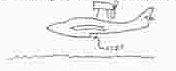
Air moves along the step and then goes back as a sheet of ripples under the aft part of the hull. The craft then skims on the smaller surface in front of the step.
Like the French aviator, with plenty of wind, the sailor can control the angle of the board and thus plane. But for light air and in less expert hands, the sail board needs a step just like the seaplane does. of course the seaplane in normal use keeps the same side up on the water, while the sailboard is often tilted radically on its edge, on its "beam ends." Obviously the step needs to be designed to take that into account.
And I would not be surprised to find that a board with a step would perform better than one without even in good hands and a fair wind.
The bow and arrow also requires a good pair of hands. There was a time, on the field of Agincourt, when the Welsh archers made the longbow the dominant weapon of the planet. Firearms were invented as a poor substitute. It was not until, worse luck, the War of Northern Aggression that a gun was as deadly as a bow. But for centuries, no one has shot an arrow in anger if he could lay his hands on something easier to use. In sporting use, the challenge is to use the bow and arrow accurately. A modern compound bow can shoot an arrow as far as you would care to walk to pick it up.
The longbow shot a cloth yard shaft, an arrow 37 inches long, named I suppose because it was drawn back much the same way cloth is measured. The arrow consisted of a metal head that put the center of mass somewhere in front of the center of the shaft, a shaft, fletching and a nook for the bowstring. The length of the shaft gave the arrow its beauty, made it possible to draw the arrow far back and impart a lot of energy to it, and gave the arrow tremendous penetrating power. One recalls the story of the archers who loosed their shafts at a castle, and the arrows penetrated the six inch thick oak planks of the raised drawbridge. One can only hope the rotten planks were replaced before anyone tried to ride over that bridge. The fletching consisted of little bits of feather tied or glued to the back of the shaft that added to the beauty of the arrow and, together with the bulbous nock, shifted the center of air resistance toward the back of the shaft. The fletching was set at a slight angle so as to give the shaft a spin as it moved forward, just as a quarterback throws a spiral pass.
With the release, the bowstring moves powerfully toward the center of the unbending bow. The shaft of the arrow slides along beside the bow. The result is that the shaft is bent. Throughout its flight, it continues to whip back and forth. Since it is also spinning, the arrowhead describes a pattern sort of like this:

Now you know why a supply of arrows is called a "quiver." Compare that with the course of a bullet:

Obviously, there is some room for improvement.
The most obvious thing would be to put a little bole in the center of the bow and shoot the arrow through that. That would get rid of the initial bend. of course if the arrow got jammed going through the hole, the archer would wind up with a face full of splinters. None the less, it would be easy enough to offset the center of the bow so that the shaft of the drawn arrow went through the point at which the released bow string would come to rest. I suppose this has already been done.
The next obvious improvement would be to discard the cloth yard shaft itself and use a stubby broad dart like a crossbow bolt. The shape should be like two cones placed base to base so that there are symmetrical points at the head and nock but the head should be of denser material than the nock. Since the length of the dart is much less than the length of the draw, the bow will need a little track for the dart to move along. The shape of the dart does not lend itself to gliding stably along the track, so there should be a little dolly that slides along the track. The dart rests in the dolly during its acceleration. As soon as the point is reached where the dart is no longer accelerating, the track swoops downward, bringing the dolly down away from the flying dart.
One further caution. The mechanism should not be too ugly. If it is not beautiful, and if it is an improvement, they will figure a way to keep you out of the sport.
When the Beaker folk came to Britain thousands of years ago, they brought with them a new technology. Or at least the technology arrived. How many people it brought with it is a matter of speculation. That technology consisted of putting a little lip on the edge of a cup, a little beak that permitted one to pour water without having it run down the side. Like some other technological innovations, this one was nearly worthless. Water still ran down the side.
In science lab, when you pour from a beaker, you are taught to place a glass rod over the top so that the end of the rod sticks out over the beak. This makes it drip less. Predictablly, the fact that beakers don't work has not made them disappear. They look good.
Handsome though the beaker is, there was still the need for a vessel that would pour without slobbering all down its side. They then invented something called, in a hopeful tone, the pitcher. The pitcher instead of a beak has a long spout. The spout is arched, so that liquid dribbling from its end sometimes doesn't run down the underside of the spout but drips directly on the table cloth. A wary pourer may place his cup so as to catch the last drop, but it generally drips anyway.
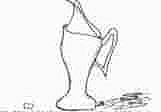
Although the pitcher did not live up to its name, it was an improvement, and it served the bibulous for millenia. But it is really very simple to make a pitcher that does not drip. Imagine a pitcher with a spout that reaches high but does not reach very far out. Such a pitcher would drip onto its own front. Build a little aqueduct to collect the water as it runs down the side and take it around to the back of the pitcher. Like this:
Of course the pitcher cannot be filled higher than the level at which the aqueduct enters the back or water will run backwards along the aqueduct when you try to pour and come spewing down the side of the container to everyone else's mirth.
I had just designed this great boon to civilization when M came by with a smirk and put a bottle of Cheer on my desk. Some friend had told him about it. The thing that pleased M was not that after five thousand years I was six months late, but that with a little wrist action, he could get Cheer to muck up the side of the bottle even though in all important respects it was as I had designed it. I say my design would be easier to wash than the Cheer bottle, but who ever worried about washing a detergent bottle anyway.
So as revenge I am going to tell you about an improvement in luminaria. This was not invented by me or even M but by M's older brother.
Luminaria are little paper bags with some sand in the bottom into which a lighted candle is placed. The sand keeps the bag from blowing away. The bag keeps the candle from blowing out. The sand holds the candle up. The bag holds the sand in. The bag filters the light of the candle turning it into a warm glow. In warm parts of the world, at times of celebration these luminaria may be placed by the dozens or the hundreds. On a pleasant evening their soft silent radiance lend a beauty almost spiritual in its peace and innocence.
Older brother struck upon the plan of replacing the sand with dog do and leaving out the candle. The bag was to be placed on the doorstep of some innocent enemy. The plan was to light the bag on fire, ring the doorbell and run. Then one waited for the person to come to the door, see the burning bag and stomp it out. The result, I am told, was also soul satisfying.
We do not recommend it.
Booty
Editor's Note:
Wild Surmise is an occasional newsletter on speculative matter. It is sent out free. We are happy to add anyone who asks to the mailing list. Of course anyone who asks can get off the mailing list too. And we have never sold our mailing list to anybody.
Next issue Booty will try to explain what free will has to do with the night sky and why every person should consider every other person to be a dear and wonderful thing and that differences between people are some of the most wonderful things about them and as such are to be preserved.
The day of the Martian perigee, Mars's closest approach to earth this fall, M came in from an early jog and said he'd seen his name in the sky again. We stumbled out into the false dawn and saw the dawn itself, Venus, Sirius, Jupiter and Mars forming an fli all the way across the sky. We decided it was M's biggest delusion so far.
We notice that M got a bit carried away this time and wrote for longer than usual. You might consider reading only half of it. Can't imagine it makes much difference which half.
Ed
Copyright February, 1989 WILD SURMISE
BALBOA AWARD
Randolfo Pozos, Ph.D., recent Balboa award recipient, along with Richard Hoaglnad, says, "Stay tuned; one of our team members from the Defense Mapping Agency will be presenting some new findings on the quantitative relationships." Dr. Pozos has been studying formations on the Martian surface that are provocative in their superficially artifactual appearance, and hard to explain as natural. Like a face a mile across.
MISSING AT HOME.
Dateline Washington. Apparently a Veterans Administration study released December 28 found one Vietnam veteran in six to suffer post-traumatic stress syndrome. We do not know yet what the prevalence is for veterans who were involved in combat. It seems that the notion that combat and comparable experience or the recovering from it is corrosive to the human soul is a robust concept.
MILD SURPRISE
My mother had been traveling in the South of France when I met her in Paris. There was not time to look up friends in France, but we nianaged to visit the cathedral of Notre Dame, see the Roman ruins on Isle de la Cite, browse among the book stalls on the Seine, lunch at a little cafe on the left bank and do a taxi tour past the Louvre, Place de Concorde, Champs, Arc de Triomph, Eiffel Tower, and Sorbonne before the plane left that afternoon. She set a firm pace.
We feasted sumptuously and managed to doze some that night on the Air France flight to New Delhi. Another night in an airplane was not quite what I needed to be refreshed, and when morning came anomalously early in India, it seemed like a major burden that the stewardess would not bring our jackets, but I must fetch them myself. I found my own and put it on, but could not locate hers. We were doing our best to find it, with the help of the less than enthusiastic cabin crew when I noticed my jacket felt a bit tight. I'm not a small guy but...
Uh, it's ok. I've found it."
'1Where is it, then?"
"I've got it on." The~stewardess had hung it up inside my jacket, with the sleeves drawn through as well.
Clothed and in what was left of our right rninds, we collected bags and caught a cab to the domestic airport. I got the sleepy impression of rough paving, of brilliant green verges upon which animals browsed, people squatted in loose clothing, tents were pitched and the sun shown with impossible brightness. An impression of a far distant horizon low and obscured by haze that would be our constant companion for two weeks, of discouraged trees, buildings that suggested people had been living here a long time and buildings of red brick just going up that suggested people were not yet content.
In order to enter the terminal, we presented our tickets to the solders at the door. Tall brown men, thin of limb with old rifles they had chained to themselves with the kind of chain they used to hang cheap swings from. They seemed vigilant rather than nervous.
The waiting rooms were high, dark and cool and richly ornamented with idols, tile mosaics and a children's art show, crayoned pictures tender with understanding and radiant with. light. The great rooms echoed stonily the sound of many people talking. It
was a cheerful sound, like that of water playing. We learned that the language was Hindi. The lettering on the signs we saw was distinguished by running right to left and by the letters being joined at the top by a horizontal line. The letters themselves, I could not recognize. We accomplished little before mid-afternoon, when the plane left for Agra. I survived. Nother shopped at all the stalls in the airport, went to the post office window and bought one of every kind of stamp the man had, checked out the ladies' room, made some friends and learned a little Hindi.
The short air hop to Agra was memorable for lunch, which consisted of little squares of white bread with a slice of pale cheese between. It was definitely not Air France. Soon we emerged blinking into the sun at the Agra airport.
A hearty but officious man asked where we were going and named our hotel. I answered yes that was where we were headed, and gave him my name when he asked for that too. From then on, he called us by name. Said he was from the hotel, and that it was his duty to see that we got to the hotel and that we got driven about to see anything we needed to see. He did not, however, present any identification for himself or anything with the hotel's name written on it. As soon as he had laid claim to us, he made a dismissive gesture and a cluster of other eager faces dispersed.
We were placed with our baggage in a car with driver and guide and so came by adventure to the hotel. We had little care for the resident snake charmer at the front, for the long approach, for the palatial entry halls or resplendent reception staff, for the multiple dining halls, the resident atrologer, the resident travel agent, the enormous ceiling fixtures, the pleasure gardens below the windows or the sight of the Taj Mahal beyond. What mattered was that the rooms contained beds, rather hard for me but about right for my friend or perhaps Torquernada, fresh fruit and some bottled water.
Two hours later, the man who had met us at the airport called for us, frantic lest daylight pass before we had seen the town. He turned us over to a guide and driver. As we approached the great mausoleum, gleaming in the late daylight, Mother had the car stop so she could get a picture with her camcorder. Then she decided that the passing traffic was also interesting, and soon the driver had a pony cart stop and pose. I asked if the cart driver would expect a tip, and the guide said, 'He will accept it if you offer it, but he will not ask for it." We offered.
What need to tell of the Taj Mahal? Built by a Mogul potentate for his beloved wife, marble inlaid with precious stone on a bank above the river, approached through a red stone fort past busy shops among curious people and eager hawkers, seen through a high gate of red stone inscribed in pious Arabic, surrounded by reflecting pools and garden walks, flanked by a mosque on one side where the craftsmen might pray and by an identical secular building on the other side built only with an eye for symmetry. Four towers guarding the corners of the platform lean outward so as to please the eye and so as to fall away from the main building in case of earthquake.
No bats fluttered out of the building at dusk. There was no temptation to swim in the reflecting pools by moonlight, as the pools are only four inches deep. We donned shoe covers so as not to mar the shining floors and entered by the failing light. Inside the tomb was close with the press of humanity. An oily film seemed to cover the finely wrought stone as it does a child's skin. A light pressed against the stone showed it translucent, glowing as your hand will when clapped over a flashlight in the dark. Save instead of veins, jewels patterned the glow. All was hushed until when one of the attendants was encouraged to call, and when he raised his voice in a high keening wail, the sound reechoed and alarumed under the high dome like nostalgic banshees renewing old times. The grounds are closed at dark for fear of attack from Sikh nationalists who have threatened this Hindu and Muslim shrine.
But the coming of dark did not deter our guides. We pressed on into the heart of the town, where shops were opened for us. There in the night, we saw decendents of the very families who had made the Taj still working the same stones into marble, saw marble screens worthy of the original, saw jewelry and clothing and ancient treasures such as a dress that had belonged to the woman for whom the Taj had been built, and her tiny portrait. The colors had not faded over the centuries, for the pigment used had been powdered jewels.
We sought to verify our flight out the next day. All we could discover was that we did not, to our surprise, have a reservation. Nor could we get one. There was nothing to do but to have some supper and try again the next day. Joking, the guide said he could arrange a car to drive us the three hundred miles to Varanasi if the airplane would not take us. Amused, I said that sounded like fun. Not amused, my mother said it sounded difficult.
We selected what looked like the least exotic restaurant out of what the hotel offered. There were varied vegetable dishes that reminded one in turn of Santorini, Vesuvius, Stromboli, Tambora, Krakatoa, Mauna Loa and Mount St. Helens. We picked our way through and washed it down with much bottled water.
Our car fetched us early. A stout little car of English design, new but designed in 1915, they said. The driver had been hand picked from all Agra as the one most likely to make it to Varanasi. A quick check by the airport office verified there was no other way. So while the driver tanked up and found a co-pilot, we were conducted on more tours of the hidden treasures of Agra. It was not until ten in the morning that we were fairly on our way. And even then, it took almost an hour to get out of town, since there was construction on the bridge and the traffic in never ending procession of humans, animals, bicycles, oversized tricycles, camels and three wheeled scooters choked the road.
There were almost no cars. We were an oddity. No one travels that route by car. It is cheaper and faster by plane or train; and it only takes a month to get a reservation. Add to that our pale skin, my mother's light hair and bright blue eyes, and you may imagine the stares we brought. Add to that her disposition to smile and greet anyone who met her eye.
The born yelped constantly. In all fairness, there was only one lane for much of the trip. Approaching bicycles were run off the road in front of us like water shearing from the bows of a destroyer. You could tell when we were in the country because the houses were away from the road. In town, buildings hugged the road closely and had no front wall, so you peered constantly into shops that sold lentils, cloth, grain, pots, metal work, hardware, clothing, repaired machinery and generally did all the little chores of life. Once when a pony would not clear the way, we pushed him, gently but effectively, with the front bumper. Once the driver missed his judgement on the amount of room we had and pushed into a row of parked bicycles~ The bicycles all leaned but did not fall. There was no room for them to fall over. Someone shouted, yanked the bicycles from under the car and waved us on our way.
The old name was Benares, although the Hindu say there was another name before that and many more before that. Today they call it Varanasi, and so it said on the road signs. But ever and again the driver would stop and the co-driver would shout, "Benares?~ And some helpful person would wave us on down the road. we were fortunate that Hindi is spoken in Agra and Henares as well as a broad band of territory in between. Had. we gone south the sane distance from Benares to Madras, I was told we would have char~ed languages five time. They said that the number of languages in India runs into the dozens, five or six dozen not counting dialects, and that many have different alphabets, some running right to left, some left to right.
Once the co-driver looked back and said, "Forty foot high statue of the Monkey God." Indeed, a tall idol bright orange in the bright haze, loomed in the distance. It was a human figure with a rather simian face, an enormous bludgeon leaning against his thigh. The guide said, "They said to the Monkey God, 'Yes, but you do not have Rama in your heart~' And he tore his heart open and there were flama and his wife~" Indeed the huge form had opened his breast with his hands, and inside were portraits of a male and a female face. Time for a snapshot~
I piled out of the car, and without reflecting whether this might be a sacrilege, took two pictures of the giant statue. The next time I looked at my camera, a portion of the front had been broken. As I watched, a piece of broken plastic fell away. Happily, the camera continued to work, and even the pictures of the idol survived.
Before we agreed to attempt the trip, I had particularly spoken about rest stops. I insisted that we would need to stop regularly where there were clean facilities. The told us with a cheerful smile to dismiss the entire matter from our minds. There would be no problem whatever. There would be many places, all equally convenient and modern. They spoke the literal truth.
Along about the middle of the afternoon I said, "Not many rest stops, eh?~
No, they said, they hadn't seen any either. However, they would find a suitable place beside the road sheltered by trees.
'What trees?"
Many trees. A jungle. A true jungle.
"No snakes in this jungle, are there?"
No, there would be no snakes. Guaranteed no snakes.
"No snakes in all of India, are there?" Weill....
Presently we stopped by a little swale with a cane brake on the other side.
"Jungle," they announced gleefully. The guide did go so far as to do a snake check before turning it over to us. No point in doing a people check. There were people everywhere, but in some directions, they were at a fair distance. My mother's infallible good humor rose to the occasion.
We ran across a snake a short time later. Already killed, it had been laid out across the road, where it seemed to reach from one side to the other. I did not step it off, but it looked like a ten to twelve footer, the color of the Monkey God and as big around as an arm. "Water snakerur said the guides. "Completely harmless.
They seemed to have a custom of processing cow flop. When the cow would make a deposit, they would break it up into little balls and then stomp the balls flat. After the resulting pancakes had dried sufficiently, they were stood on edge to finish drying. They were then stacked and presumablely carried off to be used as fuel.
Places of refreshment were frequent. There would be a little cook building and a yard with a shade tree, although the trees seemed leafless and the fall air was cool and pleasant. In the yard would be a number of articles of furniture, each consisting of a rough wood frame maybe a foot and a half off the ground, two or three feet wide and six or seven long. Natural fiber rope would be woven on the frame, the ropes covering one half perhaps six.
About two thirty in the morning we came to the Varanasi railroad station. The great parking lot was poorly lit but very crowded. Our drivers passed the hotel across from the station and didn't even slow down. You could not blame them. Huge and dark so late at night, the hotel looked forbidding to the point of seeming evil. And yet it was in that hotel, when we returned to it, that we found a clerk who was helpful enough to phone the friends we had come to visit, and the clerk arranged for a motor rickshaw to accompany us as far as the gates of the university.
Our friends there were gracious beyond courtesy. They took us in, had us wash ("What? Wash off this dirt? Do you have any idea what we just went through to get this dirty?"), put us to bed (Good hard Indian beds. No danger in lying in these if you don't need the rest.) and let us sleep until eight in the morning ("Of course you will not be able to see the bathers on the Ganges at dawn. That is something you should not miss, but you will need your sleep.")
The first trip out, our host took me on the back of his scooter to the airline office to check on our connection back to Delhi the next day. Everything was in order. We would only have to present ourselves at the airline office at four in the morning and a bus would take us to the airport.
The trip across Benares and back was memorable. There was the usual surging traffic, except now it was seen not from the back seat of a car, but from the back of a scooter. Under normal circumstances, I do not ride a scooter. The little wheels are just too unstable. Nor will I ride a full sized motorcycle without a helmet and heavy clothes. So there I sat1 hatless, bootless, jacketless on the back seat of this missile swirling through broken pavement, eager drivers, indifferent cows and strangely decorated vehicles. There were Enfield motorcycles that I thought had vanished from the earth decades before. There were carts. There was confusion. And I was disgracing myself.
You see, I was holding on. There were scooters with passengers everywhere, but nobody else was holding on. Worse, when they saw me holding on, they stared. As near as I can figure it, these were Hindu, who reckoned that dying in Benares was the nearest thing to a guarantee of a good reincarnation as you could find. A nice fatal traffic accident would be splendid, unless of course you had led a truly heinous, disgusting life and expected to come back in worse shape. In other words, holding on was an admission of moral turpitude. I held on anyway, but I tried to do it discretely.
The temples, the temples of Benares. They are endless in their number, endless in their variety. Old but not ancient. Secret looking ones and ones without walls thrown open to view on all sides. High roofs like steeples. Ornate carving. How many gods are there in India? I do not know who counts such things, but I have read serious estimates ranging from the tens of thousands to inches apart and those on the other half woven reasonably closely.
Men could be seen stretched out napping on these couches at all times of the day, but niostly in the heat just after noon. Eventually we stopped to get a bite to eat. what you did was sit cross legged on the mat part of the weaving and a board was laid in front of you. On the board they placed a small bowel of spiced peppers that the guide thouqbt should be left alone. There was some flat bread, a dish of rice, a dish of milk curds and a dish of some sort of beans or lentils in a pale sauce. There was also water. Knowing I would regret it if I did not, I tried a little of everything but the water. It was fresh food and wholesome, not offensive in any way. I think if it had had more color, I might have liked it. As it was, I ate without ill effect. Mother prudently restricted herself to an apple she had brought from the hotel and which she peeled before eating.
The press of people was endless. when school let out, you could see the children marching home in their little uniforms, or sitting rank on rank with smiling little faces on the back of a tricycle while father pedaled. I think I counted as many as twelve little ones on one such vehicle. Later in the day, the crowd began to thin out. At times the car got up to what may have been close to forty miles an hour, but never for more than a few seconds. Once we passed a little girl who could not have been ten standing partly clothed beside the road with her hips tilted provocatively. What she was thinking as she gazed past us down the road, I do not know. She seemed to have disrobed rather casually, but the pose was precisely that of some of the female erotic carvings in some of the ancient temples. Once we saw a woman and child sitting gazing at a pond, she in a colored dress with a cloth over her bead, the child clean and swaddled. It was a touching sight, two humans taking an instant to sit and dream in the midst of such a press of practical necessity.
All in all, the people we saw that day seemed happy, even enthusiastic. They were thin but did not look hungry. They were as clean as the circumstances would allow. Spain is now a prosperous nation, a full member of the European economic community, which is in turn the mightiest economic force on the globe, not to say of all time. The feel of the countryside was like that of Spain of perhaps twenty years ago, except that the people seemed happier, more energetic, more cooperative1 better organized, possessed of a higher technology and a better government, or perhaps of the South forty years ago, the North ten years before that, or the flutch countryside painted by the old masters. The sensation was that of watching the rising forehead of a tidal wave, the apprehension of unthinkable energy locked in strange beauty and a profound threat to the preconceptions.
Late that night, we stopped beside a small temple, where a lone woman sat before some unrecognized idol, the little room lit up with a pale blue light. The intensity of her worship seemed clear although she sat motionless as long as we were there.
About two thirty in the morning we came to the Varanasi railroad station. The great parking lot was poorly lit but very crowded. Our drivers passed the hotel across from the station and didn't even slow down. You could not blame them. Huge and dark so late at night, the hotel looked forbidding to the point of seeming evil. And yet it was in that hotel, when we returned to it, that we found a clerk who was helpful enough to phone the friends we had come to visit, and the clerk arranged for a motor rickshaw to accompany us as far as the gates of the university.
Our friends there were gracious beyond courtesy. They took us in, had us wash ("What? Wash off this dirt? Do you have any idea what we just went through to get this dirty?"), put us to bed (Good hard Indian beds. No danger in lying in these if you don't need the rest.) and let us sleep until eight in the morning ("of course you will not be able to see the bathers on the Ganges at dawn. That is something you should not miss, but you will need your sleep.")
The first trip out, our host took me on the back of his scooter to the airline office to check on our connection back to Delhi the next day. Everything was in order. We would only have to present ourselves at the airline office at four. in the morning and a bus would take us to the airport.
The trip across Benares and back was memorable. There was the usual surging traffic, except now it was seen not from the back seat of a car, but from the back of a scooter. Under normal circumstances, I do not ride a scooter. The little wheels are just too unstable. Nor will I ride a full sized motorcycle without a helmet and heavy clothes. So there I sat, hatless, bootless, jacketless on the back seat of this missile swirling through broken pavement, eager drivers, indifferent cows and strangely decorated vehicles. There were Enfield motorcycles that I thought had vanished from the earth decades before. There were carts. There was confusion. And I was disgracing myself.
You see, I was holding on. There were scooters with passengers everywhere, but nobody else was holding on. Worse, when they saw me holding on, they stared. As near as I can figure it, these were Hindu, who reckoned that dying in Benares was the nearest thing to a guarantee of a good reincarnation as you could find. A nice fatal traffic accident would be splendid, unless of course you had led a truly heinous, disgusting life and expected to come back in worse shape. In other words, holding on was an admission of moral turpitude. I held on anyway, but I tried to do it discretely.
The temples, the temples of Benares. They are endless in their number, endless in their variety. Old but not ancient. Secret looking ones and ones without walls thrown open to view on all sides. High roofs like steeples. Ornate carving. How many gods are there in India? I do not know who counts such things, but I have read serious estimates ranging from the tens of thousands to creature, some eight feet high and weighing six hundred pounds, standing in the center of the chamber, slouching slightly to one side, staring back.
"The Monkey Cod is the god of strength. People pray to him for strength," said our friend. "He is very popular. Everything is difficult here."
We went to the Ganges, the holy river. "The government says that there are 800 million of us in India. Unofficially it is more like 1.2 billion. But of course it is political suicide for any politician to talk about the population and its growth."
"Yeh. There are things it is suicide to talk about in our country too."
"Every Hindu wants to see the Ganges. For the rich, they want their ashes to be brought here. That isn't necessary, of course, but they like it. Properly, a person should be cremated soon after he dies. One very holy man was so strong on that point that they cremated him within thirty minutes of his death."
It is a beautiful river, broad and powerful, capable in time of flood of rising tremendously. We were told of a high water mark two hundred feet above the present level. On one bank perches the city, its temples and · ghats saturating a high cliff for what looks like a distance of miles along the river. The other bank is deserted, a low marshy plain that stretches toward the horizon. The water it would take to make the river flood staggers the mind, yet the Ganges drains a substantial part of the heart of Asia.
We took one of the many flights of steps down to the river's edge, past a ghat that was under construction, past at least one funeral in progress. The river looked sullen and murky from where we stood, and we were told that those who collected water to take away generally took it from another place on the river. But all was not gloomy. There was a child flying a kite there by the river bank.
On the way back to the motor rickshaw, we passed a Brahma cow, a sacred cow, by no means our first. no they play the color game in India? Does light skin represent a sort of status symbol? I never heard a word breathed about it, although there was a tendency for the upper classes to be a little lighter. But to say that no one speaks of it is not to say it is unimportant. A century ago the Sepoy rebellion occurred when Hindu troops realized that they were being asked to prepare musket balls for loading by warming the greasy missiles in their mouths. The balls had been lubricated with beef tallow, so that this was technically eating beef, unthinkable for the Hindu. The mutiny was the beginning of the end of British rule in India. So one is disposed to take seriously reports that skin color is important, that part of the spiritual leaSership of the nrahmins is due to the fact that they are thought to be a purer strain of some nearly assimilated paler race, that preservinq racial purity is then a sacred duty.
I had never noticed it before, but Brabma cattle are white.
We buzzed off to a place at the edge of town where Buddha is said to have given his first sermon. The place is marked with a group of statues representing Buddha and some disciples. They are shaded by a large tree which was grown from a cutting taken from a tree in Ceylon. Ceylon, or course, is now called Sri Lanka. They have another civil war going on there since the Tamils there are not happy being controlled by the more numerous Hindi. That tree in Ceylon was grown from a cutting, so they say, from the very tree under which Buddha gained his enlightenment. Close to the spot is a temple. In the place of honor in the temple is a silver reliquary that contains a relic of Buddha himself.
MThe relic, the tree, the place of the sermon all together," said our host. "Benares is the holy city for over a billion Buddhists and more Hindu," said our host. "But there are no Buddhists in India."
"None.'.
"O very few. Mostly we are Hindu, with many Muslin, some Sikhs, some Paresees, some Christians. Almost no Buddhists. when Buddha preached, the Hindus said to him, 'Yes. We already know all that. Go some place where you are needed.'"
On the way back to the university, we were tied up in traffic. There was an explosion and the crowd, which filled the street as usual, started shouting, then chanting and stamping. It was some happy religious festival; the explosion was a fire cracker. I wondered how you could ever tell if you were in a riot.
Some rapid fire conversation before dinner:
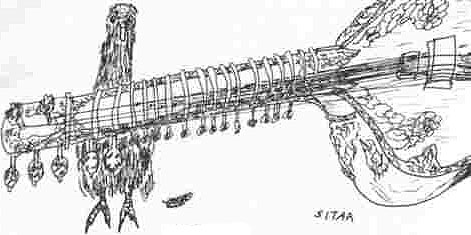
"Can you buy a sitar in India?"
"Yes, this is the best place in the world to get a sitar. I will arrange to have one made for you."
"Er, surely that takes some time, and besides...
"Yes, it will take time, but I will do my best. If you want a sitar, you ought to have one."
And again,"This Monkey God they call him, is he Both host and hostess had ideas.
MHe is not really a monkey of course. You have seen him. He is a man that looks a little like a monkey.'1 "If you look at India, you will see much that shows that the history books are wrong.
There was civilization here many thousands of years ago. One ancient civilization had a high degree of technology. we think the people died out. They monkey god was their god, and he looks like they looked."
"But is he the type to get angry? Like if you took his picture?"
"O you must never take a photograph of God. But you can take pictures of a temple. And you can draw a god or paint one."
Dinner consisted of some flat bread, a dish of rice, a dish of milk curds and a dish of some sort of beans Or lentils in a pale sauce. On friendly ground, we took it without hesitation. "Very traditional," we were told.
Conversation returned as if by gravity to religion.
"I like to go to the temple sometimes. You get points. It's like you build up an account. And then if you accidentally sin a little, you have a balance to draw against.
"Brabman is the supreme being, what you would call God, but it is Brahma who is the creator. Brahuta created the world; then he stood back. He is not worshipped very.rnuch any more. He turned the world over to Vishnu the preserver and Shiva the destroyer. But you must not think of Shiva as being evil. He is the destroyer of what is evil, so that new good can come. All things must change. When Brabma created the world, the waters of the world were poison. Shiva drank it to take out the poison, but he only swallowed it half way down. The heat from the poison is terrible, and has turned his neck black, and so he must always be kept wet to cool him down.
"Come. Let us go for a ride around the campus." We boarded the scooter again and went out into the chill gloaming. For once a tweed jacket was a good idea. we pulled up before an temple, tall and imposing. It's overwhelming ornateness so pervasive that the impression was one of tranquility. We checked our shoes and started toward the temple. "Shiva has different manifestations. nut usually he is represented either as a dark skinned man with a cobra or as the linga."
"The what?"
"You will know it when you see it."
We crossed the broad portico, walked under the bell, entered the temple, open on four sides, and came into the presence of Shiva, the destroyer, consort of Kali, father to Ganeshi. The linga.
From the unseen inner top of the high temple hung a chain and at the end of the chain, at waist height, a brazen vessel of some two or three gallons that dripped water constantly upon the god to quench the raging heat of the poison. The god itself, some eighteen inches high and perhaps ten across, was a blunt phallic shape of stone, dimly perceived through the layer of fresh flowers strewn over it and freshened by the water.
The linga rested on a stone, feminine in its curves, like a keyhole, an ear, a canoe, some four feet long and two across while only two inches high, it lay flat, recumbent, supine, and the waters of the metal vessel glided down the sides of the linga to be carried away with the flowers in the curved recesses of the supporting stone.
The linga was not so intimidating, dwarfed as it was by its larger than life female counterpart. But the entire idol was not so warm nor so generative nor so life affirming as one might expect. For one thing, despite their juxtaposition, the stones, both the male and female components, were, from their proportions, clearly in a state of repose; this was an ascetic symbol.
In the second place, the two stones were of different kinds. It must be less shocking to the Western mind, which can contemplate cooly the death of animals simply because there is money to be made by it, which can contemplate an end of spiritual growth after the accidents of a single lifetime, which can eat dead animals simply because they taste kind of nice and make the belly feel good; it must be less shocking to the hard headed Western mind, but the feminyfle base was of the purest white alabaster, while the linga itself was of a rich black stone. As sexual objects, they would not, could not reproduce each other.
We walked around the idol, clockwise. We walked around the columned porches of the temples and then around the temple grounds. We recovered our shoes and started out on the scooter around the campus, always turning clockwise, until we were at the front door of his home. I asked him whether it was an accident that we had made such a large spiral. He brightened, I We made a lot of points."
An evening meal, then up late talking and looking at slides. The sitar would not have to be made. Once could be purchased. "But how am I supposed to learn how to play it?"
Ah, well, you play it any way you like, don't you? No, a formal lesson would not be possible.
Up at two in the morning. Two motor rickshaws wait in the dark out front to carry three of us and the baggage. Moving out fast. The drivers work to stay together in the heavy traffic. Once a Than steps aboard as we round a corner. The driver shouts a quick explanation and the man obligingly steps off. Once we are separated for several minutes. Once another rickshaw, no lights, plunges out of a side street, going down hill easily at forty miles an hour. We pass within inches. No time even to react. I'll take all the points I can get.
Was dark and misty. Almost murky as the vale was hemmed in on all sides by mountains.
We were met by people from the houseboat company, who put us in a car to go to the boat on the other side of Srinagar. In Srinagar, there really are cars. There are traffic policemen at the corners, whom the drivers scrupulously ignore, and who seem to spend their lives guessing what the drivers are going to do and beckoning then to do so. There VQas many a two wheeled horse cart with enormous wheels traveling at a merry trot, the driver, a dark faced young man, standing erect with his feet together over the center of the axle, while the cart gyrated around him. A few of the women wore veils. The buildings were higher than what we had seen, with an air of preparedness for the coming cold; many had open lofts some day to be completed as upper stories. Here too, there were plans for the future.
The city was pierced by canals lying far below the bridges, and in the canals lay any number of houseboats, side by side rafted up against the banks, long low and narrow, unpainted. The hulls were made of huge slabs of cedar inches thick, feet wide and many yards long cut so they fit edge to edge and fastened with enormous iron staples. I expected that at any moment the car would stop, and we would begin to pick our way down a steep bank and move in. But these were ordinary homes, not tourist lodgings.
Many miles later we reached lake Nagin and the boat. It lay at the bottom of a high grassy bank, surrounded by flowers and viewing the lake and the high mountains beyond. It was unpainted cedar again, slated to be painted for the first time that very winter. The interior wood was carved, every visible surface, into a fantasy of birds, foliage and geometric designs. It was broad and high with living room, dining room, butler's pantry and three bedrooms, of which we used two; the other went unoccupied at this season.
On the end of the boat that projected into the lake was a balcony, for sitting and a little flight of steps down to the water. Here tradesmen would come in their little sikorahs, light canopied gondolas they paddle& about in all weather and at all hours, bringing jewelry and postcards, film and laundry, saffron and soft drinks, musicians and tailors and entire boatloads of flowers.
Everything is the family in that part of the world. One suffers or prospers with his family. One would no more imagine a person "rising above the limitations of his origins" than imagine a Western athlete mutilating himself to gain a competitive advantage; it may happen, but it is not admired. If one strays from the teachings of one's religion, it is the family that points it out. No government or clergy is trusted with that authority. The family, the extended family, is the identity in the community. Thus it was that we found we were guests of a family.
One bother told us that landslides had cut us off from India, war had cut us off from Pakistan and the mountains cut us off from Tibet. But they would do their best to make us comfortable. And that they did. We had hot meals three times a day, including once a day real meat, a meatball of ground lamb. One brother took us for rides in a sikorah, to see shalimar, the pleasure gardens of the Moguls, where the ancient rulers would sit and gazeat the beauty of the lake and mountains. (Mughals they are called now.) He took us to see the floating gardens, to see women pulling grass from the lake to feed cattle, to see the downtown canals from the water, the old houseboats looming high overhead, shops even higher opened toward the water, Mosques and temples on the banks. Another brother went with us on a drive into the high mountains to Golden Meadow among peaks topped with eternal snow, where we saw the last supply convoy coming back from the town of Leb. For the rest of the winter the only highway to that town would be closed.
With another brother, we explored cottages where silk rugs were made by hand forty knots to the inch, where paper mache was gaudily painted and where wood was carved and polished. Our guide said he had two hundred fifty families working for him. He took us to his home, a fine new three storied house where twenty three ofthem lived. In the loft, he showed us his rugs, good wool. ones and reasonable cotton ones and fabulous silk ones woven with stern traditional Persian designs and with more naturalistic easy going Kashmiri patterns.
One night we had musicians over, four of them. Two played stringed instruments, one strummed and one~bowed. Each instrument had two sets of string, a primary set and what looked like a set of drones. One played a sort of hand organ that he pumped with one hand and keyed with the other. The fourth, the most energetic of them, played a clay pot, round, a little larger than a basketball, from which he could wring different sounds and rhythms with seeming ease.
One day Mother announced that she would like to see a Christian church, and the first brother took us there. It was in a nice part of town, the church set in a garden of trimmed flowers. The protestant minister came out of his home to open the church and show us around. The building was large but spare with cushions instead of pews and much of bare concrete showing in the floor, the walls and ceiling. The bars in the windows were wrought with religious motifs, concealing the fact that they were, indeed, bars. Living water playing in the stone baptismal font enlivened the sanctuary. Around the walls was a mural of the life of Christ, his features and poses Hindu and oriental, not Western and Nuslim. No need to try to please the Muslims with a mural; for them any representation of God is part and parcel with the linga.
"I have been here twenty three years," said the minister. "We used to have a beautiful church, but it has been burned three times by the Muslim." ("Shia Muslim," said our Suni Muslim guide later. "They do not understand that 'Islam' means peace.")
As we thanked the minister and left the building, a young man greeted us. 1'Are you Americans? My sister here has accepted Christ." There was much hand shaking, picture taking and address exchanging before we left the Christians there in the garden.
We visited the Catholic Church, smaller but in better shape, as it had never been burned. We visited a stupendous mosque, each wing the size of a cathedral around four sides of a great courtyard. The wood pillars that supported the roof rose to breathtaking height, and the carpet on the floor designated prayer locations for thousands of the faithful. Then we shopped downtown in the oldest part of the city where you stood in the street and did business with the shopkeeper, whose floor was about at the level of your breast. There were clothes and textiles and brassware and fire baskets to fill with coal and tuck under your caftan for warmth. There were beans and lentils. One merchant made my mother a gift of a walnut when she expressed an interest. she bought a few yards of silk at a price such that when our guide later showed it to his brother, the brother announced he was going to have his wife go shopping in that part of town.
On the same busy street, we came to the tomb. We took off our shoes, entered a gate and then entered a protecting building. Even inside the building, the tomb was protected by an enclosure of glass, through which you could peer at the stone. Beneath the stone, according to the sign, lay the body of Jesus. Excavation had revealed that there were in fact two people buried there.
"Of course it is not really Christ," said our guide. "You do not believe that as Christians. Nor do I as a Muslim. Christ is not here on earth. He is up there, and he will return on the day of the last judgement.
"Islam is a discipline, a way of seeking. We say it stands for Intelligence, Sobriety, Love, Adoration of God and Maturity. We believe in Christ as you do. So we do not believe that Jesus is buried here.
"But there is someone buried here. And it is a good place. I have a good feeling for this place. I think he must have been a very good man."
One morning we got up early and spent the day in airports and planes and came late to Delhi, where we were met by our friend from Benares. He had crossed India by railroad, coming in a sleeping car in order to bring the sitar. fly the time we got to the hotel and had supper, it was past midnight. He showed us the sitar. It was a four and a half foot instrument with twenty strings. He showed how to pluck the strings with a little wire loop on the finger. He explained that the sound of the sitar is spiritually beneficial, and that it does not matter what is played on it, the benefit is the same. There was much to talk about, but with only two hours before time to leave to catch the plane out, we all at last went to bed. He and I shared a room. The beds were the usual very hard. "Bed too soft," he said and was asleep in thirty seconds.
We made the plane. Our friend caught the train back to Benares. It was already moving when he stepped aboard.
Mother and I wiggled into the deep seats of the flritish Airways jet. The air was fresh and clean. There was all the pure water you cared to drink. The passengers wore pressed clothes with collars and buttons. There were pink cheeks. The pilot spoke in a relaxed voice with only a touch of British accent. The food was excellent. The plane was on time.
"Welcome to British Air, Delhi to London with a stop in flubai."
"Where's Dubai?" asked Mother.
"What do you mean, 'Where's Dubai?'"
"I mean I want to know where Dubai is."
"That's where the plane stops before we get to London. Don't worry."
"But why should we stop there?"
"Look, Mother. Dubai is a forlorn little town in a forlorn little third world country and LIFE IS VERY DIFFICULT THERE. But it doesn't matter because we never have to go there in our whole lives."
She summoned the stewardess. "Why Dubai?"
"O," said the stewardess. "Dubai is in the United Arab Emirates. You can see here on the map they gave you. The flight used to stop in Beirut, but with all the trouble in Lebanon, all the flights now go through Dubai. I'm not supposed to tell you, but the biggest duty free shop in the world is there at the airport. You'll only have twenty minutes."
"Mother, if we tighten our seat belts and hold very tightly to the arm rests, I'm sure it will take them longer than twenty minutes to pry us out of here."
"In twenty minutes we can shop the whole place." And we did.
Later as we passed over the wilderness where the Children of Israel wandered, Mother tried to find Mount Sinai. London.
With two hours of sleep out of the last thirty six, we emerged blinking from the airport terminal and found where cabs were supposed to be. There were already two groups waiting at the curb when we dragged our bags up. A taxi pulled up immediately. The others on both sides indicated that they had been there first, but our driver brushed them away and took us. He piled most of the bags in back with us instead of in his luggage compartment, so it was a few pence cheaper for us.
He was a big stout fellow with a square jaw, winter blue eyes, curly red hair and a nose that had apparently changed shape a few times; rugby football, perhaps. On the way into the hotel, he questioned us on how we were leaving town, told us that the airport was a very long taxi ride and explained how to make the trip by bus or train.
Listlessly I asked, "Couldn't we just go by cab?"
"What time do you want me to pick you up?"
We checked into the hotel, tidied up and then went out for dinner with a friend in London at his club. For the novelty of it, I decided I would eat only things I could name and could identify on the plate. Fish, potatoes and green peas. It was wholesome and familiar. The atmosphere of the club, even more than the British jet, was of things well in hand, important things remembered. There were pictures of famous people and mementoes of famous occasions, as if remembering history as it actually had happened was a matter of grave importance carried off in however a light and pleasant manner.
The next morning the cab collected us.
"On the way," Mother said, "I wonder if we could go past Westminster Abbey? If it won't make us late."
The driver worked out a route that took us past the British Museum, St. Martin1 S in the Fields, Trafalgar Square, parliament, Westminster Abbey and a host of other landmarks. In India, when Mother wanted to take a picture, she would say, "Pictures,t' and the driver would stop wherever he was for her. This morning, she would say, "O do you suppose..." and he would stop, let us out, open the engine compartment of his cab and start taking the windshield wiper mechanism apart. It seems to be all right to stop anywhere that is safe to make emergency repairs.
On time, as advertised, we reached Heathrow Airport, loaded our things on a trolly, and I paid the man. He checked the cab for forgotten articles, went over to Mother, bent his huge form over and kissed her gently on the cheek. The he bounded into his cab and sped off into traffic... G'bye London.
M