WILD SURMISE
MAY l988 #16
AN ALMOST ANONYMOUS INFOPMAL NOTE
VARIOUS KINDS OF SPECULATION
There are a number of different kinds of speculation. Let us refer to them as the logically untenable kind of speculation, such as that men are more promiscuous than women are. There is the uninvestigatable kind of speculation, such as whether the Viking used horns on his helmet as handles in order to bail out his boat. There is the self-defeating or manifestly wrong speculation, such as does pi repeat after sorne interval. There is the irnpractical to investigate speculation, such as does a solar powered steam lunar kangaroo really work. There is the speculation that could be investigated, but results, even if positive would be explained on some other basis, such as does a 100 million year old bubble of air caught in amber have a higher than atmospheric pressure, indicating that the earth is increasing in size while maintaining. The same mass. There is the inconvenient, but manageable speculation, such as does a variable resistor attached to a clock act as a capacitor for charge storage. There is the reasonable kind of speculation, such as does an iceberg breaking off of Antarctica contribute to global world cooling. And finally there is the question more easily investigated than understood, such as the question of whether a number of vertical lines spaced with greater intervals on the left and progressively smaller intervals toward the right seems to recede toward the left or to the right.
 The logically untenable speculation, "Men are more promiscuous than women," is in fact widely believed. There was recently a magazine article that cheerfully reported the results of a survey in Italy. The litmus question, asked of adult Italians was, "Have you had an affair?" It was expected that a large proportion of men would say yes, but only a small proportion of women. As it turned out, more women said yes than men. We could go at some length into the mechanics of what does and what does not constitute promiscuity. The subject is a diverting one, but we will forbear. Instead, consider these assumptions. A person, man or woman, is not promiscuous until he has done a promiscuous act. This assumption is, of course, in direct defiance of scripture. "whosoever looketh on a woman to lust after her hath committed adultery with her already in his heart," is the relevant quote. But we are considering what people do, not what they think. Next assumption is that in order to be promiscuous, a person must have an "affair." The affair involves one man and one woman and lasts for a finite period of time. If a man is involved with more than one woman, he is having two affairs. Likewise a woman with two men. There are approximately equal numbers of women and men. Finally, one's degree of promiscuity is simply the measure of the number and duration of one S affairs. Finally, the population under consideration is the population available for having affairs. If there are tourists in the Italian community, they are to be considered "Italian" for the sake of the numbers. We also exclude homosexuality from consideration, since that is generally not the issue people refer to when they aver that men are more promiscuous.
The assumptions are generally reasonable, widely accepted, yet if you add the assumptions up, you will find that the promiscuity of women in any population is exactly equal to the promiscuity of men in that population. what one sex may lack in nurnbers of promiscuous, that sex must willy-nilly make up for it by a greater number and duration of affairs among those who do have them. There is nothing to investigate.
Some speculations cannot be investigated even though the could logically be true or false. Consider the notion that Vikings put horns or their helmets to serve as handles while the men used the helmets as buckets for bailing out their boats.
You remember the Vikings. They were Scandinavian seafarers of the eighth to tenth centuries who had developed a light fast seaworthy ship which they used to raid Britain and Europe, pressed eastward to the Volga and westward to New England. r£heir ships, propelled by oar and by sail, were the first to use a substantial keel, giving the craft a degree of stiffness with minimal weight and a tendency to hold its course.
The galleys of ancient Greece and Rome were mortise and tenon built. Each plank butted edge on edge with the one above and the one below and was secured to them by pebbles or pegs in little holes, so that the whole strength of the structure was in its skin and so that damage to one joint stood fair to dismantle the whole galley. Accordingly they were built very stiff and very heavy.
The Viking ship was stiffened by its keel, but still had a tendency to bend and flex considerably. Its planks overlapped, so with a generous amount of pitch caulking the seams, the craft remained almost watertight. They were called dragon ships. Our modern ideas of dragons are strongly shaped by our knowledge of dinosaurs. The modern dragon is enormous, dozens of feet long, robust, broad bodied and rather stiff, save for its long neck and long tail. In times past, the dragon was patterned after a serpent or snake, was even referred to as a worm. It was a slithering twisting writhing thing. They say the Viking ship did not waster the sea, it married the sea, adapting itself to the sea 5 own undulations.
Jt seems safe to suppose that the Viking ship leaked freely, that it required frequent bailing, and that the Viking's helmet was pressed into bucket service on many an occasion. At such times, of course, the bailer would have held on by what ever he could. But the question is not DID any Viking use a horn on his helmet for a handle, but whether the PURPOSE of putting horns on the helmet was to be an aid in bailing. For that kind of information, of course, one needs written documentation. If a contemporary account were to say that the horns were handles, there would be no further need for speculation. It would be a matter of documented historical fact. And there are documented histories from that part of the world at that time.
The first substantial written document in English, or for that matter in any Teutonic language, dates back to the beginning of the seventh century. It is called Beowulf. The plot of Beowuif is simple enough. As a young man, Beowuif hears of a monster named crendel that is terrorizing the Danes. He fights the monster with his bare hands and kills it. The next night, the monster s mother kills some people in much the same way crendel had, and so Beowulf fights and kills the mother. As an old man, Beowulf hears of a dragon that is terrorizing his own land. He fights and kills the dragon, but at the price of his own life. It is a tale full of fanciful monsters, exaggerated events and with lots of noise and blood.
Yet for all its primitive elements and its extremely early date, it is not a primitive tale. For one thing, Beowulf matures in the course of the story. His method of engaging crendel is to get drunk and lie down and go to sleep in a place where crendel has been known to kill sleeping people. His method of taking on the dragon is to arm himself, including an iron shield specifically designed for the purpose, and to choose some companions who might be expected to help him. Many years as king have taught the man prudence. Portraying the way a character changes with time and events is the hallmark of the modern novel, and few enough novels do it well. Beowulf is portrayed as fair minded. When a certain Dane named Unferth undertakes to taunt him, Beowulf responds by defending himself and then remarking that unferth has a past to be ashamed of. Unferth, far from being bitter, accepts what Beowulf says as the truth and later, when Beowulf is in need, lends Beowulf a sword. The sword fails, but Beowulf tells no one. He will not embarrass Unferth in response to generosity.
In a very subtle way, Beowulf is portrayed as educated. Much of the tale, old as it is, delves even deeper into the past. Some of the past, as narrated, is confusing and contradictory. When Beowuif speaks, however, he makes perfectly good sense- The effect is that Beowuif seems to know more than the narrator. The past is built up in a systematic and powerful way. The narrator and his audience, as shown by Biblical references, were Christian. Yet all the Christian references are to the old Testament, indeed to the book of Genesis. we are given to understand that the events we are listening to occurred shortly after the creation, when the world was young. Yet later, mention is made that the fire drake with which Beowuif has his last battle has been guarding his hoard for a thousand years. The description of the barrow in which the treasure lies is so good, there is no question that the narrator knows what he is talking about. No question but that he knew such barrows were built, were of immense antiquity, and served as tombs for rich burials. This he knew in the seventh century, and expected his audience to know. Accept the narrator's estimate that his story is of about the same age as Genesis purports to be, say about two thousand B.C., toss in a thousand years that the dragon had stood guard, and we get a date for the building of the barrow of about three thousand B.C. That is not a bad guess for when some Pict might have built the last barrow. (The Celts had their rich burials, but not in barrows.) No problem finding two modern authorities who will disagree, but they will also disagree with each other.
The narrator goes on to explain that the barrow was built by the last of a long and prosperous race, a bronze age people if we are to accept the dates. Thus the narrator blandly introduces a world that goes back far beyond the time the old Testament specifies as the beginning of time, a world his listeners would have been familiar with, assuming that the pre-Celtic influence was still present in the south of Britain. It definitely was further north.
And last, notice that Beowult does not kill people. He kills a monster and he kills a dragon. He mentions that he has killed people, but for what occurs on stage, Beowuif does not lift his hand against his fellow human. And even the monster has a mother that cares for him. Even the dragon is not blindly evil, but is only enraged because he has been robbed. The notion that. Beowulf might have done better to come to terms with the dragon, to return the stolen flagon that started the rampage, is never stated, but is quite obvious from the plot. Despite to glorification of war and bloodshed among the Celts and among the Teutonic people, this first recorded Teutonic story is fundamentally humanist, even pacifist in tone. Perhaps I am wrong to guess that the story is heavily influenced not only by Christian concepts, but by the ancient Pictish culture that went back so many thousands of years, that unified all of Britain and that sometimes spent thousands of years with no evidence of being involved in war. But it seems clear that the writer of Beowulf was educated, observant, knew his stuff, and did his work even before the height of the Viking expansion. The saga even talks about armor and clothing. Perhaps our hope for documentation is not in vain.
Now for the baa news. Vikings didn~t have horns on their helmets.
I'm very sorry. No horns. Helmets, yes. Swords, yes. Long boats, yet. Pound shields, yes. Horns, no, never, not once. I have it on very good authority. In fact, I have not been able to find any evidence that any Viking ever put a dragonas head on the prow of his boat.
But do not give up hope. Go to Skane. (It rhymes with Daytona. The locals will tell you behind cupped palms that the English word for it is Scania, rhymes with mania.) A beautiful level land, the most fertile in all of Scandinavia. It was the land of the Ceats. Beowuif was a Ceat. Look south across the Kattegat, and beyond the water is Denmark, where Beowult slew Grendel. Years later, Beowuif returned from a battle in Denmark by swimming the Kattegat. Look north and there is the bulk of Sweden; the saga makes it plain that after the death of Beowuif, the Geats were conquered by the Swedes and vanished from the earth. This then should be Ceatland. Indeed, there is an island in the Baltic called Gotland. Some say the last of the Geats may have gone there. Indeed, some say to this very day that the people of Gotland have a higher incidence of six lumbar vertebrae than people ~n any other part of the world. It is the kind of "fac£" you would be loath to accept without seeing the evidence directly. Counting lumbar vertebrae is not so simple. flut there is a feeling that for all Sweden's vaunted ethnic homogeneity, these Ceats were different. Very different.
And what did they look like? Co north to the high gray dreaming city of Cothenburg. It may say G3teborg on your map. But the English word is Cothenburg. There is no "" in the English alphabet. (The natives call it something that sounds like "Yourtiborn" anyway.) There were never any Coths in Gothenburg. They say the city is named after the OSta Aiv (sounds like "your tailv"), a river, in turn named after Cotland. Well I say it is Cothenburg, city of the Geats. And I say I have every right to call it by its English name, because the Geats were spoken of in English long before anything at all was written in sweaish. Go to the railroad station in Cothenburg, and out front is a statue of Neptune. This Greek god of the sea is portrayed as a young man. He has a round head, a short round body, long powerful limbs, a nose that is flat and turned up, lips twisted into a perpetual smile, and eyes that are broad but short top to bottom, as if he were squinting with his skull, the bone ridge of the eyebrows close to the bone ridge of the top of the cheek bones. A little imagination, and you will find the same features among living people in Scania. Neptune? One of Beowulf's boasts was to be a powerful swimmer.
Push north across the C6ta Alv. But now the pleasant rich land of Scania is far behind. The ground is harsh and barren. Gray stones parch under a cold gray sky. flehind a hill the size of a house cower trees tough enough to survive on a mountain's timberline, their tops coming only as high as the top of the hill, there eaten off flat by the unthinkable storms that come ravening in from the Skagerrak. Somewhere up there, beside the road is the Bohuslan.
An outcropping of gray granite, sloping up and back perhaps some twenty feet and perhaps forty or fifty feet left to right. Not so steep but what you could climb it in impious sneakers. The surface of the rock is grooved with little carvings not a quarter inch deep, picked out in red paint by some helpful modern. Unless you are lucky enough to come during the mythical "warm" part of the year, some of the figures are only visible by peering through an inch of glare ice. The carvings are not much different in size or complexity than what you might do with chalk and a blackboard, but what you are looking at is a human record four thousand years old. More ancient than the great pyramids of Egypt. You are looking back across a span of time that singes the mind to contemplate.
Many of the marks are simply little spots that anthropologists insist are of ritual significance, meaning they have no idea what the significance might be at all. But some of the markings are self explaining. There is a little man on immensely long skis. There is a little man wearing a horned helmet. And there is more than one dragon boat. Unmistakable dragon boats. One even has a little dragon on the prow.
These were no Vikings. These were an elder race, the dreaded ones that the Vikings reminded people of. These were the people who made the Viking raids seem terrible. Did they raid Britain? Indeed, Picts of the same era built stone brochs on the north of Scotland, evidently to turn back sea raiders. And the raiders came to this place, to put their likeness, their horned helmets and their monster prowed ships on this stone.
Perhaps the Geats were the last remnant of this tribe. Perhaps, primordial peoples, they had more relationship with the Pict than that of plunderer and victim. The red hair of the Pict, if indeed that was his mark, is not unknown in Scandinavia. Nor is the round head, the short round body and powerful limbs an unusual build among the modern Scots, nor among the American Scotch Irish.
But the horns as handles? Alas, it was too long ago. These people left no written record. If the helmet was used to bail out those boats, it was an event lost in the mist of time.
Somewhat less discouraging is the manifestly wrong speculation, such as "does pi repeat." Pi is the ratio of the diameter of a circle to its circumference. If the earth is twenty four thousand miles around, it must be something under eight thousand miles straight through. The value of pi is 3.141... followed by a string of digits as long as you care to make it. The value has been calculated to an accuracy far beyond any practical application, but mathematicians keep coming up with clever ways to push on, for more and more accuracy. I believe they are now thinking about working out to a couple billion places. Their purpose, beyond testing their own skill and the power of the computers now used for this kind of work, is something like, "well, maybe there is a surprise out there. Maybe pi, after a while begins to exhibit some sort of regularity." Let us phrase this: if you calculate p1 out far enough, the digits start to repeat themselves, true or false. In fairness, everyone knows it is false, even if they don't come right out and say it. But let us prove the statement false.
To begin with, it has already been proven that pi is not the ratio between two integers. An integer is a whole number like 2 or 45,386,162,904. I do not know how they proved that pi is not the ratio of two integers, but they say they did it. Now any decimal that comes out even is the ratio of two integers. .234 is the ratio of 234 to 1,000. So we know right away that p1 can't come out even. They are sure that if they calculate pi to a billion places, it won't come out to an exact decimal before they get there. But perhaps it might start to repeat. Maybe the digits will go 3.141...(long bunch of numbers)...1989 1989 1989... repeating ad infinitum. nut such a number would have to be the ratio of two digits. Divide that number into two parts, the part before it starts to repeat and the repeating part. The part before it starts to repeat is, obviously, an exact decimal number. It is the ratio of two integers. Another word for that is to say that the number is "rational." Well if the repeating part is rational, then the whole number is rational, because any two rational numbers added together gives you another rational number.
Imagine any four integers; call them A, B, C and D. The ration of A to B is a rational number and the ration of C to D is a rational number. You can add them. You will get A plus C divided by fl times P. Two integers add to give another integer. Two integers multiply to give another integer, so the sum of any two rational numbers is another rational number.
So our question is: If a number repeats itself, is it therefore rational? The answer is yes, with one possible exception. Take one divided by nine. The ration is .1111.... no it by long division and you can convince yourself that you will get l's as long as you care to do the arithmetic. Now you can multiply your string of ones by two. The ratio of two to nine is .2222.... This holds for most digits.
Ah, but suppose you want your repeating pattern to be a two digit pattern, such as .232323 simple enough, just divide one by 99. Now you get. .01010101.... Multiply that by 23 and you wind up with the repeat you were looking for, the ration of 23 to 99. The ratio of 1989 to 9999 will give you a decimal that repeats next years date. That is also the ratio of 221 to 1111, something you might have a little fun with some time. Or you can bet some trusting soul that you can come up with a division problem that will give as its answer his phone number repeating itself.
In general, any system of repeating numbers is the ratio of two integers, and thus pi cannot start to repeat itself, no matter how far you carry it out. 0, it can repeat itself briefly, but that would be of little interest. It cannot repeat iDdefinitely.
The exceptiob is obvious. What about the series 0.9999....? The trick won't work for that. The ratio of 9 to 9 is 1. If you like, you can insist that you now have a proof that 0.999.... is equal to one. And at worst, you would not be far wrong.
But pi cannot repeat, unless it repeats 9's. And repeating 9's would be tantamount to coming out even. There is no.need even to go and look. Not that I am suggesting not going to look. In fact, there is a delightful article on pi in the February 1988 issue of Scientific American by Borwein and Borwein. The authors are prepared to carry out the two billion digit calculation, and if you are interested in work in progress by world class professionals, read it.
Then there is the solar powered lunar steam kangaroo. You could build one, but at high cost. And the market just isn't developed yet.
The machine, a sort of lunar rover, let us make 30 feet high in a squatting position. The body, a black sphere, is both radiator and boiler. The boiler side is always pointed toward the sun and the radiator toward sky. Since the lunar surface is not as cold as the sky, a set of mirrors reflects the sky onto any part of the radiator facing the surface. Two pilots control the vehicle from inside the head on top. Any passengers cling precariously to the back.
The machine moves by leaping on two hind legs. The power comes from steam expanding into cylinders. One pilot stands with his hands on the controls, one control for each foot. The control is mounted on a set of jointed members that are a scale model of the thighs, legs and feet of the machine. Sensors inform a computer of the position of the control feet and the steam drives the working feet into the same position. The pilot is strapped into a seat, the motion of which drives the tail of the machine. For scrabbling up sheer rock faces, there are front claws that are controlled by a secondary pilot.
Since there is no air resistance on the moon, the machine will landwith virtually all the energy it went up with. The energy is collected by compressing steam into the driving cylinders and then letting the steam reexpand on the next leap. The machine thus bounces from bound to bound with very little expenditure of energy. It should travel as fast as the pilot's reflexes can control it.
In theory, such a machine might be able to leap across the surface of the earth, too, even if not by solar power. But the demands on the pilot would be much less under the slower acceleration of lunar gravity. Besides, we have cars where there are roads and horses or camels where there are none.
Well, there it is. Impractical at present. We aren t even walking on the moon these days.
Less disastrously impractical, but still probably unproductive is the question of what is the air pressure inside a bubble of air trapped in amber. Amber is sap that has dripped out of a tree, dried and solidified. Oak and ash generally don't drip much sap, but some like the eucalyptus ooze constantly. If the sap dries to amber and is covered so that it is protected from the elements, it may last millions of years. small insects have been found trapped in amber, indicating that it is geometrically stable over long periods. Also, amber occasionally traps air bubbles.
Now imagine an air bubble trapped since the time of the dinosaurs. The amber is impervious to gas, so that the bubble has not leaked since the day it was captured. By putting the air bubble in a vacuum chamber, crushing it and analyzing the released gas, it is possible to get some notion of what the composition of air was that the dinosaurs breathed. This has actually been done, and it turns out that the dinosaurs breathed an atmosphere far richer in oxygen than what we make do with.
So far so good. But what pressure was that air under? It would be an easy enough thing to measure the size of the trapped bubble before the amber was crushed, measure the amount of released air, and calculate the air pressure the day the glob of sap fell while some dinosaur browsed nearby. The expected result would be that the pressure should be about what it is now. Our atmosphere is about as thick as our gravity can hold down at current temperatures. The temperature at the time of dinosaurs may have been different, but not greatly so. If anything, the earth was warmer, so the atmosphere should have been thinner and the pressure less. Oxygen is a little heavier than nitrogen, so a relatively~oxygen rich atmosphere might have produced a slightly greater atmospheric pressure, but the difference would not have been great.
But there might have been a great difference. Consider that time in the universe may be running backwards. For most purposes, this would make no difference, since most things that go on are reversible on one scale or another. Our clocks would all agree with each other and with our experience. The big difference would come when one introduced a "black hole," a concentration of matter so dense and so massive that it would not let light escape. Since light enters but cannot leave a black hole, the object provides us with an unambiguous arrow. It tells us whether our perceived time is actually goinq forward or backward. A black hole into which matter falls may lie at the center of the galaxy. Such things may power quasars. But until you have actually seen something fall into such a black hole, you are not certain that it is not a "white hole," and equally dense concentration of matter that light escapes from but cannot enter. This would be simply a black hole seen in reversed time.
Where could such a white hole exist? well, one could lie at the center of the sun, providing the sun's power. Nuclear power is supposed to be doing that, but so far the number of neutrinos that the sun is producing seems inadequate for the amount of power the sun ernits. A white hole, or black hole running backwards in time, might lie at the center of the earth. This could account for the presence of continental drift. Continents are cracking and buckling and drifting like pie crust on the surface of an expanding balloon.
Under this condition, it would be expected that the oldest continental plates (they call them 'cratons") might be very thick. According to now classical tectonic plate theory, plates should only be, say, one hundred kilometers thick. plates are constantly being made and destroyed, and it is hard to imagine a very thick plate being generated , or how such plates would survive the convection currents in the mantle below that are assumed - in the absence of an expanding planet - to be moving the plates about. If the cratons go back to the first cooling, however, they might be quite thick indeed. In recent years, there have been measurements that suggest that the continental roots are two hundred, even four hundred kilometers thick. unfortunately, to suggest that this supports the idea of an expanding planet is an argument after the fact. It is much less persuasive than setting out a prediction before the measurement is made and having that prediction born out.
If the earth is, indeed, expanding from the center out, without increasing its mass, a number of things would be going on. For one thing, days would be getting longer as the average distance of the earth~s.. mass from the axis decreased. For another thing, surface gravity of the earth at the poles would be decreasing as an observer at the poles was getting farther and farther from the center of the earth. At the same time, the observed gravity at the equator would be getting greater and greater as the rotation of the earth slowed. That is because the acceleration of an object as it went its diurnal course around the equator would be getting less and less; or as we used to say, centrifugal force would be decreasing. (Perhaps dinosaurs were held up by centrifugal force.) Also the world would be getting more and more spherical as the flatness caused by a rapid spinning diminished.
All these things could, in principle, be measured, but the measurements would be indirect. We only yet one chance to see the planet, experience only one geological moment. But the amber might give us a clue. A smaller earth of the same mass would have a thicker atmosphere. It would be, so to speak, down a deeper gravity well. The air pressure in the trapped bubble would be higher than any air pressure on the planet.
Very well, suppose the measurement were wade and it showed atmospheric pressure half again as high as what currently exists. One would not then simply conclude that time was running backwards. One probably wouldn't even mention the possibility. One would begin to talk gravely about poorly understood structural instability in the amber itself, or chemical reactions that had occurred after the air was sealed off. The concept of reverse time is too heavy a burden to hand from so slender a fiber as the air pressure inside a bubble in amber. Still, the measurement could certainly be made.
Much less momentous, and rather easier to find out about is the speculation of whether a clock and a variable resistor can store a charge. First some terms. An electron is a very small particle with a fixed negative charge. A "coulomb" equals the charge on a number of electrons; that number is 625 followed by 16 zeros. Just think about it as a whole big bunch of electrons. If electrons flow past a certain point in a wire at one coulomb per second, the rate of flow is called one ampere. A ten amp fuse in your basement will blow out if you try to put more than ten coulombs per second of electrons through the circuit the fuse guards. A volt is a measure of the force that pushes electrons. The electricity in an American household runs at about 110 volts, which is quite a dangerous amount. You car battery puts out about twelve volts, which would be enough to give you a very nice shock. Your flashlight probably only runs on four volts; not enough to feel even if you wet your finger tips.
If you have a wire with electricity running through it, you can cut the wire and put a resistor in the circuit. Attach the two ends of the resistor to the cut ends of the wire. Now the rate of flow of electrons will be reduced, and there will be a voltage drop across the resistor. Take a volt meter, and you can measure a difference. If the voltage drop across the resistor is one volt, and the rate of current is one ampere (one coulomb per second), we say that the resistance of the resistor is one ohm. The same resistor will let one ampere pass if a voltage of 100 volts is placed across it. The resistor will also heat up. In fact, the power that the resistor puts out is equal to the number of amperes going through it multiplied by the voltage across it; the unit of power is watts. Thus a one hundred watt light bulb is a bulb that allows one ampere to pass when it is placed in a socket with one hundred volts across it, more or less. The resistance in such a bulb would be one ohm. A sixty watt bulb, not as bright, not as powerful, lets fewer coulombs per second of electricity past. It has a higher resistance, more ohms, and thus, the voltage remaining constant, draws less power.
Take your car battery. Within limits, it sits there with twelve volts available across the terminals. You walk away leaving the lights on, say a couple hundred watts of light burning. Say in round numbers, the battery is showing ten volts. In order to light up two hundred watts, it must deliver twenty amps, twenty coulombs per second of electricity. The battery is able to do that for many minutes, although if you are gone all day, the battery will have run out of available energy, and you will not be able to use it to start your car.
You can have the battery recharged. Put the proper voltage across it, and you can pump electrons back in so you can use it again. In fact, your car will do this for you, once you have the motor running. Eut there is a limit to how fast you can put the energy back in the battery. The battery depends on an interaction between sulfuric acid and plates of lead in order to store a charge. When you are charging ox discharging the battery, you must wait for the chemical reaction to take place.
A device that serves a similar function much faster, although at a given size holding much less energy than your car battery, is called a capacitor. Imagine two big sheets of tin foil separated by a sheet of wax paper sandwiched between them. Attach a wire to each sheet of metal foil. Hook up a battery across the wires. As it turns out, you will be able to pull a few electrons out of one sheet and stuff them into another. Although electrons cannot pass across the sheet of wax paper, the electrical charge can, so that for an instant you have a little flow of electrons. Disconnect the battery, and the energy you put into the system is still available. There isn't much of it, but it's there, just like your car battery. If you exchange the tin foil for a better conductor, and if you change the wax paper to something thinner, you will be able to store more charge. You can rol~ the whole thing up in a cylinder and it is handier to manage, although it is still no match for a good lead-acid battery. The rolled up sheets of conductor and insulator (the wax paper) together make up the capacitor.
As it turns out, the number of electrons you can put into a capacitor is a function of the voltage you subject it to. Double the number of volts you charge the capacitor with, and you double the number of electrons it holds. You more than double the amount of energy it holds, since the average electron goes in and comes out past a higher voltage.
In principal, you might put an arbitrarily large amount of energy into any given capacitor, but in reality, every capacitor has a limiting charge. Put in too much voltage and the instrument breaks down, consuming its energy to char its own innards.
The amount of electricity you can put into a capacitor (they also call it a condenser, but I like to reserve that term to mean a part of a steam engine) is its capacitance. It is measured in terms called "farads." A theoretical Tone farad capacitor" would accept one coulomb of electricity at one volt, twelve coulombs of electrons at twelve volts, and would begin to compete with an ordinary battery. Real life capacitors are usually measured in micro micro farads. That's a lot smaller than a whole farad. Still the unit of the farad (named after a gentleman called Faraday) is coulornbs per volt; double the number of volts you impose, and you double the number of electrons stored.
Now if an ampere is equal to a coulomb per second, a coulomb equals an ampere times one second. If an ohm equals a volt per amp, a volt equals an ampere times an ohm. So (watch close now) if a farad equals a coulomb per volt, a farad equals an ampere times one second divided by an ampere times an ohm. The amperes drop out of the traction and you are left with one farad equals one second per ohm.
Seconds per ohm, of course, is the equation of a clock driving a variable resistor. It is quite easy to make a variable resistor that changes in resistance one ohm for one complete turn of the knob. A standard hour hand on a clock can turn a knob once around in twelve hours. Such a resistor-clock combination the size of your wrist watch would have a capacitance of about forty thousand farads. That now compares very nicely with the battery in your car. At twelve volts, it could store five hundred thousand coulombs or let us say three million watt seconds. Or enough to keep those lights on a few hours. Decrease the speed of the clock by a couple orders of magnitude, increase the resistance by a couple or orders of magnitude and increase the voltage by a couple of orders of magnitude, and you have a device that could power the whole car for a long, long time. Not to mention take out a good part of the town in event of an accident.
Obviously, there is something wrong with all this. Otherwise, the effect would have been noticed before. Still, it would be fun to try to make the device work. Make a little trough in a block of insulating material. Put a resistor in the bottom of the trough, perhaps a semi-conductor like doped silicone. A lead to one end of the trough goes to your ammeter and power source. The other lead, possibly a super conductor, moves along the trough. It would be simple enough to arrange. At worst you waste your time.
Then there is the reasonable kind of speculation. Not, I fear, what I am best at. Hut let's try.
In the antarctic, there is an enormous sheet of ice called the Poss Ice Shelf. Icebergs routinely break off from this and drift north. In the late summer of 1987, an unusually large chunk of ice broke off, something like twice the size of Rhode Island. It represented a fair share of the usual annual break off.
First question: Did this, in fact, mean that more ice broke off that year than usual? This could be answered by looking at the appropriate satellite images of the ice shelf for different seasons and different years.
Second question: Assuming more ice actually broke off than normal, would it be enough, when it melted, to chill the earth down noticeably? Or specifically, if you melted that chunk down, turned it into snow and scattered the snow in places where snow generally falls, would there be enough to notice?
They guessed the ice to be seven hundred feet thick. That would be enough to make a layer of snow of the same area (two Rhode Islands) three thousand five hundred feet thick. Or a three foot blanket more than six thousand times the size of Rhode Island. I would think you would notice that, even spread over the globe, but it would have to be compared with the average fluctuation in global snow fall.
Final question: Assuming a measurable result, has the effect been felt in the northern hemisphere or was it confined to the southern hemisphere? Charts of global atmospheric motion do not show extensive mixing of northern and southern air. If the two are really separated, there is a danger that one hemisphere get a lot warmer than the other and that the resulting potential energy release itself by a catastrophic change in world air flow and resulting world weather. In other words, if the winter of 1987 -1988 was an unusually cold or snowy one in this hemisphere, it would be an encouraging fact. This would be a matter, I submit, that would be worth checking into.
And last, there is the trivial easy kind of speculation. One that you can look into and decide what you think quickly.
To begin with, most of us have two functioning eyes. If you do not have two, this will not work. The eyes have a number of ways of moving. They can look up and down. They can move left and right~ They can swivel in their sockets. This last may be a surprise, but go look at your eyes in a mirror. Now rock your head left and right, left side down then right side down. Your eyeballs will stay upright even when your head tilts. Once you see it, a moment's thought will convince you that it had to be true. In order for the eyes to stay upright, parallel and keep two images of an object superimposed through complex eye motions without the ability dynamically to correct for slight errors in muscle pull would be a nearly impossible engineering task.
The pupils of the eyes constrict when looking at something close, in bright light or when one is in a negative frame of mind, and they dilate when the contrary is the case. The lens of each eye is able to change shape in order to bring objects into focus on the retina. The change of focus gives the mind a clue as to how close the object is to the~eye, although the effect is not a very strong one and is generally ignored when people discuss depth perception.
Most of the clues to depth perception, to being able to tell how close an object is, can be duplicated in a picture. Objects that are farther away are smaller, tend to have other objects in front of them, tend to be closer to the horizon, tend to be fuzzy and tend to have less brilliant colors because of the opaqueness of the intervening air.
Take a set of vertical lines like this:
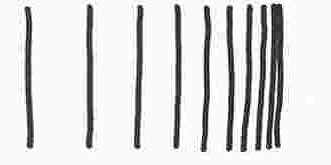
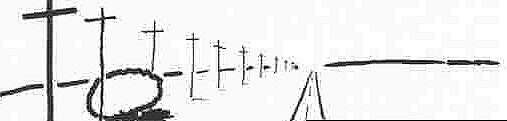
The lines are all the same size and color. But with a little imagination, you can convince yourself that they are receding to the right; the right-most line is farthest away from you. Of course the lines are not getting smaller, but the spaces between the lines are getting smaller, which is enough to give you a clue. Of course, it is easier if there are other clues to distance, like this:
There is another clue to depth called "convergence~" The eyes are a finite distance apart. Relaxed, they point in a parallel direction, or even diverge slightly. When they are looking at something several yards or more away, the eyes are effectively parallel. However, since the eyes are a finite distance apart, when the object is brought closer, the eyes, if they are to continue to look at the same point of the object, can no longer point parallel; they must point inward. And the amount they point inward increases as the object comes closer. The perception of the increased tension of the muscles away from their relaxed position is interpreted as seeing the object closer at hand.
Mathematically, the eyes are dealing with information that would permit them to locate an object by triangulation. we have learned the distance between our eyes, we detect the angle they are pointing inward from parallel and then calculate the distance to the ob~ect. In fact, the mind is doing nothing of the kind.
Take a three dimensional scene. Make the scene some abstract design that does not give you clues about what should be close and what should be far. A landscape will not do, since it provides clues that are very powerful. Take two pictures of the scene, photographs or line drawings. Take the two pictures from positions that are close to each other and side by side. Now put the pictures in a device so that one of your eyes looks at one picture and the other eye looks at the other picture. Now you will have to talk to yourself a little and train you eyes. Things that are superimposed when your eyes are relaxed, you must say to yourself, "'rhese things are far away." Things that are superimposed only when you converge your eyes. you say, "These things are close to me." Co back and forth a few times and at last your eyes will be able to '15ee1' it. You will perceive the scene as a three dimensional space.
Now rotate the two pictures one hundred eighty degrees. The scene looks upside down, but no matter, it is an abstract picture anyway. Now things your eyes were relaxed looking at before require convergence. Things that were close together you see with your eyes relaxed. You have turned the scene front to back. What was far away is now close. of course, once more you will have to talk to yourself, train your eyes to perceive the new apparent reality.
Now, and this part is fun, rotate the pictures ninety degrees. Some objects now superimpose nicely with the eyes relaxed and parallel. However, there will be other objects that your eyes can see as two superimposed images only if one eye looks slightly up and the other down. The eyes are now not pointing at any point in real space at all. However, with a little talking, you will once again perceive a three dimensional space even though geometrically none exists. By now, you also probably have a headache and need to spend a while in a dark room with a cold compress on your forehead recovering from eye strain.
Now let us consider our parallel vertical lines again. Number them left to right one, two, three and so forth.
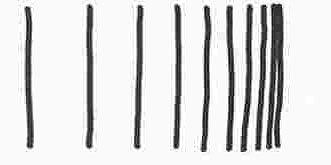
As we remarked before, the fact that the spaces get smaller going to the right gives you a clue that the right side is farther away. But suppose the universe of what we can see consists only of those lines. The lines are all identical and there are no numbers to guide us. Furthermore, the array of lines is wider than our field of vision. Now, when one eye looks at a line, say *3, the other eye has no sure way of knowing which line to look at. Jf that eye looks at #3 also, convergence will give no clues to depth, and the only clue will be the closer spacing toward the right. The line will recede to the right.
But suppose the left eye looks at line #3 and the right eye looks at line #4. Now the glance shifts toward the right. The left eye looks at line #4 and the right eye at line #5. But the space between #4 and #5 is smaller than the space between #3 and #4. The eyes will have to converge to keep the images of the lines superimposed. The mind will, with a little encouragement, accept this as a sign that the right side is closer than the left. The array of lines now recedes toward the left.
What is worse, consider an array of authentic parallel lines on a flat page. Turn the page at an angle so the left side of the page is closer to your eyes than the right side. Now the spaces between lines get smaller going toward the right because they are actually farther from you. But now let your eyes relax so that the left eye looks at line #3 and the right at #4.
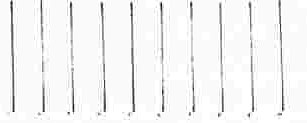
The left eye at *4 and the right at ~5 and so forth right across the page. Now, by rights, even though the page really is receding to your right, you should be able to persuade yourself that you see it receding toward the left.
And that, I think, should be a very easy experiment.
So there are different kinds of speculation. Speculations vary not only in the likelihood that they are true but equally importantly in the nature of the evidence that might be brought to bear to verify or refute them.
Booty
Editor's Note:
Wild Surmise is an occasional newsletter on speculative matter. Over the past year, the occasions have become rather infrequent. This issue we are adding a new group to the mailing list, mostly editors, literary agents and members of the Harvard Club (about fifty in each category selected generally at random from among thousands). Don't bother with a rejection slip; this is just for your amusement. This will be the last time we start sending this to somebody unless he requests it.
After a long spell of inactivity, the gang got together and went skiing at Aspen this winter. old Moneybags, our esteemed sponsor decided that financial ruin was upon him at last and went on a bread and water fast; no harm in that, Colorado bread and water are better than Florida bread and water anyway. Booty discovered to his delight that it is possible to come down a chair lift if you grovel and whine long enough. The beautiful official laboratory assistant spent her time skimming over the snow like a sparrow or hovering near one fallen staff member or the other asking, "Are you all right? Cooter, our silent artist, spent his time gazing at the snow conjuring up images in white on white. M announced at the end that he was really impressed with the mountain and how much punishment it could take. Said he spent days hitting that mountain as hard as he could with all his weight hour after hour, but it never broke, never fell over, in fact was never knocked an inch out of line. They all came back with sweat shirts emblazoned with black diamonds and the boast "No guts: No glory." only Booty's shirt had been altered to read, "No guts." M's had been altered to read, "No glory."
Next issue, some time in a few months, as M would say, "Lord willin' an' the crick don't rise," Booty will talk about materialism.
Ed
copyright April, 1988 WILD SURMISE
Survival Kit
It is just possible that the dwindling number of Wild Surmises coming out has left somebody with some free time. We have put our heads together to see if we could correct the situation. One possibility would be we all get to work here and give you the good old monthly issues. That didn't fly. Old Money bags screamed and fainted, woke up, screamed and fainted again.
The beautiful laboratory assistant then said that anyone with any free time could go look at manatees.
M says that there is a new comic strip out called 11Calvin and Hobbes." It bids fair to become one of that tiny group: the truly great comic strips (like Bloom County). It is about a little boy and his toy tiger. The title suggest that there is a theological and philosophical drama being carried out behind the veil. We have not figured it out but do not discount the possibility. Even so, it is a vividly honest description of childhood, its realities and its fantasies.
Booty says that if you want to see really serious writing, seriously consider looking at the Economist. I think they won his heart with the remark that Japanese performance continues to demolish Western preconceptions "like a dogma run over by a karma."
Cooter doesn't talk much, but he did scribble down a note:
A young lady was introduced to Mr. Hefner. She said, "Is it really Hugh, Or just a pigment of my imagination?"
So Booty and I and the Devastatingly Beautiful Official Wild Surmise Laboratory Assistant did a video tape of Booty doing a lecture on tirne running backwards. Starring me, Edgar, or course. The tape runs about thirty minutes. We figure we can get copies made and sent out for about $25 each. However, the laws are pretty strict about what you can do through the mail, so we don't want to make an offer we can't back up. If a whole bunch of you sent money and we couldn't get good copies made it would be a mess. Likewise, if we make a slew of copies and nobody wanted them (understandable: you can get a professional grade movie on tape for that kind of money) it would be awkward. So here is the pitch. If you think you want a copy of the tape, drop us a note. If we think we can get a tape to you, we'll write you a note saying send us the 25. Then AND NOT BEFORE send us the money and we'll send a copy of the tape to you.
This makes it very inconvenient for you, but it looks like the best way to keep from separating anybody from his money without a reasonable good expectation of the prompt arrival of the tape.
0 yes. It's on regular VHS, U.S. style format.
Ed (Edgar Poe Raven)
MILD SURPRISE
The needle had stuck in my finger while I was mending my grandfather's red gabardine shirt. I hadn't felt it.
Grandfather used to wear the shirt when he went fishing on Pawley's Island. Never caught any fish. He just liked to chat, and figured one fisherman needed no introduction to another. Ten years after his death, it was still my favorite shirt. Neither the corrosion of the salt and sun and sand of the South Carolina shore, nor the grime and wind of a long motorcycle tour of Europe had faded its deep color or frayed its tough threads. But the buttons were coming loose. I sat that sunny morning on the stone steps of Pelligrino's hostel deep in the inward parts of Rome eternal and sewed. My big old English 'rriumph motorcycle perched on its center stand a few yards away. Beside it slouched Al's Triumph on its kick stand; he had the hide of a Scottish deer over his seat. Stev S red zundap - he called it Rosenante - and Dug's zundap - he had bought it the night before - stood together a few feet farther on.
Stev was the romantic. Stev of the big grin. He had worked as a lumberjack in Idaho. They had made him straw boss in spite of his youth. He was not short of muscle. He hated cigarettes; was known when upset to take a person's cigarette and crush it between his fingers. I only did that myself if I was showing off. Stev who could not smell. Stev who never went anywhere without a guitar and something to eat; ready for any emergency. He named his motorcycle Rosenante after the horse Don Quixote rode. Dug named his Lazarus after the beggar.
The little zundaps regarded the hoary English motors with cyclopean indifference. Together, the nine of us made a gang; that's four motorcycles, four drivers and Jo, my bird.
She had set the adventure up. Mostly, she wanted to travel with Stev, but since mine was the only motor that could be expected reliably to carry two she worked it out that she and I would drive to Athens, where I had an appointment a few weeks hence, and the others would come along for the company. She asked me to drive her up a hill she knew near town where we could look out over the town, and as we watched the amber Tiber glide and the twilight darken over Rome, the bargain was struck. I was delighted. I never had a girl go motorcycling with me before.
So it was in a mellow mood that I stitched down the buttons next rnorning and was surprised to learn that the needle did not hurt; nor did the finger bleed. I understand that people with very bad emotional problems will mutilate themselves. No doubt, it is not because they enjoy hurting, but they are rather interested in how little it matters. Their own indifference to pain surprises them, and so they pursue it.
In a comparable frame of mind, I proceeded to bury the entire needle in the palm of my hand. The callous was so thick from months of driving that you could only tell the needle was there from a low little ridge that it raised. I shrugged, pulled the needle back out and went on with my mending. But you must understand that my hands were very rough and calloused.
We lost Al the first day out. His clutch began to smoke, and we all pulled off for a powwow. He'd complained about his clutch ever since Genoa, where I'd met him. He had looked into getting it fixed in Rome, but the price had been too much. So we all sat down beside the road, pooled our tools and watched Al take his clutch apart. The clutch was housed in a little aluminum case near the gear shift pedal. Once it was apart, you could see it consisted of a stack of metal discs with little cork plugs that supplied the friction. Several of the corks were scorched, and some had burnt away. Dug pointed out that it was supposed to be filled with oil, the whole clutch casing. That was why it had burnt out it the first place. Al had not put any oil in it since he had left Scotland.
We suggested putting in some oil, but Al thought that would only make it slip more. Had I to do it again, I am sure I would have pushed the idea of oiling it, but instead I stood back and watched the others reassemble the clutch and then tighten it down so that it could not sli~p. Then we put Al on his motorcycle, had him crank his engine, pushed him down the road and let him shift into gear. He clapped down the visor of his helmet and roared off down the road back to Rome.
He made it alive, for I saw him again months later. He picked his way through that stupefying Rome rush hour traffic, spent the money to get the clutch rebuilt, and then burned out a cylinder trying to catch up with the rest of us. Still, I have seldom felt worse about something than I did about letting Al drive off alone on that crippled machine.
So it was with three divers and three motors, one carrying a bird, that we arrived in Naples. From there we turned east across Italy to Brindisi. We crossed mountains on roads so steep that the zundaps would have to stop and the drivers run along side them up the hills. We stopped in crowded little eating places were people were happy to share their tables with grimy motorcyclists. We ate simple food and drank sparingly of the rich red Italian wine. Fine to drink of an evening, but lethal on the road.
There was the night we camped by the sea. We slewed along miles of sandy dirt road to get to the beach. And there rolled out our sleeping bags. Jo didn't have one, so I gallantly offered her mine. I would just put on a few extra sweaters and sleep in the sand. Eventually, the others got tired of listening to my teeth chatter and ordered me to get into the sleeping bag with Jo, and they promised I would behave myself or they would throw me out again. I behaved.
There was the time Dug stopped at a little roadside shop for cigarettes. There was no door to the shop, just some plastic tapes hanging down in the doorway. Dug went into the shop politely enough, but he forgot to take his motorcycle off. Now you can go into a shop in boots, and you can go into a shop in your helmet, but shop keepers frown on your wearing your motorcycle, even if it's just a little zundap. Re got his cigarettes anyway.
There was the time I broke a drive chain. It snapped in heavy dirt, and was thrown into the bottdrn of the chain guard, where it ran under the rear sprocket in a wad that tore the chain guard up. I had a spare master link in my pocket that I had picked up in Spain, and fixing the chain guard turned out to be less of a problem than you would think, nothing like the time one of the mufflers eviscerated itself, but the real problem was rethreading the chain through the gear box. I finally did it, lying on my back in grease mired sand and using a coat hanger that Stev produced from some source I never learned. I thought I would never be clean again, and perhaps never will be.
But the weather was sweet, the local people cheered us at every turn, and the motors kept on burning. So we came by adventure to the city of Brindisi.
A brief scouting mission proved that although we might be able to afford births on the Phaedra, a sleek tourist ship bound for Athens, we could never afford to have our bikes crated and shipped. On the other hand, the Aggelica was willing to take the motorcycles in the hold and we could travel in steerage virtually for free. The choice was easily made.
They had a steam winch to load us. One of us would pull his bike up on the dock. They would lower a platform with the winch. He would drive on and kill his engine. (They didn't want an engine running in the hold.) And they would lower driver and cycle together. Down below stevedores helped muscle the machine to a wall and lash it in place. I remember looking down on the top of Dug's head as he dropped into the blackness of the bold, the wooden platform bending visibly beneath him and thinking, "There is a brave man." This time it was my memory that failed. I was next.
You can see the Aggelica if you want to. The Anthony Quinn movie Zorba the Creek includes a trip in the Aggelica. Only Zorba and his boss traveled second class. We traveled steerage. flown with the pigs, chickens and women in black dresses right a water level. We were lucky in getting aboard in Italy. Steerage was almost empty. we found a little platform about seven feet on a side where we could roll out our sleeping bags. As we island hopped, more people and more animals got aboard until the floor was covered. To move about, you had to entreat one person after another to move over or lean aside so you could step over. It was all very friendly, and we were in no hurry.
The Aggelica was actually built in the Northwest around Oregon for hauling timber. She was a shallow draft vessel and rolled on a dead calm sea, which we were fortunate enough to have. This was close the the spring equinox, the traditional halcyon season, and it was true to its name. I believe in the movie, they had a storm that would have sent waves into steerage as high as our sleeping platform five feet off the deck, an woe betide our smiling peasant friends then.
One day Dug sat up suddenly and announced, "Today is my birthday. I need a birthday present."
"Happy Birthday!" we all cheered.
"No," said Dug. "That won't do." He reached over and opened his back pack. Now I had traveled beside that backpack as it perched on the back of his Zundap for many miles and many days and expected it to contain nothing I hadn't seen. But out if it he pulled a wad a fawn colored material, a shapeless wrinkled mass. He frowned and shook it, and a few wrinkles fell out. He shook it again, and the outlines of a suit materialized. After a few more shakes, he was holding the niftiest fawn colored suit you ever want to see. He grabbed a couple other things out of his bag an vanished.
An hour later, Dug returned, dressed in a fawn suit with an apricot ascot and tan shoes. "I broke into a first class cabin," he explained, "And took a shower.1' He tossed his hairbrush into the pack. "Now I'm off to get my birthday present.'1 He hoisted the pack and made his way back through the animals and people, smiling and nodding. I suspect he found some young lady in first class who decided it would be a pity to send this splendid creature back to steerage1 and he spent the night in her cabin. At all events, we didn't see him again until the ship was at dock side in Piraicus, when he turned up in grimy driving duds ready to join us for the drive to Athens.
That night it was hot in steerage. I do not know who first suggested it, but the idea grew that we should slip up on deck and find a life boat to sleep in. We had made friends with the sailors, who came by with silly little coffee cups in their big hands. And we had met the captain. I used some days to play cowboys with the daptain's son. So we were not likely to get arrested even if there turned out to be some rule against sleeping in the boats.
The night was dark and cool. As the Aggelica resolutely pressed her peregrination among the legended isles, the rich air of the Agean flowed over the boat, reaching down seraphic caresses to the three 6f us so long strangers to luxury of bed and shower. The thicker sleeping bag lay unfolded beneath us and the lighter one covered us. My mind dwelt on Jo, the strange silent girl who had traveled with us so far, perched like a bird on the back of my big motorcycle, always ready with advice for navigation seldorn volunteering anything.
A motorcycle is not an easy thing to handle, and the amount of trust a passenger must have for the driver, the amount of danger the passenger endures at the drivers decision is tremendous. Yet she never complained. I reached my arm casually around her shoulders and was rewarded with the touch of a gentle hand. I folded the hand in mine and went into a dreamy sort of dose. I remember Stev and Jo were talking at the time, laying plans for what we would all do when we reached Athens. The place to stay was going to be in the shadow of the Acropolis. We would have to learn new words for food and shelter and money. We already knew yes and no.
I do not know at what point in the conversation Jo decided to roll over on her side, but I do know it was then that Stev and I realized we were holding each others hands.
They~ve been married for many years now, Stev and Jo. He has always regarded our mistake as a lot funnier than I thought it was at the time.
M