WILD SURMISE
DECEMBER 1986 #11
AN ALMOST ANONYMOUS INFORMAL NOTE
SAIL
Safety, of course, is the single most important issue on the water. That is not because the water is particularly dangerous; many city streets and many swampy, mountainous or ice clad terrains involve much greater risk, hour by hour. Rather safety on the water is important because it is the only issue. Barring accident, loss of the craft, running out of supplies or being boarded by pirates, the boat will continue to make progress, if only by running up a little sail or putting out a paddle. It helps not to get lost, of course, but even lost, a boat will eventually find help. If the navigator continues to want to make progress, progress he will make. If he stops wanting to get there, then it no longer matters whether he gets there or not.
A sail boat has an advantage over any other vehicle. It has a power source that is inexhaustible. The boat itself only takes advantage of the energy available as one fluid moves over another, air over water. Running out of fuel. Getting too tired to carry
on. Having a pack animal die. Having a tire blow out. These are not things that worry a sailor. Give him a well found boat and he will sail around the world.
So let us say that you have a sail boat. The boat offers you most of the world as your playground, have you but the interest. You think of your boat as good. Perhaps you think your boat is very good. By implication, some boats are better than others. What, then, is a good boat? The first answer must be a boat that makes efficient use of the energy available. The boat must be fast, given the wind conditions. The best boat must be the fastest. It is on this assumption that races (they call them regattas) are arranged. Boats of similar design race over a defined course.
Exactly what constitutes "similar design" is a field in itself. The America's Cup races already under way in Fremantle are run with boats called "12 meter" yachts. "12 meters" only roughly means that the boat is that long. It is shorthand for a boat that has certain specifications. There is a formula: the length of the boat measured at a level 18 centimeters above the waterline PLUS twice the distance frow the edge of the deck at the mid fore-and-aft level of the boat to a point on the keel fifteen meters below the waterline as you would measure it with a tape on the skin of the boat MINUS twice the distance back to the deck if you now pulled the tape tight so it took the shortest available distance MINUS the height of the deck over the waterline PLUS the square root of the sail area - the resulting sum (all measurements in meters) divided by 2.37 must equal 12. I understand the commentary on the rule now runs for many pages. The rule permits variation. You can have a longer boat (Longer boats are faster.) but then you must carry less sail. You may have dramatic concave sides on the boat (meaning less water displaced and hence a lighter boat), but then you must have a higher freeboard, the distance from the deck to the water. (Higher freeboard means more air resistance.) An ideal formula should render all boats equal1 so that the race is not boat against boat, but crew against crew. Since formulae are not ideal, the race is boat against boat, crew against crew and boat against formula.
Let us imagine a lenient formula, restricting only overall lenyth1 and see how fast we can mak a boat sail. Given only a restriction on length, we have no choice, we must build a catamaran. The catamaran consists of two thin, blade-like hulls side by side, each as long as the rule permits. The hulls are joined by a long light bridge. The resulting craft is very stable; it will carry an enormous amount of sail without leaning over. Thus it is fast, so fast in fact that it slams through waves at a speed that will shake your fillings loose.
'rhe trouble with a two or three hulled boat is that it is stable both upside down and right side up. If a boat with a keel is turned upside down by a gigantic hand (or a gigantic wave), it will ship a lot of water, but it will soon right itself. If the crew is safe inside, they rnay be shaken about, but they will be able to get out and use the boat again. Turn a multi-hulled boat over and it stays there until an equally powerful force flips it over again. Any crew inside an inverted multi-hull will be very unhappy.
Thus, accepting safety as a prime issue, there is good cause to ban multi-hulls from competition, or at least to make a category so that they only compete against each other.
Even faster than the multi-hull, if you ask me, would be a boat that skimmed along on water skis. However, this craft would only work under conditions of high wind and few waves. At other times, it would revert to being either a conventional multi-hull (dangerous) or a conventional mono-hull. The conventional mono-hull, however, gets its stability from a deep keel. If the keel does not clear with water, the boat will not skim on skis. If the keel does clear the water, the boat will have to be so high as to be very unstable.
Our ideal boat must be a mono-hull, getting its stability from a deep, heavy keel and from the shape of the hull. The design must be able to run before the wind (straight downwind), to reach across perpendicular to the wind and to beat against the wind. I have heard that boats can be made to move straight into the wind; consider putting a giant windmill on the boat that powered a generator that ran an electric motor that ran a propellor. Such a device might go straight into the wind. (It is not a perpetual motion device; it stops if the wind stops.) We can all decide whether it is really a sail boat after somebody gets it to work.
Consider the boat reaching across the wind. The wind sweeps around the outside of the sail and around the inside. Since the air going around the outside is faster, a partial vacuum is created. The vacuum provides a force sucking the sail in the direction of its convex curve.
Perhaps it is not clear why moving air should create a vacuum-Suppose a line of tennis balls is rolling along a flat surface. Each ball is something over two inches in diameter and each is something over three inches in front of the next ball as they roll along, all in a straight line like a file of Indians. They are rolling at one foot per second, so two balls pass any given point along their path in any given second. Introduce the mad thumper; he kneels astride the line of balls, and as each ball goes by, gives that ball a thump, speeding it on its way at twenty feet per second. Farther along, where the balls are whizzing by, the balls still pass at two per second, but they are several feet apart; the mad thumper has created a relative vacuum in the direction in which he is thumping the balls. It is this vacuum that propels our boat on a beam reach. It is also one of three reasons that the breeze from a fan feels cool. (The other two reasons are that the fan moves air that your hand has warmed away, replacing it with non-warmed air, and that the moving air increases the evaporation rate.)
Now that we know why moving air produces a vacuum, I will propose an aircraft as a test of the theory. Imagine a jet airplane that consists of a cockpit with two turbo jet engines, one on either side. Each engine consists of a compressor (which draws air in), a combustion chamber (into which fuel is pumped and burned), a turbine (spun by the hot gases from the combustion chamber and mounted on a shaft which, in turn, turns the turbine) and an afterburner (into which fuel may be pumped for quick bursts of speed). Add to each engine a pipe, maybe eight or ten feet long and a couple feet in diameter. Air leaving the engine goes straight through the pipe before leaving the back of the craft.
The roof (the top half) of the pipe can be removed, either by telescoping it forward over the afterburner, sliding it back, or rotating it so that it slides inside the bottom half. Now with the top half of the pipe removed and the engine on, the bottom of the pipe faces a partial vacuum. This vacuum is enough to lift the plane straight up into the air. Since the jet exhaust will tend to make the plane drift forward, the plane needs to be parked in a gentle nose-up position, so that the lift frorn the pipe pulls slightly back to balance the jet thrust.
Two horizontal elevators are placed, one at the intake of each jet. They are used to raise and lower the nose as the craft hovers as well as to roll it toward the left and right. To have the plane yaw (turn) to left and right, one or the other jet engine is given increased power. As the craft reaches altitude, the top of the pipe is slowly replaced and the nose lowered and the machine speeds away horizontally.
You can now remove the wings with their flaps and spoilers, the vertical stabilizer and rudder, the horizontal stabilizer and elevators and the landing gear. Since the machine does not need to deal with hard landings or with sudden forces on wings with long lever arms, the whole structure can be made lighter. On the other hand, one should build in a very good ejection seat and provide that if the pilot does eject, the craft comes down by parachute as well; this machine will not glide.
The craft will also be very unstable, tending to roll, spin or tumble out of control. An onboard computer.will be needed to make it safe to fly.
To the bottom of this craft, you may attach a float, a larger aircraft, a fuel tank, weapons, a machine to be transported, a compartment full of people, a ram jet or a rocket. You can attach several of them to haul a particularly heavy load such as a module for a build-it-at-sea air craft carrier or a space craft.
Of course there is already a vertical take-off and landing jet, the Harrier. The Harrier, however, uses the reaction from jet exhaust, not lift, to get into the air. Thus it is troubled with a fairly 19w payload; a Tomcat fighter carries as much weight in weapons as a Harrier weighs fully loaded with weapons and fuel. The Tomcat also flies about three times as fast; the Harrier cannot fly supersonic because it has oversized air intake ducts for its jet engine. These ducts let the engine breathe at zero forward speed, but at the sound barrier they produce enough drag to keep the machine from going any faster. This new machine will be able to hover even though the engines without forward speed will only develop a fraction of total power. One can pick up far more weight using aerodynamic lift than using the same power to push air straight down; that's why almost all airplanes take off by running down a runway rather than just going straight up.
M, who has just read the book, Yeager, insists I name this craft the "Yeager." That's just fine with me, provided somebody demonstrates that the contraption can actually be flown.
Good. The curve of the sail is pulling th boat forward. But the force of the wind also is tending to push the boat down wind. That downward drift is resisted by the keel or hull. So we must design a keel or hull that runs forward while resisting the force to the side. This is as much as to say that the keel or hull must develop lift in the direction of the wind as it is moving across the wind. It acts as an airfoil, or rather a hydrofoil.
If you look at the hull of an ancient sailing ship, or better yet look at the illustration of one in a fanciful children's book, you will be struck with the shape: Bluff stubby bows and a graceful tapered stern. The bow and stern are also very high, but ignore that. The shape of the craft at the water line is broad at the bow and tapered toward the stern. It approximated the tear drop shape of a standard airfoil. As the vessel starts to move across the wind, the wind pushes it somewhat sideways. There is a point somewhere downwind of the advancing point of the bow where the water divides, some going around the downwind side and the rest going around the upwind side. The upwind water must take a longer trip before it reaches the rudder, so it moves faster (relative to the boat) and developes the needed lift towards the wind.
Later sailing ships had more highly developed keels, so the action took place below the surface, and the shape of the bow began to look more tapered. The classical racing yacht was very narrow, tapered at the bow and stern and designed to slip through the water with the minimum of resistance. It depended on the keel alone to keep it from drifting sideways down wind.
The classical racing yacht also depended strictly on the weight of the keel to keep it upright. The keel, of course, was kept light in order for the yacht to ride high and again reduce resistance. The result was a boat that lay right over on its side (its "beam ends") when the wind struck it from the side (beam, to you old salts.) As the boat approached this position, the convex curve of the sail was pointed mostly straight down toward the water. This the lift of the sail tended to tilt the boat even farther.
The resulting sight was beautiful: A slender, tapered hull, usually of natural wood, careened way over its beam, great white sails dipping low toward the water, a feather of spray glancing off the bow. Since the boat could not make much headway in this position, you could also watch it a long long time.
Then, alas, people decided to try to win the race. Boats were built beamier. They held their masts up straighter, and generally went faster. Modern hull design calls for a hull that is sharp at the bow and broad and rounded at the stern. It "knifes in on the bow and planes off on the stern." A brief glance at the shape of the waterline shows you what they have done. Of course, it looks like a tear drop again, only now going backwards, sharp end first. No harm in that, of course; an air foil or hydro foil works backwards just as well as forwards. On the other hand, the pointed end of the hydro foil seems like a good place to put the rudder, so we will design our boat with a blunt bow and a sharp stern with the rudder acting as an extension of the stern.
There is one other possibility that would be great if you could figure out how it would work, but first a word about left and right. In the earliest ships, the stern was pointed, partly for the reasons we have described and partly because it was easier to beach a boat with a pointed stern; waves didn't get in so readily. In those times, instead of a rudder, steering was done with an oar put over the side. Since most people are right handed, the oar was put over the right side so it could be handled with the right hand. This is the "steer board" or starboard side of a craft. The other side was the side brought up against the pier or the port, if you were lucky enough not to have to beach the craft. Obviously, you kept your steering oar side away from the pier, so you could still steer. The left side of the boat, facing forward, is the port side. Since the helmsman is expected to be on the starboard side, a green light is placed on the starboard side at night announcing that the helmsman will keep his eyes open and avoid anyone who approaches from that direction. A red light is put on the other side, indicating that that side is not visible from the helm and others must stay clear.
Now suppose we have a wind from the port side. The boat heels over toward the starboard side. In this position, the hull - the wet part of the hull - should ideally be shaped like an air foil with its lift toward the port side. A non-symmetrical air foil or hydro foil can be made much more efficient than one that has to be used in both directions. Then when the boat heels to port, the part of the hull that is now under water - a different part of the hull, of course - should develop lift to starboard. Such a shape can be made, of course. But if you take the same hull and try to run down wind, both sides will now develop lift downward, and the boat will try to bury itself in the water.
What you would prefer is a boat that gets up and skims on the surface when running before the wind but develops lift into the wind when it is on its side. If you can to that, fame and fortune await. Or at least, if not fame and fortune, a chance to write a letter to wild Surmise.
So our hull consists of a blunt bow and a sharp stern ending with the rudder (which we will call the hull rudder). It is the hydrodynamic shape of the hull, not the keel, that will keep the boat from drifting to leeward (down wind.) The keel is just to keep the boat upright.
The part of the keel just below the hull should be thin, blade like, producing no lift. Any lift toward windward produced by this part of the keel will tend to increase the boat's tendency to tilt to its side, to list. This thin plate-like keel should extend the entire length of the hull, to keep high pressure water from the leeward side of the hull from escaping under the hull to the lower pressure windward side.
Then we get to the bottom of the keel. The 12 meter America's Cup racers have a sort of wing on the keel. Just what that wing is supposed to do, I do not know; perhaps it lifts the boat a couple inches out of the water to lower water resistance. In other boats, standard technology now calls for a slab of lead or, hang the expense, a slab of uranium. The weight of the foot of the keel will keep the boat more-or-less upright. After all, this ballast is at the end of a fair lever arm. Somehow it seems a pity just to pile on weight to keep the boat straight. Put some weight down there, indeed, enough to right the boat promptly if the wind is not bearing it down. But what we really want is for the foot of the keel to develop lift to leeward. If we can do that, we can keep the boat straight up and down even with a strong wind abeam. All it needs is another rudder projecting from the foot of the keel, the keel rudder.
The Achilles' heel of any air foil is the end. Places like the tip of an airplane wing, where air from below the wind swirls up to the low pressure area above the wing, making a vortex. A rudder placed on the sharp trailing edge of the hull can be tapered so that it does not produce a vortex. The rudder at the bottom of the keel presents a problem. It will produce a lot of vortex unless protected. One way to protect it is to have the blade-like part of the keel end with a flat horizontal plate. Below this is the keel rudder, a vertical hydro foil, blunt at the bow and and tapered at the stern. It pivots around its center rather than around its leading edge, so that control forces are not excessive. At the bottom of the hydrofoil is another horizontal plate. The two plates should eliminate any vortexes. The keel rudder is controlled by a wheel at the helm. This wheel should be somewhat smaller than the wheel for the hull rudder and mounted on the same axis. The helmsman thus has the task of maintaining the heading of the boat with one wheel and keeping it upright with the other wheel.
Keeping the boat upright this way solves a problem and creates a problem. The solved problem is with the hull rudder. In an ordinary boat, the hull rudder acts to turn the boat to port and starboard. But when the boat is listing hard over to port or starboard, the rudder also tends to force the bow up and down. At some point, the rudder loses its ability to control the craft at all, and the boat is "knocked down, which is to say that it swings uncontrollably into the wind, if it is a well designed boat, or capsizes if it is not. Keeping the boat vertical means that the rudder continues to be effective. There are boats in which provision is made to pivot the rudder post itself, so that the rudder is always vertical and remains effective. we will just keep the whole craft vertical.
The created problem is this. The weight of the keel not only tends to keep the boat from leaning to leeward, it also reduces the amount that the bow pitches up and down. By reducing the weight of the keel, we have increased the amount the boat pitches.
In the America's Cup trials now being run at Fremantle, the size of the waves (is or will be when the wind kicks up) and the length of the ten meter yachts is such that a boat goes over one wave and goes crashing through the next, going over one and crashing through one for all the world like the warp weaving with the weft. That can't be the best way to do it.
To stabilize the pitching of the boat, put in another hydro foil, right up at the bow. The hydro foil should be horizontal, with the usual plates at the ends. It is controlled by yet a third wheel at the helm. The helmsman can use his third arm, or have an assistant. Jf he plays the wheel right, he can stabilize the boat. He can even recover a little of the energy of the pitching of the boat and turn it into forward progress. To do this, he angles his bow hydroplane up slightly when the bow is rising and down slightly when the bow is dropping. Someone has even invented a boat that travels on this principle alone, making progress as long as there are waves about it.
The deck of a modern racing boat is smooth and flat, encumbered by little more than a few ventilators and life lines to keep the crew from being swept overboard as they go scrambling about changing sails. It would be better to clear the decks completely. No life lines. Instead, there will be a long thin well in the fore deck where the crew will stand while working with the jib. As soon as they are done, they duck and pull a lid over the well, restoring the smooth surface of the boat. The cockpit behind the mast is another well, where the crew can work with the main sail. When they are not working on the main sail, a lid is drawn over that, too. The helmsman stands in a bubble of his own, where he can reach the triple wheel, see all around, and see his instruments. Vent openings are flush with the deck, air being drawn in by fan.
Cockpit instruments include such things as magnetic and gyrocompass. Wind and water speed. wind and water temperature. Wind and water direction. Strain gauges on the rigging and keel. Setting indicators for all three rudders as well as for the sails. Satellite navigation. Depth gauge. Video display of relevant charts with the boats position, including depth charts, navigational markers, other boats seen on radar, tidal currents. Computer suggestion for best heading and sail settings to reach goal. Computer suggestion for best way to out-fox the nearest competitor. Radio phone and intercom to rest of the boat. Clock. Read out of remaining grog and so forth.
Before going on to sail design, there seems to be an unused loop hole in the America's Cup formula. Boat speed is generally limited by the length at the water line. Since the formula measures the length a few inches above the water line, there is an opportunity to cut a deep notch in the bow or stern and have a boat that is effectively a bigger boat although it measures to twelve meters by the formula. One trusts that such a ploy has been anticipated in the many pages of corranentary on the formula already on the books.
And then there is sail design. There is reasonable sail design and unreasonable sail design. consider the reasonable first.
The oldest sails, we believe, were square sails. There was a fairly short vertical mast and a long horizontal spar. From the spar hung the rectangular sail. This was an excellent design for going down wind. Going across the wind, it was not very good. The wind tended to hit the side of the sail and fold it up. The first known boat that was able to beat against the wind was the lateen rig. In this rig, the mast was very short, and the spar was set at a steep angle. Thus:
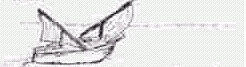
If the wind was on the ~ the spar kept the sail in place and the boat made substantial progress against the wind. They used to have two masts with the spars set at opposite angles. One sail was raised when the boat was on starboard tack and one when the boat was on port tack. Both sails, I suppose, went up when the boat was running before the wind.
Ungainly the lateen rig was, but effective. I like to think about how it was invented. Everyone had square sails, but one captain was such a slob he could not be bothered to keep his spar level. Then one day everyone noticed that this captain could sail closer to the wind than anyone else.
The lateen sail was first described in the Mediterranean, but I am not sure it was invented there. The Vikings were known to be the masters of sail in their age. No one knows what a Viking sail looked like. Those beautiful pictures of a square sail with vertical red and white stripes are only pictures of how people wish the Vikings looked. There are no surviving Viking sails, but there are a few hulls. One has a provision for the mast to be folded down into the boat, suggesting that the mast was very short. It also has crutches to support two spars. Two spars and a short mast makes me think of the lateen rig. Instantly I wondered whether the lateen rig had not, in fact, been invented by the Vikings. I wrote N's childhood hero Thor Heyerdahl and asked him what he thought.
Thor Heyerdahl had a few years previously crossed the Atlantic on a craft he called the Pa. It was a craft of papyrus reeds with a square sail. Mr. Heyerdahl answered my inquiry with a post card saying he hesitated to speculate on Viking sails, but the Ra, when going fast enough, could make progress against the wind, square sail and all. The picture on the card was the Ra on the high seas, beating against the wind.
Which all goes to show that, in a boat, the most important thing is wanting to get there. Being Thor Heyerdahl apparently helps. And if truth be known, if you put full battens (little stiffening boards) all the way across a square sail, it becomes a lot more tractable. It is the many battens that give the sail of the Chinese junk its characteristic appearance.
Modern racing boats are sloops. There is a single tall mast. A long horizontal boom extending out aft of the mast close to its bottom. A triangular main sail. A triangular jib, clipped onto the forestay than runs between the mast and the bow. Modern sail design is very advanced. The manufacturers understand that the sail is an airfoil and design it as such.
Now the best air foil, like a wing, has some thickness. Modern parachutes have two horizontal rectangles of cloth. These two layers are a few inches apart at the front and come together at the back. They are held together by vertical baffles and held apart by the air rushing into the opening in the front.
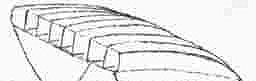
It would be easy enough to build a sail that worked the same way. But one would have to change sails every time one changed tack. So whether an inflating sail was worth having would depend on how often one was going to tack.
Possibly an inflatable pocket could be put on each side of the sail. When the boat is on port tack (wind coming from the port side), the starboard pocket is stretched out flat against the convex surface of the sail. The port pocket, crossing the concave side of the sail, is able to fill. In fact, the port pocket would then be too big and a zipper or lace would have to be used to tighten it down and give the sail its optimum shape. At all events, if we are seriously interested in getting speed out of a sail, full battens are a must, even on a sloop.
When running before the wind, modern sail boats use a great big jib or a sail called a spinnaker, which is basically an old fashioned parachute. More down wind speed could be gained by doing what they do with modern parachutes. Either put a lot of vents in the jib or use an inflatable air foil. If you choose an inflatable air foil, You can use the lift of the jib to pull the boat part way out of the water and decrease its water resistance.
Go on to the ridiculous design.
Hull as before. A single mast extending from the bow up and back at a forty five degree angle with the end over the stern. The mast rotates so that one side always faces the wind. An endless track runs up the leeward side of the mast, around the top and down the windward side to the bottom, then around to the leeward side.
Two spars run up and down that track. As a spar starts up the mast, if unfuris its sail, an inflatable air foil that is oriented to produce all of its lift upwards. The lift of the sail forcibly raises the spar, driving the boat forward. At the top, the sail is automatically furled and descends just as the next spar and sail start upward.
Well, now, something seems to be lacking, doesn't it? Fresh air, that's it. The crew is cowering in a wet and noisome hull. The helmsman is enclosed in a bubble, surrounded by high tech gadgets, taking orders from a computer and trying to do ten things at once, any one of which done wrong might drown everyone. Night just as well turn the whole job over to the computer and stay home.
The trouble is, of course, that we have lost track of what a "good" boat is. A good boat makes efficient use of the wind, indeed. But it also make efficient use of the crew and of itself. It should not be on the verge of catastrophe.
So let us list some catastrophes. Sinking. Getting lost. Fire. Running into things. Capsizing. Structural damage to the boat. Being hit by the boom. Falling overboard. (Don't stop to say "Person overboard." Say "Nan overboard;" then give her your most sincere apology when she is picked up again.) shipping water. Running aground. Swamping while beaching.
Some of these problems our design can deal with. Pack in enough flotation material, and a boat will not sink. Satellite navigation makes it hard to get lost. Fire hazard is reduced by proper choice of materials and good ventilation (although I think we had better go back to vents that don't require the electrical system to be working). Radar is a help at avoiding collisions. The heavy keel prevents permanent capsizing.
To reduce some of the other dangers, we will need to change our design.
Clearly we are going to have to give up the system with the spars zipping up and down the mast. Even if it could be made to work, it would be an invitation to disaster, either in the form of structural damage or someone getting hit. In fact, we ought to do away with the boom, too. Have a sloop rig, but leave the boom off. Put a couple of out-riggers off the stern and run the main sheets to them and; handle the main sail like the jib. (0, sorry. A halyard is a line that pulls a sail or anything else upward. A sheet is the line that holds the free corner of a sail in place.)
There is no sure way to prevent people from going overboard, but there are better things than a smooth, flush deck. A good stout rail all the way around the deck would seem like a reasonable precaution. Besides, it gives you a nice place to sit and look at the sunset. The sides of the boat should rise high enough from the water to give some protection from the waves, but there should be plenty of places to grab hold to the side of the boat and scramble aboard.
Of course there is no excuse for running ashore, but neither is there any denying that it happens. Having a keel with a hydrofoil on the leading edge is asking for trouble. Modern keels run ashore gracefully. The bottom curves away so that the boat rides up onto whatever it hits. It is a good way to get stuck. The deepest part of the keel ought to be the leading edge. That way if the boat hits something, it stops before all the weight is over the obstacle. Then it is easier to pull the boat back off.
Since we have given up the hydro foil on the front of the keel, we have a boat that tends to pitch its bow up when it hits a wave. We can control this, to a certain extent, by having the bow sweep down and forward, like the raw of an old Greek trireme galley. This also increases the efficiency of the hull. Without such a projection, the bow tends to go up as the boat develops forward speed, so that the boat is always climbing a hill. Modern supertankers are built with an enormous extension in front of the bow below the water line for just this reason.
Another way to deal with running aground is to have a boat with a shallow draft. The draft is the distance from the water level to the deepest part of the keel. In this part of the world, a sail boat with a shallow draught is called a "gunk holer.11 A gunk holer is able to explore gunk holes, romantic little bayous and estuaries where mangrove caress the clay with finger-like roots, where the egret struts and the spoonbill flaunts his roseate plumage. Where fish strike and manatee burble beside the hull. We call them gunk holes to keep the tourists out.
So we give up the keel altogether. Instead, we have a broad beamed boat, ballasted enough to be safe at sea, but without enough keel to hold close to the wind. Instead of a keel, we will use leeboards. A leeboard is like a centerboard except you have two, one on each side. When the wind is from port, you lower the starboard leeboard. Now you can shape your leeboard like a good asymmetrical hydrofoil, since it will not be in the water at all when you are going down wind.
And finally, we need to be able to beach the craft. You cannot beach an ordinary sail boat, since its deep keel keeps you away from the shore. If you run an ordinary motorboat bow up onto a shore, the waves will come in over the square stern and swamp the boat. You can't run it in stern first, because the weight of the motor keeps you from lifting the stern up onto the beach. If you run the bow of our sailboat onto a shore, the deepest part of the keel hits the shore first and the boat swings around sideways and ships water. So what we do is have the stern high, like the prow of an old fashioned sail boat. We beach the boat stern first, leaving the deep keel and the bow to breast the waves.
Now, of course, there is no place for the rudder. No problem, we steer with a steering oar where it belongs, over the starboard side of the stern.
Such a craft will probably not bring the America's Cup back to our shores. The craft that wins the cup will doubtless have the winged keel, the hull sharp in front and broad toward the stern, bow rudders computers, and all the other fads of the moment. Still, a boat with a high narrow stern and deep, broad, forward jutting bow, with a broad sail without the dangerous boom and with a shallow draft, in short a lazy boat for a lazy day, would have its charm.
Booty
Editor's Note: WILD SURMISE is an occasional newsletter on speculative matter. This is our Christmas issue, and a merry Christmas to you all. We will be skipping the January issue, so look for us again in February, when Booty will ponder the beginning and ending of things.
Many thanks to all of you for helping us stay anonymous. By now, we have said most of the things we were frantic to say, so we are somewhat less worried about retaining our anonymity. On the other hand, we've gotten used to it, and will continue the policy for the foreseeable future.
Since last month, I have been informed of the proper spelling of "Wissahickon."
N, as you may have guessed from Booty's article, has just read The Right Stuff. The rest of us found him reading the passage about the NF-104, which he declares is the most gripping story he has heard since his father read him, as a young child, the duel between Hector and Achilles. M was sitting there whispering, "Roll it, Chuck. You can get the nose down if you roll it."
"Trying to second guess Chuck Yeager, eh M?" asked moneybags in a supercilious tone.
"He can't get the nose of his plane down because the elevator is deflected," said M. "Why doesn't he roll it on its back and get the nose down that way?"
"Possibly," said Booty, "Because he is one of the world's great pilots and knows better than you."
M responded in his quiet dogmatic way, "If they had given the x-20 to Yeager instead of building the Mercury and Gemini systews, they would have had a useable space shuttle twenty years ago instead of maybe five years from now, and saved forty billion dollars at the same time."
"The X series," said Moneybags, "Put excessive demands on the pilot. )nly a few elite airmen could handle those beasts."
So M said, what's wrong with that, and Booty called him a racist, and Cooter and the beautiful laboratory assistant apparently thought that was unfair, because they wandered out to see if any of Moneybags' fruit trees were going to produce anything this fall.
Ed
Copyright December, 1986, WILD SURMISE
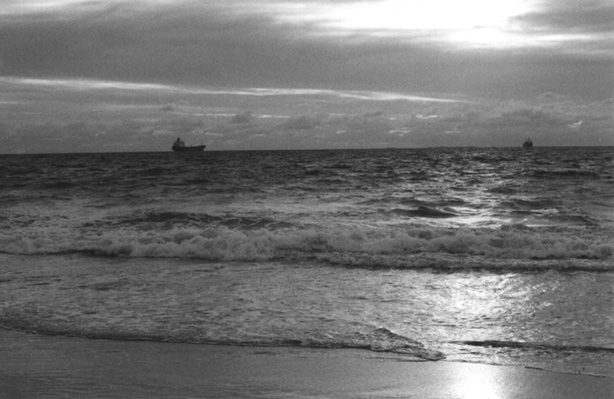
View Towards Rotnest Near Fremantle
MILD SURPRISE
(Fiction, by M))
The shadow of the hill top already lay on the quiet waters of the Straight of Hormuz. The mountains in Persia to the east showed red against a burnished blue sky. As the sun settled, the shadow would reach eastwards toward the far shore. Two thousand feet below my lookout, a last galley was toiling its way up the straights. Its course would make almost a complete circle around where I stood. It had come up from the south, hugging the shore, passed to the east of me and was even now moving due west in the shadows. Shortly, it would be drawn up on the beach for the night. In the morning, it would go on to the southwest before turning west and then northwest up toward Uruk, Babylon and the great Parthian empire to the north. The trade routes were a secret by which fortunes, empires rose and fell. Frankincense and myrrh from southern Arabia moved up the Persian Gulf into Mesopotamia as well as up the Red Sea to Egypt and flame. Spices came mostly from India, past the mdi's and up these straights or west along the Arabian coast to Aden and the Red sea. From this spot, you could see it happening, the galleys turning into the narrows while the sail boats continued along the coasts. We protected our secret well.
Faster and faster the shadow reached out, the edge moving at the speed of a galley, then at the speed of a bird. One moment the shadow had reached the far shore, and the mountains were luminous against the dark sky. The next moment the mountains were in darkness. In so little time the shadow had scaled a height that a man would toil all day to reach. At that distance, the shadow of the hill where I stood was very small. I turned west toward the setting sun and thought how, if the shadow was moving so fast, the sun, much farther away, must be moving much faster. Suddenly I had the sense of something vast.
My task was to check on the security of the trade route from Aden to Babylon. So far, all was well. I had but to take my leave of the men who guarded this headland, descend to the waters edge, identify myself to the captain of the galley and catch a ride. Before I did, I would watch the stars come out. First a planet, then a few bright stars. Then more and more stars until the night was filled with them, flashing and gleaming in many colors in the clear sky. From time to time a falling star streaked by. All was familiar. All was as it should be. The galley pulled up on shore. They spread out to camp and lit cook fires. I glanced one last time toward the east and noticed, high in the eastern sky, a tiny wisp of light. I thought it must be a cloud, and that could herald rain. I resolved to watch it.
It neither grew nor vanished, but moved always westward with the silent drift of stars. The night waned, and I stood upon the rock. But this new thing did not vanish until it was in the west, and the waning. moon came out and lit the night sky, so that the mystery vanished and I could see it no more. And yet I wondered what it could be. And it seemed to say to me, "Follow me." I made my way down to the waiting ship.
Many days the galley skimmed over the wine dark sea, the rowers dashing their oars into the rich foam. The officers moved about with a word of encouragement or a look of menace. The rigid rules that surround the ship in port are relaxed and the mood is quite casual when a galley is under way. I would chat with the relief rowers and learn their mood, where the rowing was hardest, what other places they had been. But when I raised the question of the wisp of light, that now every night could be seen high overhead, neither the boldest of the officers nor the most superstitious of the crew would speak of it.
We reached the mouth of the Euphrates, a marshy sea of reeds. Men hunted the white ibises from reed rafts or fished in the teeming fresh waters. The estuary stank of plough mud, and the flat treeless marsh was wearisome to the eye. We churned our way up the brown river past the ancient and deserted city of Ur and at length reached Uruk, where we unloaded. I took long farewell of the ship, speaking to each officer in turn. Arabic is a beautiful language, full of complex formulas and elaborate greetings and partings, most enjoyable for him who takes the time to speak it well. I spoke briefly with the import broker, who explained how he intended to arrange for the further transport of the myrrh and frankincense up river. His Arabic was terse, but he was cordial and efficient. Tenth generation import broker, he explained. Looking after imports was more than his life; it was his world.
I looked up the harbor master in his office overlooking the docks. He assured me that the channels were well marked and the docks were safe and commodious. He have me direction to the government offices. There we spoke only Persian. The bureaucrats of the Parthian empire made no attempt to speak Arabic. They asked me in a routine manner where the incense came from and listened straight faced to my outrageous answer. Arabs lie poorly. Unconstrained by fact, instinct turns us at once to poetry, which deceives no one. But their job was not to learn my secrets just as mine was not to tell them. They told me all I asked about the road to Babylon, and we parted friends in a blunt Persian way.
I bought camels, tall white dromedaries unmatched for speed and beauty, and taking leave of that most ancient city of Uruk, started up the river toward Babylon.
The people of the countryside spoke a gentle lilting language, soft compared to the blunt ways of the parthian conquerors. I rode for many miles through a grassy land rich with grain, moist with sweet water under sky that was an eternal spring. Perhaps envy crept over me when I compared this land to the harsh bare rocks of home, compared the way the women here bared their faces to the veils women wore at home to shield their faces from the corrosion of blowing sand, compared the number of young men with the few at home who survived the ceaseless tribal wars. I envied also the slow way history rolled past their doors, empire succeeding empire indeed, but at a decent interval of centuries. So it was that I was riding along scowling when a young girl of eight or ten signaled me to stop. I thought she might want help, but all she wanted was to give me a fistful of flowers to cheer me up. I tucked the flowers in a fold in my robe and went on, but if I frowned after that, it was only to keep my dignity.
Late that day I offered a ride to a young lad who was carrying a huge double armload of rushes. I took him as far as his home, where the family insisted I spend the night. They put me to bed early and got me up before dawn; courtesy required that a traveler not be delayed on his way. By mid morning, I had a collection of three or four little urchins who were hitching rides for various distances. We were going through marsh ground, glades of grass at times head high on either side and even closing overhead so that we were in a green tunnel. my came1s~ broad feet kept them from treeless marsh was wearisome to the eye. we churned our way up the brown river past the ancient and deserted city of Ur and at length reached Uruk, where we unloaded. I took long farewell of the ship, speaking to each officer in turn. Arabic is a beautiful language, full of complex formulas and elaborate greetings and partings, most enjoyable for him who takes the time to speak it well. I spoke briefly with the import broker, who explained how he intended to arrange for the further transport of the myrrh and frankincense up river. His Arabic was terse, but he was cordial and efficient. Tenth generation import broker, he explained. Looking after imports was more than his life; it was his world.
I looked up the harbor master in his office overlooking the docks. He assured me that the channels were well marked and the docks were safe and commodious. He have me direction to the government offices. There we spoke only Persian. trhe bureaucrats of the Parthian empire made no attempt to speak Arabic. They asked me in a routine manner where the incense came from and listened straight faced to my outrageous answer. Arabs lie poorly. Unconstrained by fact, instinct turns us at once to poetry, which deceives no one. But their job was not to learn my secrets just as mine was not to tell them. They told me all I asked about the road to Babylon, and we parted friends in a blunt Persian way.
I bought camels, tall white dromedaries unmatched for speed and beauty, and taking leave of that most ancient city of Uruk, started up the river toward Babylon.
The people of the countryside spoke a gentle lilting language, soft compared to the blunt ways of the parthian conquerors. I rode for many miles through a grassy land rich with grain, moist with sweet water under sky that was an eternal spring. Perhaps envy crept over me when I compared this land to the harsh bare rocks of home, compared the way the women here bared their faces to the veils women wore at home to shield their faces from the corrosion of blowing sand, compared the number of young men with the few at home who survived the ceaseless tribal wars. I envied also the slow way history rolled past their doors, empire succeeding empire indeed, but at a decent interval of centuries. So it was that I was riding along scowling when a young girl of eight or ten signaled me to stop. I thought she might want help, but all she wanted was to give me a fistful of flowers to cheer me up. I tucked the flowers in a fold in my robe and went on, but if I frowned after that, it was only to keep my dignity.
Late that day I offered a ride to a young lad who was carrying a huge double armload of rushes. I took him as far as his home, where the family insisted I spend the night. They put me to bed early and got me up before dawn; courtesy required that a traveler not be delayed on his way. By mid morning, I had a collection of three or four little urchins who were hitching rides for various distances. We were going through marsh ground, glades of grass at times head high on either side and even closing overhead so that we were in a green tunnel. my camels~ broad feet kept them from miring in the soft earth.
Then, as our tunnel intersected another, we met another animal. This animal was enormous, far bigger than even my camels. Its nose was a long trunk. The rider sat in a little house on its back. It was steered by a man, a mahout, that walked beside its head and nudged it and spoke to it. I knew what it was, although I had never seen an elephant before. It was a wonderfully fat animal and the old man who rode it was also quite fat. His skin was dark. His hands were folded over his portly belly, which rolled in a way that compounded the rolling of the great beast's back. We fell in together, side by side.
Presently he spoke in Arabic. "The beauty of light," I replied.
"The beauty of morning."
"The beauty of your Arabic language," be said in Persian.
"And the size of your animal," I said presently.
One of the children riding with me pulled my sleeve and pointed at the elephant, her eyes wide with appeal. I said, "I think you may have passengers."
"0 very well," he said. He spoke to the mahout, who spoke to the elephant, which casually reached across with its trunk, plucked the children one by one frorn the backs of my camels and lifted them to the little house-like howdah on its own back. For the rest of the day, we were in a constant round of loading and off-loading children and passing them back and forth. They looked out after each other and directed us through the marshes. The roads changed with every season, with every change in water level and with every whim of the river. Presently my new friend said, "For a merchant you travel light."
"Only inspecting the route as far as the city of Babylon," I said. "Our sources are limited, and a secure trade route has become more important to us."
"The times are, indeed, troubled," he said.
"And what brings you hither, my friend?
"My name is Baithazar. I am a Parsee from Taxila high on the Indus river close to the mountains of Cashmere. All my long life I have studied and watched the sky, scholar under the ancient empire of Bactria, although we Parsees still speak Persian. I traveled by boat down the Indus where the river wanders across plain devoid of hill or tree, not so green as this. When we reached the sea, I took this elephant and started west along the coast and so into Parthian territory. Then I followed the north shore of the Persian Gulf to the mouth of the river and now am going on to Babylon."
"Parsee," I said. "Then you worship fire.
"We hold fire in a certain veneration, yes. It is a very old tradition. But we no not worship it. The idolators proclaim that there are many gods or none; we have no quarrel with them. But we believe that there is only one Cod worthy of worship. As for the others, we respect them out of respect for others. If Arabs choose to worship stones, for instance..."
It was my turn to choose my words carefully. 'There are, indeed, a number of stones. Black square stones. And we treat them with respect. But no, we do not worship the stones themselves. 0, perhaps there are those among us who do. But we, too, believe in one true God."
Balthazar went on to speak of many things, how his people believed that there were two kinds of people, those of truth and the people of the lie. The people of truth were the modest industrious folk among whom we traveled. Those of the lie were pirates, raiders, murderers and thieves. He went on to imply that those of the lie included those who used the same strategy to gain wealth - those who dealt falsely, who exacted high interest rates and were merciless toward debtors. His people taught that when a person died, that one true Cod judged the person and decided whether he should go to heaven or hell.
As the day waned, he went on to speak of other things, dream like and obscure. How that at the end of time the world would be renewed, hell emptied and the unequal contest between good and evil be resolved at last. He hinted darkly that the time might not be far off. That there were signs even now of some climax in events of the world.
As evening drew on, we came to a house. It was made of sun dried mud bricks, perched high on a little hill that probably represented the remains of many generations of mud brick house gone by. The mahout inquired at the door, and presently a middle aged man rushed out, raised his arms and shouted, "Balthazarl" The cry brought squeals of joy from within and you could hear the shout being relayed out across the fields and marshes. A swarm of people gathered around the elephant, and I feared we would have a disaster. But the great beast did not panic, somehow they managed to get the old man safely onto the ground, and at last someone came to me and announced proudly that as Balthazar S servant, I would be an honored guest.
How the women fussed over him. How pleased they were to run flapping like beautiful birds at his mildest request. How skeptical they looked when he insisted that squatting on a mat over a mound of fresh rushes dipping two fingers into a crock of porridge satisfied his every need and appetite. How they gazed at him. I overheard enough to learn that he had been here once before several years ago, but they still remembered him. One girl turned to me with moist eyes and said, "He reads."
And read he did. That evening, the house was packed with women. The young men slipped in at the edges, shy but not to be denied. The elders sat closest to Baithazar. He read stories of their own, of heroes and gods and kings long forgot. He read wicked tales and good tales. He read stories of the high mountains of Cashmere. He read of the dragons that made the earth. The sun failed and they brought rush lights. He read on until very late. At last I grew weary and stepped outside.
The wisp of light had grown brighter since I had first seen it over the Straight of Hormuz. It was now a star with a long banner for a tail. It had moved west across the sky, so that now, so late at night, it seemed to point toward the western horizon. I gazed and gazed, wondering. The crowd inside was breaking up and Balthazar joined me.
"Does it frighten you?" he said.
"0, the star? Well, yes. Yes, I suppose it does frighten me. Does it frighten you?
"It is written in one of our most ancient books. 'The comet, now came ever close to the earth. Some days it moved eastward across the sky and some days westward, but ever it loomed larger and larger, until its great tail filled the night sky and the head loomed larger than the moon. Then with a rush it arrived, smiting the earth so that the earth quaked like the wild sea. Dragons were burned in their lairs. Forests were laid waste, and the sea was churned. Tidal waves ravaged what had been wrought by the fire and when the ruin was done there were no dragons, neither the running dragons nor the flying dragons nor the dragons that swam the sea. For all was desolation and silence.'"
I continued looking at the star. "No one knows."
"Is it an evil thing?"
'Can a comet do that?"
"It is only a sign that things will pass and new things will come. With every destruction there has always been a new birth."
"And what will be the new birth this time?"
"Perhaps we can find out in Babylon."
That night I did not sleep well. My dreams were troubled by a star that burned with a pale fire. It's tail was of purple and green and it reached down out of the night sky with unthinkable speed to wipe out my routines, my security, my preconceptions.
The next morning we rode in silence. The land became higher and better drained; the grass grew shorter until we could see for miles over waving fields of grain. We continued long after dark, as the star moved slowly westward ahead of us~ At length be became aware of another camel and rider moving parallel with us first framed against the sky, and then closer until the rider hailed us politely in Persian. He joined us until the star went down, and we all stopped to make camp.
The mahout built a fire and laid out a meal of bread and pickled chicken, then busied himself with the animals. When we had eaten, Baithazar settled himself with a cup of coffee and said, "Now, my friend, what keeps an honest man so late on the road? Or are you some bandit who will fall upon us in our sleep?"
He spoke. He was a little man, bald but for a fringe of white around the back of his head. "My name is Casper. I come from Herat in the land of Aria, my observatory above the Harirud river. There is a new star in the sky and I wished to know what it meant, so I traveled westward, going south to avoid the Zaragos Mountains and so came in haste to Persepolis, the city of poets. There I inquired of the astrologers. They knew only that it meant a great change, but whether for good or ill, none could say. So I fixed in my mind to follow the star westward to Babylon, where the astronomers have lived time out of mind and inquire there."
Herat. Afghanistan. The heart of the world. The doorway between East and West. Legend had it a gentle rolling land where nature was kind, too kind, for marauding tribes had no natural barriers. I looked at his camel with new respect. It was a two humped flactrian, favored beast of the Bactrian Empire. Proof against cold and hunger both.
Star? What star?" said Balthazar casually.
"It has only now set."
"But what is your star more than another? There are many. Are they not all the same?"
"Times are changing. It does not seem so many years ago that Dlithradates extended the peace of the Parthian Empire to the whole world. He had a firm alliance with Rome and an alliance with the Chinese Emperor. A man could walk in peace frorn Italy to the far end of China. But now the sun is setting on the empire, and shadow is reaching out over the East."
"Rome," I said.
"only fifty years ago Rome brutally attacked. The empire thrust them back from the Euphrates almost to the Mediterranean Sea, but at the same time we were being overrun by the Scythians, nomads from the central plains."
"They came all the way to the Indus," said Balthazar.
"And now Phraates, Emperor of Parthia, has been assassinated by his Italian wife and her son, who has married her and now claims the throne."
"People of the Lie," said Baithazar. It is easy to know them. But how does one learn the truth?"
"I mean to follow that star," said Casper.
"So do we," said I.
Babylon. We saw afar its high stepped towers hung with trailing garlands and hanging vines. Smelled its breath that mingled the best and worst of human life. Listened to its many languages like the laughing of many waters. Prowled among its twisted streets with shops where everything was offered for sale that human love or greed could create. Priests of one cult drank themselves into a sacred stupor while those of another denied themselves everything. There were still the old blood cults and fire cults that threw frankincense and myrrh onto the fire as a form of homage. Jews in sober dress moved briskly through the crowds disapproving of almost everything. If parthia stood as a wall between Rome and the East, then Babylon was the ornate gateway in that wall, older than Rome, older than Persian, yet as modern as well.
We went to the observatory. Here there was no denying the presence of the star. The astronomical records of Babylon went back for centuries. The new star would be added to the ephemeris. In addition to the old records, there were at the observatory a host of bright young creeks, who delighted in turning their logical discipline loose on the vast fund of information that was astronomy. We caused some excitement ourselves, for there were not a few of them who asserted that the star announced no more than our own arrival.
It was an exciting time. Days we spent reading, nights we stood on the top platform of the ziggurat and watched the sky, meals we argued around the table about what it could all mean. The work was familiar enough to Casper and Balthazar. For me the cuneiform writing was unfamiliar, and the calculations seemed strange. But when it came to numbers, there I was at home. For an Arab, numbers are poetry. For a merchant, numbers are life. I was both. When they laid out a problem, I could give them an exact answer in time or an approximate answer very quickly.
And slowly over the days and weeks, across the table and around the observation deck, a conviction came on us. A sign of change boded good or ill. There was already enough evil in the world, so that no sign seemed to be called for to announce more. Therefore, the star meant a new birth. But where?
The Babylonian dragon Tiamat was expected to return. Legends spoke of Marduk. Slaves from the far North spoke of a war god they called Thor. The Jews patiently awaited their Messiah. And all the time we studied, the star grew brighter. At last we could see it dimly in daylight and at at dusk it was spectacular, a stream of gold pointing at the sun just set.
One evening as we watched the sun go down, Casper remarked, "At this rate, it will be in Judea in a few days." It was an idle remark, but indeed, the comet was pointin9 at the horizon just where Judea lay, straight west from flabylon.
Balthazar grasped my elbow very hard. His voice shook with emotion. "We must hasten," he said.
Westward again. We would cross the Syrian desert and search Judea. The way would be too harsh and dry for the elephant. The time was short, and we could not wait for the flactrian camels. We took only the sleek dromedaries and made a forced journey. We left that night.
There was no time to eat or sleep. We dozed or ate what meager rations we had brought still seated on the camels, which rolled steadily on. Each two or three days we found an oasis to water the beasts and fill our canteens. In the end neither we nor the camels ate for almost a month.
But there was time to talk. In the day time we talked about the star and what it could be. Perhaps it was a soul or spirit coming to earth, still streaming glory from its place in the spirit world. Perhaps it was no different from the falling stars, a huge stone cast across the sky, burning as it~went. Perhaps it was a great sky faring ship, hull black against the night, putting out its breath in a long fiery plume after the manner of whales. Perhaps it was an ordinary star only visiting the earth. Perhaps it was a weapon hurled by a hostile world.
During the bitterly cold nights, we talked about what it meant. About what this birth was that we were seeking. Perhaps it was a god that had come to earth. Perhaps it was to be a great rnan~ Perhaps it was to be a man of truth to balance the People of the Lie. Perhaps it was something that would render all such distinctions meaningless. And then, of course, if was quite possible we were mistaken, and that there was nothing out of the ordinary at al~.
But in the early part of the night, while the star was yet with us, we rode in silence. The other stars flashed now bright, now dim, red, blue and every color in succession. This stars, like truth, neither flickered nor changed color, but glowed steady and soft in the cold sky.
At last one night the star was only another ray shining from the setting sun, and the next night it was gone. We pressed on through the night, arriving at the borders of Judea the next morning. We were met by a flornan decurion and his squad. The soldiers looked at us with flint-like eyes.
The officer spoke in Latin. "Who are you barbarians and what do you want?"
"0 we just want permission to sweep to Rome, burning and looting on the way," I started.
Casper put out his hand and stopped me, but the soldier had already signaled his men, there was a trumpet blast and at once little squads appeared in the distance and began to move toward us double time. No sense of humor, that was clear.
"My friend jests," said Casper.
'Then he can jest with the centurion," said the decurion. I did have to concede that Rome's army was an efficient group. The men kept there armor and weapons clean. Orders were passed and acknowledged quickly. The centurion came and sized us up.
Baithazar spoke, "We come to see he who is born new king of Judea. We come to do him homage."
The centurion reflected briefly. Then he said, politics. You will have to talk to King nerod."
"Send us to him," said Casper.
"That is local
"Not before you have washed and eaten," said the centurion pleasantly. "You could give barbarians a bad name."
We ate and bathed at the soldiers' mess from somewhere the legionnaires found suitable clean clothes for us and then escorted us quickly along the Roman road to Jerusalem. But fast as we traveled, the news went faster. By the time we reached flerod's court, Jerusalem was in an uproar. The soldiers were out in force, doing their best to prevent a riot. We were brought before Herod. The king was furious.
"What do you mean, inciting rebellion in my land?"
Casper threw himself flat on the floor. "0 king, live forever. Forgive your servant if he now speaks. There has been a star. Surely you have seen it."
"Yes," said the king. He had to say that whether he had seen a star or not. A king has a reputation to keep.
"We have studied the star, and we find that your people teach a coming king who will be greater than all who have gone before. So we have come to pay him homage."
Herod began to thunder, "Star there may be, but there is no story..." At this point one of his councillors touched his shoulder. The king suddenly dismissed us.
We waited in the forecourt while the king sat in council. Baithazar wrung his hands. "I had not thought of this. There is no new born prince. We have proclaimed a revolution. I'
Casper said, "Well, he did ask - We had to tell him the truth as best we could."
We were summoned again before Herod. His face was a mask of anger, frustration and superstitious fear. His words were fair, but his tone was terrible. "As you know," he announced. "There has been no son of mine born these last months. But what you say is true. We are expecting a new king, who is to be born, so my scholars say, in Bethlehem. So this is what I ask you to do. Co now to Bethlehem, it is but five miles to the south, and search there for this child. And when you have found him, come here and tell me, so that I may come and worship him as well."
It was early in the day, but we went to an inn to rest. I lay on my couch until dusk and then, out of old habit went to the roof to watch the sun set. It was a beautiful evening. From the top of the inn, you could see Herod's palace and the great temple of Solomon glowing red against the sky. The sun settled and we looked for the star, but it was long time gone~
Presently Caper spoke.
"I don't like th? king's tone."
"Does his face make you think of People of the Lie? · ' asked Balthazar.
SI would certainly hate to be any child that man thought was a threat to his throne," said Casper.
I said, "I think our duty is clear. We must go to Bethlehem, we must come back, and we must find no child at all."
"We will stumble over twenty before we reach the town well,5' said Casper. "And we will be watched, every move."
"Not if we go by night."
"Let's start now," said Baithazar.
We collected the camels, explaining that we were going out to find entertainment. After our long trip through the desert, Jerusalem by night was thrilling. The streets were narrower than Babylon, so that buildings leaned against each other. What business there was in the night was carried on in whispers by furtive men and women one step ahead of the Roman patrols. The city smelled cleaner, but the people seemed tense and fearful. At least once we heard the cry of someone who had been robbed. It was good to have the tall camels that loomed imposingly and snorted defiance.
After midnight, we were let out of the city gates. We explained that we had special orders from the king, and soon were back in the country, breathing the frosty night air. we found the village of Bethlehem without trouble. We paced slowly along the vacant streets until we found the inn. There we made our camels kneel and climbed off. It was but a few hours until daylight. It seemed a pity to wake the innkeeper. We would wait on the doorstep until dawn; then we would feed and water our animals and go.
The inn faced west, and we crouched there, huddled against the cold, watching the stars drift slowly away from us. When it was close to dawn, Casper got up to take the camels back to the stable to feed them. When he reached the corner, he stopped and whispered. We hurried to him. There, in the east, the star had core up before the sun and now shown more splendidly than ever. A finger of light, pointing at the stable.
M