WILD SURMISE
January 1986 #1
AN ALMOST ANONYMOUS INFORMAL NOTE
(WARNING: THIS IS PUBLIC CIRCULATION OF ARCHIVAL MATERIAL PREVIOUSLY AVAILABLE ONLY TO A FEW. DO NOT TRY ANY OF THE EXPERIMENTS HERE. THEY MUST BE SCIENTIFICALLY VERIFIED, PROPERLY SAFETY TESTED AND COMMERCIALLY REALIZED BEFORE ANY MODICUM OF SAFETY CAN BE ASSUMED. AGAIN: DO NOT TRY THIS.)
VEIL OF TEARS: AN ADVERTISEMENT
We see by virtue of a thin layer of tears. This distorts and permits our vision at the same time. It is possible to see without this veil. Doing so involves some effort, some pain and indeed some risk. Making that effort is only justified if there is something we have seen already, have readily available, yet wish, perhaps just once, to see more clearly. If you wish to draw an allegory from that, you are at your liberty.
Vision proceeds in three steps: optic, neurophysiologic and psycho-social. We will take these steps in reverse order.
The psycho-social element of vision is very simple. It is just a matter of comparing what is seen with what is expected. M was once playing with a dog. There was a little rubber toy M would pass from hand to hand while the dog would snap at it. If M took the saliva-rich toy in his own mouth, the dog would make every appearance of not seeing it. No doubt the idea so totally grossed the dog out that it could not conceive what was before it. On the other hand, it may just have been humoring M.
There is a term, "doing a take," which means that a person sees something, looks away, decides that he has not seen what he expected to, and looks again. The abstract life of the mind, of course, goes far beyond vision, but once the visual stimulus has been processed by the brain and then interpreted by the mind as either expected or unexpected, and if unexpected why different, then the objects may be said to have been seen.
The neurophysiologic step in vision starts with a real image on the retina. The image is detected and then processed. The border between where the neurophysiologic step ends and the psycho-social aspect begins is not clear.
For "real image", just think of a slide projected on a screen by a slide projector. The optical elements of the eye, like the optics of the projector, produce a real image on the retina. Specialized cells called rods and cones detect the incoming light and respond by giving off a signal.
The kind of signal is called an "action potential." Generally, a living cell maintains a slight voltage difference between its interior and the fluid surrounding it. The potential is maintained by pumping ions across the cell membrane. Cells have a high potassium level inside, and there is generally a high sodium potential outside. The cell membrane can make itself permeable to either the sodium ions or the potassium ions.
Now a neuron is a cell that has some extensions. Some of the extensions branch freely, are relatively short and are called "dendrites," and there is a long one called the "axon." A place where the axon of one nerve meets the dendrite of another is called a "synapse." Axons and dendrites are tubes of cell membrane. An action potential propagates along the axon thus: one segment of axon becomes permeable to sodium. Sodium ions rush into the interior of the axon. This neutralizes the charge across the cell membrane. The adjacent section of membrane detects the change in voltage and IT becomes permeable to sodium. Sodium ions rush in there, and the action potential has now moved one tiny little bit. The membrane than has to do some tidying up. First it restores the resting potential by becoming briefly permeable to potassium, which rushes out of the cell. Then it becomes impermeable, awaiting the next signal. Then it starts pumping sodium out and potassium in using up energy and restoring the initial condition.
There are some refinements on the system that improve the brisance and speed of the action potential. For instance, there is a kind of insulation called "myelin," that speeds the signal. You may have noticed when you burn your hand that the pain of the first touch of the hot thing is felt at once but goes away quickly, but the real pain only sets in some seconds later. That is because the primitive pathways that conduct pain are not myelinated, and it takes the signal a while to arrive. (It may also be because damage is still being done. If you do touch something hot, get something cold on the burn fast.)
The cell body sits there, sending action potentials down the axon at some rate (which may be zero). The rate is changed according to what signals come into the cell from the dendrites. Some synapses tend to increase the rate at which the cell fires, some tend to decrease it. Given a sufficient number of neurons connected together, and given appropriate information input, the network is capable of doing information processing.
There is a difference between rods and cones. Rods detect black and white information while cones detect color. Rods tend to congregate in the periphery of the retina, while cones tend to cluster in the center. Rods are more light sensitive, while cones can detect smaller details. Rods are more sensitive to motion. Thus in dim light, colors are not well seen, and if the light is very dim, more can be seen by looking slightly to one side or the other of an object than by looking straight at it. If a sniper suspects a target, he will look near it but not at it; if the object moves, his eye will automatically lock onto it. The fact that his eye has been drawn is as good a clue as if he had actually seen it move.
The neurophysiology of the rods is better understood. In the cat retina, which has only rods (more light sensitive, right?), the neurons in the retina are arranged so that stimulation of any one rod tends to suppress the surrounding rods. Thus the information that comes down the optic nerve is of the form "brighter than surroundings" rather than just "bright." The two optic nerves join to form a structure called the "optic chiasm." In this area, pathways from areas on the retina that observe the world on the right side of the right eye are sorted out and join pathways that serve retina observing the world on the right side of the left eye, and together then go toward the left side of the brain. The other pathways go to the other side of the brain.
The next stop is the "lateral geniculate body," which consists of several layers of neurons. In the first layer, cells detect, not a spot, but a line. The line detected is a border, light on one side and dark on the other. One particular cell in this layer responds if and only if it detects a border at a certain angle in a certain location. The next layer detects a line against a contrasting background. Other layers have cells that respond only to motion in a particular position and direction. From the lateral geniculate body, the optic radiation goes to the occipital lobe cortex, where, presumably, ever more abstract images are drawn from the raw information, ultimately to be compared with what is expected.
There are some problems with this model. For one thing, the number of nerve tracts in a cats optic nerve is far less than the number of rods in its retina. Yet visual acuity is thought to be limited by the number of rods. It is hard to see how that much information can be passed down so few channels with some sort of coding that this model does not account for. You may notice while gazing vacantly at traffic, that you cannot see the wheel of a moving car sharply for long, but you may see it sharply for an instant when you first look at it. Presumably, during that instant, your eyeball is swiveling with the wheel. (Of course it can't keep that up long.) Some similar kind of temporal coding may be going on at the neuron level all the time.
The second problem is that, at least in the human eye, there are axons passing both ways along the optic nerve. Perhaps these serve no function, but at least there is the anatomical basis for signals going out to the retina instructing it, "look for this." Some such process may allow a large number of rods and cones to be served by a small optic nerve. Again at a subjective level, it seems that we see more the longer we gaze, as long as our gaze does not become a fixed stare.
The fixed stare is counterproductive because at one level of the lateral geniculate body, motion information passes and nothing else. The normal eye is always in motion. It is said that schizophrenics have poor eye motion-pursuit, and their tendency to hallucinate may be a direct consequence of failure to move the eyes adequately -- a physical manifestation of the failure of reality testing that is the hallmark of the condition. A "crazy look in the eyes" may be a real physical phenomenon.
It is said that the cobra's eyeballs are fixed in its head, so that it must sway, not only to get depth information, but to distinguish reality from hallucination. The clever snake charmer sways right along with the cobra, spoiling the serpent's perception. I understand that not even M has put this theory to the test.
The optical step in vision is the most fun, because it is the easiest to tamper with. It really just consists of one step: light reaches the tear film over the eye, and the tear film casts a real image on the retina.
Optics consists of two broad parts: reflection and refraction. Reflection is the process by which light strikes a surface and then some of it bounces away at the same angle it struck. Refraction occurs when light enters a transparent object.
How an object can be transparent is a mystery of no small order. It is a commonplace observation that x-rays are able to penetrate where light cannot; hence their usefulness in medicine. But it is no surprise, really. X-rays are very short wavelength, very energetic electromagnetic waves. They are made by driving electrons at energies on the order of one hundred thousand volts against a target of tungsten, gold, or any metal with very high atomic number (in order to stop the electrons abruptly) but great heat resistance (so as not physically to spatter). Of course x-rays have high penetrating power.
Light has an energy only somewhat higher that the temperature of the hot potato that you juggle in your hands. You can actually pass your hand fairly slowly through the flame of a candle without suffering any greater harm than getting dirty. Yet the light of that candle can travel through yards of water or miles of air, distances that would shield you from the radiation of a nuclear reactor. Lead glass as transparent as a windshield will stop medical x-rays cold.
It seems that a transparent object conducts light. Incoming light reaches the surface. The surface molecules receive it for all the world as if there were antennas. They then re-emit the light, not in all directions, but more-or-less in the same direction it was headed. Once within a homogeneous transparent medium, the light does proceed in a straight line. But its speed is not "c, the speed of light in a vacuum," but some other slower speed specific to the medium. Furthermore, not all wavelengths will travel through the medium at the same speed.
As it turns out, bluer more energetic wavelengths travel slower than the longer redder wavelengths. I would have thought it would be the other way round.
Ice, water and live steam are all transparent. Yet snow and clouds are opaque. It is not the elemental composition or the physical state that creates transparency, but homogeneity. It is not the nuclei of the atoms that matter (if lead won't stop light, no nucleus will) but some arrangement of the outermost electrons. Electrons are poorly localized, save when they are tightly bound to nuclei, but let us imagine them hooked together in a sort of a resilient trellis interlocking and connecting as far as the transparent object extends. Light, like a growing vine, grows across the trellis. To a first approximation, the vine always grows at the same rate. But to a second approximation, the pattern of the trellis may make the vine zigzag, so that the distance it makes good in a straight line is less than the growth rate of the vine. To a third approximation, some of the vines are heavy (melons, perhaps) and make the trellis sag, further slowing growth. These heavy vines would correspond to higher energy light. Excessively energetic radiation, such as x-rays (real watermelons), break the trellis.
Now take a cylinder of transparent air (dry air, so we don't get a cloud) and expand the air by drawing back the piston. The trellis is stretched so that light travels faster as the kinks are pulled out. Further, all the vines come closer and closer to growing at the same rate because the trellis now is less able to sag. It would be interesting if someone took the trouble to measure the wavelength of light from a rapidly pulsating star, to see by what distance the red light arrived before the blue in an attempt to get an idea of what kind of stuff lay in deep space, but I have not heard of it being done. Well, the trellis goes right on stretching as you pull back your piston and then a very odd thing doesn't happen. It doesn't break. The closer you get to a perfect vacuum, the less difference more vacuum seems to make. It is as if you could stretch the trellis forever. And that, friends, is a mystery.
When light traveling in air enters glass, the light bends. Imagine that you have two wombats you have trained so that they walk at two miles an hour on wood floor but one mile an hour on carpet. Yoke the two up like oxen and put them on the floor and they start walking away in a straight line. Put them on carpet, and they still walk a straight line but slower. Run them from the floor onto a carpet with an edge that is perpendicular to the way they are traveling, and they slow down as they reach it, but they do not turn. But put the carpet down at an angle so that one wombat reaches it before the other, and lo, the team turns.
The first wombat to reach the carpet slows down while the second goes on at the faster pace. Thus they turn TOWARD the carpet until the second one reaches it. They then go on in a straight line. You have refracted your wombats. Judicious placement of triangular bits of carpet lets you steer them all over the room. A piece of glass used the same way is called a "prism." The distance between the wombats does not alter the amount they turn; that just depends on the angle they hit the carpet (angle of incidence) and the ratio of their speed on carpet to their speed on the floor. With a little doodling and arithmetic, you can probably figure out how much that turn is for any speed ratio and any angle of incidence.
After much training of hairy nosed wombats and nights of feverish calculation, you line up teams of wombats all along one wall. In the center of the room, there is a piece of carpet across the path of the rodents. The carpet is more-or less shaped like a crescent, except that the outer curve is an arc of a parabola; the inner curve is an arc of a circle. The outer curve faces toward the advancing row of marsupials.

The wombats advance in an unbroken rank, moving in parallel. Center team meets the carpet squarely, and it does not turn. Flanking teams meet the carpet at an angle and turn inward. They all reach the back edge of the carpet, they meet the edge squarely, and there is no further turning.

The wombats now proceed along converging lines until they meet in one squealing, giggling pile of Lasiorhinus latrifrons. The carpet is called a "lens," and the distance from the center of the lens to the pile is called the "focal length" of the lens. A real lens of course steers light.
Even if a lens could do no more than take parallel rays of light and pile them up, it would be useful for such things as starting fires with sunlight. The lens is made more useful by the fact that, if the lens is properly shaped, light coming at some direction slightly off the axis of the lens also is brought more-or-less to a point. Light from a large object in the distance is then brought into focus in a set of points, each of which correspond to a place on the object. This set of points is the "real image."
Now a lens can make an approximation of a real image of just about any reasonable object that is farther away than the focal length of the lens. However, there are limits on what a lens can do. In real life, a lens that is able properly to deal with light coming in from a wide angle, to bring that light into focus on a flat plane, and to perform well both near and in the distance -- that is a very complex lens.
Any lens dealing with white light also faces one more challenge. Light in air all travels at about the same speed, but light in glass is slowed down, the blue more than the red. Thus when white light is refracted by a lens of glass (or water), the amount the blue light is bent is slightly greater than the amount the red light is bent. Thus the light tends to break up into a sort of a rainbow; this breaking up is called "chromatic aberration." Pass sunlight through a prism, and the chromatic aberration of the prism will break the light into the familiar spectrum of colors.
For a simple lens, correcting for chromatic aberration is done like this: you take two kinds of glass with a different tendency to produce chromatic aberration. Crown glass and flint glass are the classical examples. Take the glass with the lesser tendency to disperse light (I think that would be the flint glass; I'm not sure.), and make a lens much stronger than the one you ultimately desire. Then take the more strongly dispersing glass (the crown glass, I guess) and make a "negative" lens. A negative lens is thinner in the middle than the edge and tends to spread light out instead of making it converge. Make the negative lens weaker than the first lens, and adjust its strength so that it just reverses the light dispersion caused by the first lens. You now have an "achromatic" lens. It looks like this.

Of course, the second lens can't really correct all the error of the first lens. It can, however at least get all the colors going parallel. The closer the lenses are together, the less chance the colors have to get spread out before their directions are corrected. A modern complex lens thus mixes the negative correcting lenses in among the other elements.
The anatomy of the eyeball is about like this: Its overall shape is due mostly to a tough shell of fibrous tissue. In front, after passing the eyelids, light enters a film of tear fluid. Just beneath the tear layer is the tough clear cornea. Behind the cornea is the colored iris with the central opening called the pupil. Behind the iris is the crystalline lens. Between the lens and the cornea the space is filled with a liquid called the aqueous humor. The space behind the lens is filled with a transparent gel called the vitreous humor. On the back wall, behind a network of blood vessels, lies the retina with its rods and cones. Right in the center, where vision is sharpest, there is a shallow pit packed with cones and free of blood vessels, the fovea. (The angle of the wall of the pit makes the effective diameter of each cone smaller. Hawks, with their great visual acuity, have very deep pits.)
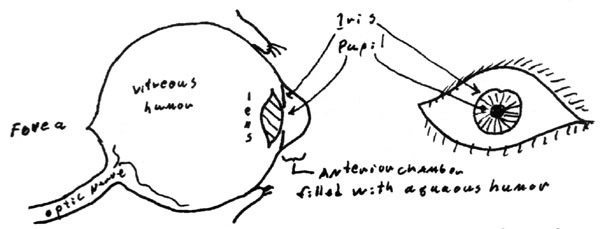
Optically, here is what happens. Light coming through the air meets the tear film. The shape of the tear film bends the light to form a real image on the retina. That's about all.
Well, yes, there's the cornea. Its job is just to hold the tears in place. Of course if you read about this in a text, they will tell you that the cornea bends the light and the tears have the task of protecting, lubricating and supplying nutrients for the cornea. But the cornea cannot bend light, because the speed of light in cornea tissue is about the same as in tears and as in aqueous humor. Well, there is the iris, which does control the amount of light reaching the retina, and also protects the retina from ultra-violet rays. In very bright light, the pupil may get small enough so that the pinhole effect makes sharp vision possible even for an eye that has errors in the shape of its tear film (because of errors in the shape of the cornea.) And there is the lens, which has a little effect, because it is immersed in fluid. The primary purpose of the lens is to add just a touch of extra converging power so that objects close at hand may be brought into focus. This is called "accommodation" and depends on muscular activity that actually causes the lens to change shape slightly.
But when all is said and done, it is the film of tears that does almost all of the optical work of the eye. Just how good is that film?
 If you make a little
glass bottle in the shape of a prism, you can find out. Figure out how much light at the
edge of the pupil must be bent out of a straight line in order to reach the retina at the
center. Then figure out how flat your prism has to be to do that. Say you make a bottle
two inches high with the base shaped like an isosceles triangle (two sides the same
length.) The triangle will be about a half-inch high and the angle at the vertex about ten
or fifteen degrees. It looks like this:
If you make a little
glass bottle in the shape of a prism, you can find out. Figure out how much light at the
edge of the pupil must be bent out of a straight line in order to reach the retina at the
center. Then figure out how flat your prism has to be to do that. Say you make a bottle
two inches high with the base shaped like an isosceles triangle (two sides the same
length.) The triangle will be about a half-inch high and the angle at the vertex about ten
or fifteen degrees. It looks like this:
Stand the bottle up empty. Shine a thin beam of white light through it. Now fill it with water. At once you have the lovely spectrum. Try putting some salt in the water. Add a little sugar. Put in some protein, meat tenderizer or gelatin. You can't make the rainbow go away. The colors may be very pretty, but if you are trying to read this magazine, you want to see good sharp black on white; amorphous globs of brilliant color just won't do. Tears do an utterly rotten job focusing light.
Here is another experiment. Drive down to the nearest meat packing plant and see if you can talk them into giving you a few nice fresh cow eyeballs.
(WARNING: THIS IS ONLY TO MAKE YOU THINK. DO NOT TRY THIS) A couple bits of advice: 1) It does absolutely no harm at all if you leave the impression that either you are a high school teacher or you are doing it for your high school teacher. Don't lie, of course, but if you happen to use words like "third period" and "recess", well you can't be blamed if they jump to conclusions. 2) Don't accept frozen eyes. Frozen eyes get cataracts. That is, the lens turns opaque.
Back home, hoping not to be interrupted, you carefully slice off the back of an eyeball. Since you won't get it right the first time, save the lens out of the first one you ruin. When you finally get the back of one sliced cleanly away, sew it onto a piece of glass -- like a microscope slide. You now can look through a window and see what the retina sees. Now take your thin beam of white light and using the eyeball as a lens, project the beam onto a white card. There is, indeed, some chromatic aberration, but a lot less than you were getting with your prism of water. There is enough so that you would think it would be very distracting, but it would still be possible to read.
So we are left with two questions: 1) If the retina actually gets a real image with gross chromatic aberration on it, how is it that we do not notice this when we see? 2) How does the eye do as well as it does, anyway?
Take the second question first: take that bare lens, the one from the eyeball you messed up, and look at it. Notice that it is smooth, clear, no rough edges, strong symmetrical curves, stronger curvature on one side than the other. Now project a real image with it: lo, the image is white. Just about no chromatic aberration at all. After hours working in a murk of smudged colors, that clean white image is a thing of beauty itself. The lens does what the tear film could not. Superb engineering. Makes a man proud to be a cow. But how does the lens correct for the error of the tears? In a glass achromatic lens, the color correction is achieved by having a sequence of positive and negative lenses. In the eye, there are three places where refraction occurs: air meets eye, aqueous meets lens, and lens meets vitreous. All three are positive refractions. You don't see any negative lenses.
You don't? Look again. Imagine the eye with the lens replaced by air. There are now two negative curves, surfaces that will tend to disperse light: the back of the aqueous and the front of the vitreous. Together they make a lens that just about completely cancels out the effect of the tear film, the focusing power as well as the chromatic aberration. Now re-introduce the lens. The lens restores the focusing power but not the chromatic aberration.
There is a second trick, of course, and that is the pupil. When there is ample light, the pupil contracts and only light passing close to the optical center of the eye goes through. This light, of course, is not bent much and has the least chromatic aberration introduced. If the pupil goes to pin point size, of course, no light has to be bent at all to have a reasonable image projected on the retina. A second result of this pin hole effect is that it increases the depth of field of the eye -- the amount of the world that is in focus adequate focus.
If you are a primate moving rapidly among branches, you want to maximize your depth of field so as the get information on branches at many different distances at the same time. You will trust the great information processing capacity of your brain to construct an abstract three dimensional model of the tree to guide you. Of the eyes, you only ask for as much information as possible from as many depths as possible all at once. You will maximize your pin hole effect by having round pupils. All light gets bent as little as lighting conditions permit.
If you are a cat preparing to spring on a mouse, you want to know details about the mouse (which end bites) and the distance to the mouse and nothing else. You want to minimize depth of field to avoid distraction and in order to get distance information. You will have large pupils, or if you must, close the pupils down to slits. Vertically oriented distance clues will be picked up by the fact that you have two eyes, so you will orient the slits vertically so as to capture what you can capture of vertically horizontally oriented clues.
If you are a cow, your eyes are on the sides of your head and you seldom see much with both eyes. This orientation gives excellent peripheral vision but poor depth perception. You get some distance information from slit like pupils also, but will orient the slit to match the opening between the eyelids.
But even using these tricks, the eye is still left with substantial chromatic aberration. The image of this page as it is being projected on your retina right now (if you are reading by white light) is a snarl of rainbows, each about as wide as the width of this 1. (That's very much an approximation, of course. If you want to make formal measurements, get on down to the meat packing plant yourself.) How can you see black and white detail?
The trick, of course, is that the job is handed over to a neurophysiologic process. The rods and cones of the retina and their attendant neurons all the way back to the cortex of the brain start doing their information processing. Taking imperfect information they construct a model of what is most likely out there and present that model for your mind to ponder. Sometimes they make mistakes. Suppose you are sitting by the window after a snowfall. You have not bothered to take the screens down, so you are looking out through a black screen four or five feet from you at a snowy yard thirty feet farther out. Look at the screen. Now look at the little square holes in the screen. What color are they? They should be white, of course, because the snow is white. But they will be little squares of faint pink and faint blue. Your neurons have screamed and thrown up their dendrites.
The mind easily steps in and interprets it all as black screen against white snow, and most people never notice the color. And under less diabolical visual conditions1 the closest inspection will not catch the neurophysiologic network in error.
Then, perhaps, you wonder what is really out there. The veil of tears makes vision possible, but it introduces systematic error. What would it be like to see past that veil? What if you projected a picture on the retina that was free of chromatic aberration? What would it look like?
Before attempting to peek, remember that chromatic aberration is not the only problem introduced by those tears. First the tears must be renewed every few seconds. This means blinking. About ten percent of looking time is spent blinking. Never decide you have seen something at only one glance. You may have blinked and seen only what you expected to. Second, even when the eye is open, the tear film does not always faithfully follow the curve of the cornea. Tears have their own surface tension and tend to bead up and to form a meniscus with the edge of the eyelid, just was water collects in any crack or corner. Third, the pressure of the eyelid itself on the cornea squeezes the cornea from top to bottom giving it a sharper curve in a vertical plane than in a horizontal plane. Fourth, the cornea may not be an ideal shape in the first place. Fifth, the shape of the cornea may be all right, but the length of the eyeball may not match it. Sixth, and basic to all this, there is no real control over the shape of the cornea, no effective way to improve that shape.
First we will dispense with the tear film. One easy way to do that is to step into the nearest swimming pool and open the eyes under water. (WARNING: THIS IS ONLY TO THINK ABOUT. DO NOT TRY THIS.) The tear film either goes away or becomes as large as the pool, depending on how you care to think about it. The lens in its normal surroundings can make no image on the retina, so the only effective image is produced by the pin hole effect of the pupil. The resulting image is so grossly blurred that reading becomes impossible, although one sees quite well enough for orientation, and it is even possible to recognize objects. Peripheral vision, never very sharp anyway, is for practical purposes unaltered.
Now in order to see more clearly, we need a lens to produce an image on the retina. A powerful solid glass lens might do, but it would lose a lot of its power by being immersed in water. A more elegant solution is this. Go down to the nearest glasses grinder and buy some lens blanks. They are made commercially with a number of different curvatures. The blanks have no corrective power until they have been ground. You will need several with about the maximum curvature available. Blanks are frightfully expensive, but if you mention that they are not to be used in ordinary spectacles, you may get a considerable discount.
 Any use of words like
"high school science project" or "granddaughter" is strictly between
you and your conscience. Hie home and get to work. Take two lens blanks and turn them so
the outside curve of each faces the other.
Any use of words like
"high school science project" or "granddaughter" is strictly between
you and your conscience. Hie home and get to work. Take two lens blanks and turn them so
the outside curve of each faces the other.
Then seal the outside edges, making a little watertight chamber. In air, this chamber is neutral but under water, it becomes a powerful positive lens. Make two or three of the little things and go back to the pool. Careful now. Lots of people don't like broken glass in their pools.
Put your head underwater. Hold up one of the lenses to one eye. If the chamber does not flood, things should seem a little sharper through the lens. By using two or three lenses in tandem, and by choosing how far from the eye to hold them, you may be able to get things into sharp focus. (DON'T TRY IT. A BRILLIANT OPHTHALMOLOGIST ONCE TRIED IT. HIS IDEA OF A GOOD WAY TO GET INTO THE WATER WAS TO GO OFF THE DIVING BOARD. OF COURSE THI IMPACT RUINED THE DEVICE. IF A PROFESSIONAL CAN FIND WAYS TO GET INTO TROUBLE, THINK ABOUT THE REST OF US.)
From this, of course, it is possible to design an underwater vision device that fits like a pair of spectacles and does not need a watertight seal against the skin like a face mask or goggles. As long as the integrity of the contraption holds, it will not flood. It does not obstruct your peripheral vision. It will never produce suction on your eyes, like goggles will, and does not cover up your nose like a mask. You could use it and still wear a moustache if you like. In fact, such a device has been invented and patented. It is not currently commercially available.
Now consider what you have accomplished. You have been able to see sharply without using your tear film. You have thus bypassed all of the refractive errors of your cornea. If you have really severe astigmatism, you may actually be able to see more clearly than you ever have before in your life. There are, however, some drawbacks, such as:
1) You can't breathe. 2) You are very wet. 3) The water stings your eyes. 4) What you see is grossly magnified. 5) Your chamber made of lens blanks is hardly the state of the art in optics. 6) You have done nothing for chromatic aberration, since this device produces just as much as your good old tear film. 7) You can only look at things that are either in the pool with you or right above the water over you.
Some of these problems can be dealt with thus: Get a good pair of swimming goggles, a pair with a good firm fit and flat lenses. Fill one chamber of the goggles with water and put it on. (ON SECOND THOUGHT. DON'T TRY THIS.) You now have one eye under water and one eye to see with. You can breathe, you are a lot less wet, but the water still stings your eye.
Enough salt in the water to make up a physiologic saline solution will take some of the sting out, but you will find that the best thing is a little dilute sugar solution. Say a half-teaspoon in a tall glass of water. It turns out that there are no blood vessels in the cornea, so the thin cell layer on the surface must survive by being fed by the tears. Tears are slightly sweet and slightly salty. If the cells of the corneal epithelium die, little harm is done, but the eye will be red and irritable until a new generation can be produced and can spread out over the surface. That's why your eyes are bloodshot after swimming; the pool water doesn't have any sugar in it, and washes the tears away, unless you do all you swimming with your head above water. A little sugar in the solution lets that epithelium tolerate being submerged a little longer, but don't forget, bacteria and yeasts like sugar too. Keep things clean and mix up a fresh batch any time you use it. And don't keep your eye under water any longer than you would in a swimming pool, anyway. Don't plan to use the underwater vision device for a long period or repeatedly. (IN FACT, DON'T DO IT AT ALL.))
THIS HAS NEVER BEEN DONE MUCH, SO THE DANGERS ARE NOT KNOWN. JUST GO ON READING.
Flooded goggles in place, you are now ready to try seeing. Get a good magnifying glass and you can use it to throw a real image on your retina. Again, the world is magnified, and again you may see more sharply than ever before if you have a very astigmatic cornea, but most likely, you will find that the resulting picture is not very satisfactory. You see, like the lens blank, the surface of the magnifying glass is ground to a section of a sphere. That's because it's easy to make machinery to do that. But a spherical surface is not ideal shape for a lens. Even the normal cornea is better than that. Instead, use the objective lens from a small but good quality telescope. Now, at last, things begin to look interesting. The world looks magnified, quite sharp, and of course it looks upright. However, you will notice one continued problem. Colors do not look very bright.
You see, as you have made the image on your retina larger, you have also made the chromatic aberration greater. Your neurophysiologic correction takes care of this, so you still do not see a lot of rainbows, but in the process, you lose the sense of color saturation.
Well, a simple objective lens is not state of the art optics, either. Get a camera lens. A high quality camera lens is optimized for aperture width, flatness of field, color correction and has coatings that cut down on internal reflections. A camera lens IS state of the art. Get a beat up used one with the shutter ruined so that it is no longer useful for photography anyway, because sooner or later, you are going to dribble sugar water on it, sure as gun's iron.
Now you are ready. Put on the flooded goggles, ignore the water running down the tear duct into your nose, take the cap off the lens, open the aperture wide, hold the lens so the axis of the lens is exactly perpendicular to the surface of your goggle, hold lens and goggle in place while you aim by turning your head.
The lens should line up perpendicular to the surface of the goggles; otherwise, the light will enter the goggles at an angle, be bent, get chromatic aberration, and all your efforts will be for nothing. NOW. Look at something you have seen many times before. (NO. JUST IMAGINE IT.)
For the first time, your retina is presented with a high quality real image. You might expect that the sudden change would confuse your network of neurons, and produce spurious color perception. After all, if there is any chromatic aberration in the system now, it is just the reverse of what it always was before. Where there formerly was a rainbow red on the right and blue on the left, it now might be red on the left and blue on the right. Accustomed to reject one kind of rainbow, the neurons might exaggerate the other. But no, the brain takes to the new element like a duckling to its first swim.
All the redundant information processing power that was used to clean up the image before is instantly applied to interpreting the new image. Colors are more saturated. The scene looks somehow cleaner. Blacks look deeper, whites brighter, and the difficult black-white edges are sharper. Since pattern recognition is what the neurons do, pattern recognition may improve. I have seen a colored picture of a castle above a ravine in France; there was a whisp of cloud in the ravine I noticed for the first time using this device. In another picture, a piece of white cloth could been seen to be translucent; looking again with the naked eye, I could confirm the impression, but it was less obvious. Not only sharp details but also misty vague hints are perceived in greater abundance with this technique than with the naked eye.
What is worth looking at? (NOTHINGS AT THIS TIME.) Obviously this technique is far too inconvenient for sustained reading or any daylong observation. Besides it would be hard on the skin around the eye as well as the cornea. Friends and family are worth looking at. There is someone in your life who likes you well enough to sit for twenty minutes while you get the apparatus working. That person will even smile for you. Look closely. You will not do this often. Things in nature are worth looking at, mountains, the sea, rocks, birds, animals, cloud formations, plants, rain on a lake. If you do not already make regular arrangements to spend a little time looking at such things, perhaps you should do so.
Buildings and sporting events are already designed for the spectator and need little extra help, unless there is one that is very much your favorite. Works of art are also designed for the spectator. Obviously, artists like Hundertwasser, who juxtapose highly saturated colors from widely separated parts of the spectrum, would be interesting (BUT NOT INTERESTING ENOUGH TO RISK HURTING YOUR EYES). Since cyan and magenta cannot be brought into the same plane of focus by the eye, looking at them together is somewhat distressing. Using an achromatic lens and a goggle full of water lets you see such works with clarity and without distress, but perhaps it is the distress that Hundertwasser is trying to create. Impressionists like Monet, Renoir and Van Gogh, and I think moderns like Dali have already explicitly taken the perceptive process into account in their work. Most rewarding would be paintings by moderns like Murray and Williams, men who plan their paint and give assiduous attention to detail as well as ancient greats like Rembrandt and de Vinci
It is rather like Beethoven, who wrote music that was beyond the capabilities of the instruments of his time. His solution was that people should make better instruments, which they ultimately did. If you can bring a better way of seeing to the painting, you are upholding your side of the relationship. (BUT DON'T BLIND YOURSELF IN THE PROCESS.)
Obviously a picture with large areas of highly saturated color imposes the least burden on the eye and brain. The greatest burden is imposed by complex line drawing by such as Blake, Dürer and Doré, by subtle black and white photographs and by any medium that makes its effect by the interplay of tones of off-white; oyster on silk, pearl against silver, grey against gray, folds of fabric and shapes of stone. To such scenes, bring your apparatus. (SORRY BUT WE INSIST YOU DON'T.)
Last and least, it may be worth looking at your enemy. Consider the battle line. Perhaps it was Robert Lee who first realized that weapons had reached the point where, if you could see it, you could put a hole in it. Excluding nuclear weapons, combat hinges largely on two things: seeing and not being seen. Not being seen includes such things as lying low, moving fast, using armor, using camouflage, and not being where they are looking. Seeing includes such things as putting your head up and putting satellites up.
It has long been known that certain kinds of color blindness make a person better, not worse, at detecting certain kinds of camouflage. By now, it should be obvious why. Freed of the task of sorting out colors, his neurons are able better to perceive other patterns. Using a color corrected lens and a goggle filled with water, it might be possible to pick out camouflage even better.
A telescope designed along these lines has already been designed and patented. Again, the patent is available. (NO IT IS NOT.DO NOT TRY ANY OF THIS.)
But perhaps what you want to look at is very small. That's no problem, you use a microscope. The standard compound microscope uses a powerful objective lens to crease a real image of the specimen. That real image is then inspected using a powerful eyepiece. The resolving power of the microscope is limited by the optical aperture of the objective lens. State of the art eye pieces are very good indeed, so there looks like little room to improve on the microscope.
However, consider this: light from the specimen slide is strongly bent by the objective lens, then it is strongly bent by the objective lens, then it is strongly bent by the tear film on the cornea to throw a real image on your retina. Now remove the objective lens and either fill the microscope with water or put on a goggle flooded with water. (NO DON'T TRY IT; SAFETY IS NOT ASSURED, AND THERE IS A PATENT TO STOP YOU.) You will need to refocus a little. Now the situation is this: light from the specimen slide is bent strongly by the objective lens to throw a real image on your retina. Now I ask you which system is simpler, which is bound to introduce fewer errors, which is superior?
Contact lenses, of course, work by altering the shape of the tear film. They don't do anything for chromatic aberration, but they correct other errors of the tear film. The lens must match the curvature of the cornea, and that curvature is measured by a laser device called a "keratometer." The method is quick, objective, painless and accurate. I haven't heard a lot of complaints about it. However, there is another way of making the same measurement. All it needs is to measure the refractive power of the eye, measure the depth of the eye, and then measure the refractive power of the eye when the eye is immersed in water. A little arithmetic lets you calculate the curve of the cornea.
Well that system would work, but it is not all that promising. To be sure, it is nice to have a "low tech" solution to a problem, and indeed all these devices are "low tech" in that they require no expensive materials, complex devices, or high energy levels. But measuring the depth of the eyeball is best done with an ultra-sound device, and ultra-sound is just about as high tech as the keratometer. (AS BEFORE: DO NOT TRY THIS. IT MIGHT BE DANGEROUS. THINK OF WHAT DIRTY WATER COULD DO TO YOUR EYE. IT COULD DESTROY YOUR CORNEA AND PUNCTURE THE EYE.)
In summery, we see because the tear film on our eye casts a real image on the retina. There are refractive errors in that image. The image can be improved by submerging the eye in a water-filled goggle and using a fine achromatic lens to cast a real image. The image will be superior, and we will see better. Whether seeing better is worth the trouble might depend on what we see. But it is not worth the risk at this time. (DO NOT TRY THIS.)
Booty
Editor's note: WILD SURMISE is an occasional newsletter on speculative matter. The next issue will be on LAV virus, and the following one Booty will introduce a time machine.
We would like to remain anonymous, so many thanks to all of you who continue to respect that wish.
The four inventions described in this months lead article do exist. If the patents still are effective, the owner does not want anyone to try the inventions out.
M came in the other day with a magazine in his lunch pail. Booty took it away from him. It was entitled M -- THE CIVILIZED MAN. Box 2621, Boulder Col 80322.
Booty studied it awhile and said, "It certainly isn't referring to you, is it?"
M adjusted his wolf skin. "It certainly doesn't say, 'Booty, the civilized man,' does it?"
Ed
Mild Surprise
I know that I made a mistake in the end, a serious mistake. But there was no mistake in my navigation. My Cessna 150 climbed stalwartly out of the pattern, turned west across the great city, and eventually found the green countryside. It was to be my first solo landing at an airport away from home. My first invasion of the big world out there. For the first time, I was going somewhere. I'll call the town ______
Only one question bothered me, "What if they won't talk to me?" It did not bother me that for a long time, there was nothing below but city streets. It did not bother me that any of a number of miracles could stop happening and leave me without power or control. And it did not even occur to me that the cobalt blue day could turn into a nightmare. Those were somehow either not my problems or problems I had already considered and then dismissed. But the radio was my problem. I was going to have to use it to do something new, to establish a link between me and whatever was going on in that airport. Willy nilly, I was going to be part of what was going on there, but I could not be sure I had a connection until I needed it.
There is a road, four lanes broad and straight with the cars going like me straight toward the town. But I kept picking up my check points and checking the time as if the whole world could be snatched away at any instant, except for those landmarks I had circled in red on my pilotage chart. Every check point turned up as docile and tranquil as you could ask. Five miles out, it was time to start calling.
It was an uncontrolled airport. I tried the unicom frequency. _____, this is Cessna 23308. What is your active runway?"
Nothing.
I tried the other radio. This is 23308. Do you read?"
Nichts.
I tried a different unicom frequency. "Are you on this frequency?"
Nada.
Other radio again.
Niechivo.
I tried the nearest flight service station.
Pas de tout.
I called the flight service station and said I was listening on the VOR radio beacon nearest.
Nihil.
Other radio.
Inte.
By this time I was over the field. I went back to unicom frequency and number one radio. They seemed to be making left hand traffic and landing northish. I think it may have been runway 1. I went out northwestish and came down to pattern altitude. Came back to the pattern. "Cessna 23308 turning downwind runway 1, _____.
Niente.
"308 turning base." I put the microphone in its clip considered the situation. I was coming in high. Time to stop gabbing and fly the airplane. Power back, carb heat on, flaps. Lots of flaps. Nice thing about those old 150's; they could really put down a lot of flaps.
The flaps are a part of the trailing edge of the wing next the fuselage. As you lower flaps, you get more lift and more drag. With full flaps, you get a whole lot of more drag, particularly in a 150. That's wonderful for exactly this kind of situation, where you would like to get rid of a lot of altitude without gaining airspeed or covering a lot of ground. Another way to dump altitude is to slip the plane, to roll it to one side with the ailerons and hold the course with opposite rudder. That spoils the aerodynamics. You couldn't use both tricks at once in a 150, because the combination could put the rudder and elevator in a pocket of dead air and rob your control.
As you put in flaps, you must make a positive movement forward with the control wheel to lower the nose. Otherwise, your airspeed may drop dangerously low. If the airspeed gets too low, one wing will stop flying and the plane will spin down. "Spun in from the pattern," sums of a lot of accidents. Well, I had the habit of not putting the wheel forward as much as you should, so I would be flying slower than best angle of glide speed...but not much slower.
So there I was: minimum power, full flaps, nose high, dropping like an elevator, coming in to the first quarter of the runway maybe three hundred feet off the ground.
That's when I noticed the wheel.
Now there is nothing extraordinary about the wheel of a 150. Perfectly ordinary wheel. You look at each wheel carefully before each takeoff, and you get to know what one looks like. Well, it is a little disconcerting to be flying along and glance out your window and notice that your wheel is not only not spinning, it is suspended in mid air. You learn not to look. But mostly, wheels aren't all that interesting. But this wheel was. It wasn't my wheel.
And it was about two feet in front of my windshield.
A Cessna 150 was landing on top of me. To think of all the people I had made furious at one time or another, and here was somebody about to kill me, and he didn't even know I was there. The radio didn't seem like the solution; nobody else was using it. As I watched the wheel, he seemed to be coming down faster than I was. Must be two of them in the plane. If I rolled I would hit him. If I slipped, I would lose control. If I dumped the flaps, I would lose lift and spin in. If I added power or lowered the nose I would fly into him. If I stayed where I was, he would drop onto me and mash me like an insect.
I lifted the nose a little. The plane got a squishy feel and started to drop faster. His wheel came to my propeller arc, so I lowered my nose just long enough to let him over and then got my nose up again. Now the long line of his fuselage slid overhead. I pumped the rudders a little to kill a little altitude. His slipstream pushed me back and I ducked my propeller under his tail feathers. When I got my nose up again, I was four or five feet behind him and a couple feet higher.
Now if I added power and tried to climb over him, he might fly up into me, but if I followed him, he would reach the runway first, and if he touched the brakes, I would hit him after all. Make like a jackrabbit. I gave it full power and then a right turn and a left turn, winding up parallel with the runway, deep grass going by the windows. I held it there with full flaps and full power just above stall and started bleeding the flaps off, half way at first and then little by little. (That one had been drilled into me.) The plane gained airspeed and decided to fly. I got back into the pattern and, babbling intentions the whole way, came around and landed.
When I got to the administration building, somebody met me and asked, "Are you an instrument pilot?"
"Huh?"
"Are you an instrument pilot?" No
"Hm.
"Why do you ask?"
"Hm.
I had no way of knowing if he were taunting me or what. Didn't people talk around here? "Why did you ask if I were an instrument pilot?"
Well, instrument pilots know a lot of frequencies they can use.
I got somebody to sign my logbook and went back to the plane. Ran her up. Taxied out to #1 and checked for traffic on final.
Not again.
Two planes were coming in, one right on top of the other. If they touched, one would probably fall on me. As if by its own volition, the microphone nuzzled my lips. I thumbed the key.
"There are two of you on final at ______. Right now, there are two of you landing on top of each other runway 1, ____________
A supremely harried voice came over the radio, around." The upper plane added power and lifted off.
"452, going"
I sped down the runway and took off. Checked each landmark on the way home. Put the plane away. Found my instructor. Got my book signer. He seemed happy to have me back alive. No questions. No remarks.
Then I made my mistake. I went home. I did not pick my instructor up by the collar and scream the story at him. I did not call every relevant and irrelevant government office and file a complaint. I did not publish a story. I did not drive back to _____ and put up a billboard saying, "Danger. Tight lipped pilots."
I drove home. Months later, I heard there had been an accident in the same town. I had said nothing. I had maintained a gloomy, doom ridden and self defeating silence. I had fallen into the error of the place.
M