WILD SURMISE
SEPTEMBER 1985 # MINUS 2
AN ALMOST ANONYMOUS INFORMAL NOTE
CYRANO AND THE THEORY OF RELATIVITY
The trouble most of us have at first with Einstein’s Special Theory of Relativity is that it seems contrary to intuition. Intuition, of course, is the perception of truth without reasoning that truth out. If you remember from the last issue about the technique and results of indoctrination, you will remember that what is self evidently true to one person may not only be self evidently false to another, but may be self evidently false to the same person at a different time, depending on his experience. Truth should be made of sterner stuff. What we call intuition either does not exist except by coincidence, or it simply consists of a quick check for consistency it is perceived as true because it does not conflict with what we already believe.
The great power of science depends in large part on formal use of intuition. On the basis of observation, a guess is made limited only by rules of consistency with incomplete information. Then that intuitive hypothesis is tested as rigorously as possible by experiment. In ordinary life, diligent testing of the first guess against experience is called being sane.
Einstein's theory, simply put, states that light is always measured as traveling at the same rate. If I am standing still and you are traveling toward a beacon, and we both measure the speed of light coming from that beacon, we will both measure the same speed. If the beacon starts moving, we will still measure the light from it as coming to us at the same speed.
Ordinary experience tells us that speeds add. If I am walking down the aisle of a train at two miles an hour and the train is traveling in the same direction at twenty miles an hour, I should be traveling at a total speed of 22 miles an hour. Measurement will show this to be the case. But when we try to apply the same reasoning to light, we get into trouble. Near the speed of light speeds don't add in such a simple way. In fact, according to the Theory of Relativity, speeds add thus:
Final speed =first speed plus second speed, that whole divided by 1 plus this fraction: the first speed TIMES the second speed divided by the speed of light squared.
or, Final speed =
speed 1 + speed2
1 + speed 1 times speed 2
speed of light times speed of light.
Clever, isn't it? Call the speed of light c. (186,000 miles per second) Add c to 20 mph and you get c.
Final Speed =
20mph + c
1+20mph * c
= 20mph + c
1 + 20 mph
c
= 20mph + c
c + 20mph
c
now invert the bottom fraction and multiply:
= c * 20mph + c
c + 20mph
= c * 1
= c.
Play around with it some. Add any two numbers less than c and you get a bigger number less than c. You've heard that you can't exceed the speed of light. Suppose you are carried off by trans-galacic aliens and the return you to the solar system in a ship of your own that had unlimited supplies and fuel. Unfortunately they drop you off at a speed of 2c. Can you get home? Can you even talk to home?
Intuition tells us that final speed equals speed 1 + speed 2. Obviously somebody’s intuition told him that it was more complicated. That person was just following the rules of consistency with some measurements made by man names Fisseau. We will return to him later.
Before we talk about why Einstein pursued such an odd intuition, let us talk about mathematics. We won’t wander far, only far enough to climb two low hills. We will linger only long enough to define a few terms.
Imagine a right angle triangle. The horizontal line we call the base. The vertical line we call the altitude, and the diagonal we call the hypotenuse. Now consider three words, sine, tangent and secant. They mean "bosom", "touching" and "cleavage." I guess the words were chosen to keep the attention of teenagers, the only people who are really able to understand mathematics. Sine is defined as the length of the altitude divided by the length of the hypotenuse. Tangent is the length of the altitude divided by the length of the base. Secant is the length of the hypotenuse divided by the length of the base. "Slope" means "tangent," how many steps up you go for each step forward.
The word "calculus" means "stone." Imagine keeping track of numbers by pushing pebbles around. The rules by which you push the pebbles around are the "calculus" you are using. We will be talking about "differential" calculus. It's got nothing to do I know about with anything on the rear axle of your car. It is just a set of rules for finding the slope of a line; that may be tricky if the line is not straight.
Consider the first hill. The hill is ten miles long (the base is ten miles long), and for every mile you go forward, you go up one foot. (This is a Florida hill.) The trick is to find out how high the hill is (yes, ten feet) but WITHOUT going to the top, even in concept. You can make any calculation you want, as long as it does not include that top. So you try to figure out what height the hill is reaching as you approach the top but never go to the top.
In order to do this, we introduce the concept of the "limit." The traditional way to define a limit is to hold the thumb and index finger close together, squint and talk in a high pitched voice. A formal definition can be made, but it's a jaw breaker. The idea is this: you set up a proposition. You propose: I have a rule. Using my rule, I can find a distance from the top of the hill where the difference between ten feet and the altitude at that point is less than any number you give me. In other words, you give me the number, I apply my rule and find a place where the altitude is closer to ten feet than the size of your number.
You say three feet. I'll say my rule is to go to a point that is half as far from the top of the hill (measuring along the base) in miles as your distance is in feet. You say three feet? I say go to 1 1/2 miles from the top (or 8 1/2 miles from the bottom) and I am within three feet of being at ten feet. Any number of rules might be used, but it only takes one. If my rule always works then the limit of the height of the hill as you approach the top is ten feet.
That should be familiar. As you keep adding speeds, the limit of the final speed is c.
Now the slope of the hill is one foot per mile. What is the slope at the top? It ought to be zero. After all, if it is still going up, it isn’t the top. But the limit of the slope as you approach the top is one foot per mile. Give me a distance from the top and I will give you a distance that is less where the slope is one foot per mile – like half your distance. Nasty, isn't it? The kind of thing that wakes you up on a hot summer night shouting feverishly, "The truth is somewhere in between." Go back to dreaming about whatever teenagers dream about.
Consider a better behaved hill. This hill starts out with a slope of ten feet per mile ten miles away, drops smoothly to nine feet per mile at nine miles and so forth. (This shape is a parabola, if you are interested.) You still can't go to the top, but the slope approaches zero as you approach the top. In fact, you can’t go to any point on the hill and measure a base and an altitude. Both measure out to be zero. But you can establish a limit for the slope at any point. Once you have established a limit of the slope at a point, you no longer talk about altitude divided by base, A/B, but you talk about a "differential," dA/dB. This notation, dA/dB is the limit of a slope at a point, and if you include it in an equation, it is a differential equation.
I wish I could stop there, but some rascal took a differential equation and divided through by dB, leaving dA all by itself. That is a "partial differential equation." That strikes me as a foul, and all of subsequent higher math leaves me suspicious. 0h I accept that is correct in form, as long as you follow the rules of division, but I feel as if I have been left at the top of the first hill alone with a dA, looking at it saying, "But it doesn't MEAN anything." It always seemed to me it could be anything from ten feet to a billionth of an inch and less.
One of my heroes is a man named Oersted. As the story came to me, in 1820 Oersted was lecturing to some students explaining that despite the similarities between electricity and magnetism, they were unrelated forces. These students were being stubborn. (Students can be.) Oersted, voice rising with conviction seized a coil of wire, hacked it up to an electrochemical cell and waved if over a compass he had at hand. He was prepared to point out that the compass had no way of knowing the electricity was there, when the compass needle almost jumped off its bearing. I wish I could have been there. Anyway, next time Oersted had a moment of peace, he wrapped the wire around the compass. When the current was sent through the wire one way, the compass pointed one way. When the current was reversed, the compass reversed.
Over the next few years, other workers discovered that force, electric current and magnetic fields oriented themselves in a mutually perpendicular way. If you had a north-south magnetic field, and an east-west electric current, you get an up-down force. They worked out the magnitude of the forces and found that one of the constants that related them was c, the speed of light. Then matters fell into the clutches of a Scot named James Maxwell. He took all of existing magnetic and electrical theory and rolled it into a single system consisting of four, you guessed it, partial differential equations. He pointed out that according to these equations, an oscillating electrical field should induce an oscillating magnetic field, which should produce an oscillating electrical field, and that the whole thing should proceed outward in waves at the speed of light. In fact, he said that it WAS light.
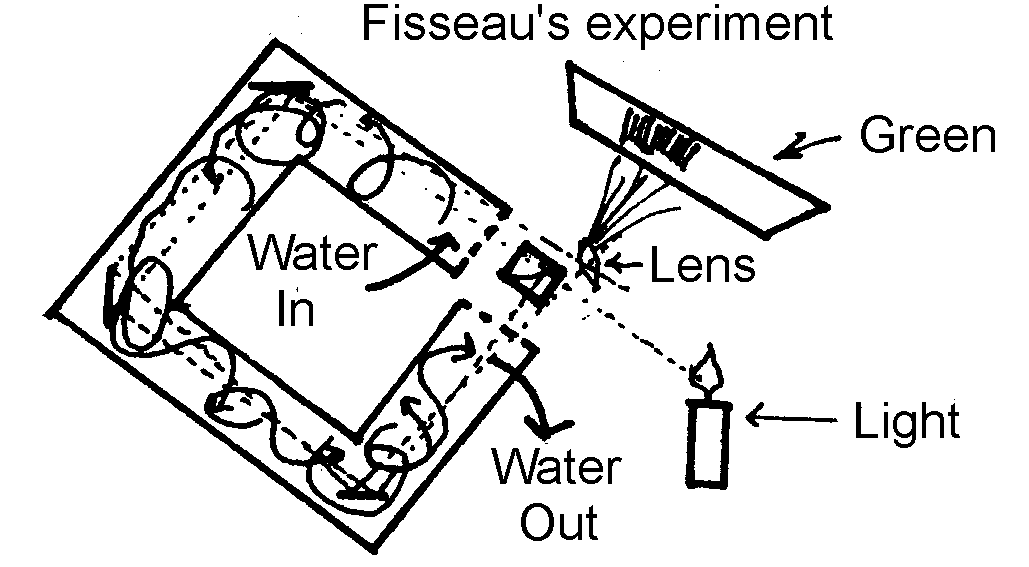
The question that vexed a lot of people was, "Waves of what?" They called the "what" ether, but then the question became "what is ether?" The most interesting experiment, to my mind, was done by a Frenchman named Fisseau. He made a chamber that looked like a thick pipe bent into about a square. He filled the chamber with water. Next he shined a light through it, bouncing it off mirrors at the earners. He started the water flowing and measured the speed of the light and how it changed with the speed of the water. He found, astonishingly, that the speed of the water added to the speed of the light (which, of course, was less than c, because it was in water and a little slowed down) but did not add in a straight forward "final speed = speed 1 + speed 2" way. Instead, he found that it added more or less according to the formula we described for adding speeds near the speed of light.
Enter Cyrano de Bergerac.
The historical Cyrano lived from 1619 to 1655. He was a fine duelist. Also, he studied under one Gassendi, who was in turn friends with Galileo and Kepler. So you see, intellectually, Cyrano kept very good company indeed. The fictional Cyrano is a character in a comedy by Edmond Rostand, appearing in 1898. This character comes to us as brilliant, vain, ugly, brave, cruel, witty, hot blooded and honorable.
In the third act, Cyrano finds himself sworn to assist Christian in marrying Roxanne. Far be it from Cyrano to consider that it is a rotten idea; Cyrano has given his word, and that outweighs good sense. Christian isn't a bad sort, just not Roxanne's sort. Cyrano is very much Roxanne's sort. While Christian and Roxanne are being married, the powerful and bold de Guiche arrives, desiring Roxanne. De Guiche has ample clout to put a stop to the marriage if he learns of it.
Cyrano intercepts de Guiche outside the door and tries to detain him long enough for the ceremony. The contrast between the two is striking. Both are bold and brilliant men. But Cyrano is romantic, headlong and working against the dictates of his own heart, while de Guiche is practical, mature, and has a well conceived plan.
Dropping from a tree and declaring himself to have just arrived from the moon, Cyrano appeals in quick succession to his rival's credulity, his fear, his pity, his sense of humor, all in vain.
In an inspired moment, Cyrano appeals to the man's strength. He engages the man's intellectual curiosity with the boast that he can give fully six ways he can get to the moon. The sixth plan concerns us. He sits on an iron plate and throws a magnet into the air. The plate jumps upward. Cyrano catches the magnet and throws again, proceeding upward by small increments.
Notice that Cyrano does not just hold the magnet away from the plate. If he did, magnet and plate would pull on each other with equal force, and nothing would move. Instead, the magnet is lowered close to the plate. At this moment, some signal must pass from the magnet toward the plate. When the signal arrives, the plate begins to move and sends some signal in return to pull down on the magnet. But by the time THAT signal arrives, Cyrano, who is after all the finest swordsman in all France, has flung the magnet upward, and there is nothing for the plate to draw downward upon. The magnet never had a chance to sense the plate, so there is an unbalanced force.
Poor de Guiche, he sits down and thinks about it until his plan has failed, his hopes have been dashed and Cyrano himself has been ruined. His brilliant mind will not let the problem go; it "rejoiceth as a strong man to run a race."
At the time the play was performed, the work of Oersted, Maxwell and Fisseau had already been done. But the paradox of Cyrano's machine would have been evident long before. Consider again. You "know" that the machine cannot work because it violates Newton's first law of motion in the most gross way. You "know" that the plate must sense the magnet before the magnet senses the plate, so the machine MUST work. It is a very real problem. Your intuition cannot help you, since it is caught in a contradiction.
Before resolving the paradox, (and at the risk of detaining you from mere important matters; if you need to get married, go do that now and read this later) let us assume that the Cyrano Machine works. It is easy to see how to improve on it. Instead of physically moving a magnet and plate, fasten two coils of wire near each other. Pass a current through the first wire, for a moment, then turn it off. As the magnetic wave passes the other coil, pass a pulse of current through it to pull or push as you need. For each end of the contraption, you may need to put up an array of little coils instead of one big one. All you need to build a flying saucer is a half dozen Cyrano machines, a stout air tight box, a life support system, navigational equipment and a power source. Most of that stuff comes with any operational nuclear submarine. If you don't have a nuclear sub, just rent a beach cottage for a couple months (a lake place won't do), put up a big billboard facing the sea saying "WILD SURMISE READER. REALLY DEEP SECRETS. ANY NUCLEAR SUB STRANDED WHILE SNOOPING AROUND WILL BE CONFISCATED", and confiscate the first one. When you tell the crew they can choose between working for you and going home to explain how they lost a combat ready atomic submarine to a madman armed only with a billboard, you will find your recruiting problems solved.
The resolution to the paradox, what de Guiche couldn't figure out in the time he had, is this. First, you must forbid the magnet or the iron plate from moving faster then the magnetic field that the magnet pulls with. Second, you must so distort time and space that the speed of movement of the magnetic field seems to be exactly the same for the magnet and for the iron plate. Sound familiar? If the magnetic field propagates at the speed of light, and if the formula we talked about is true, then it just works. What Einstein did was to take the formulae of Maxwell and the results of Fisseau’s work, put them in a box, shake well, and out came the Special Theory of Relativity, including E=Mc squared, the resolution to Cyrano's paradox and all.
Einstein is not wrong. Maxwell may be wrong, Fisseau may be wrong, Cyrano may be wrong, but not Einstein. He just put together other peoples results. If you care to doubt Maxwell, you are at your liberty. However, his equations do a pretty good job of predicting electric motors, generators, transformers, radio waves, light, electro-magnets and so forth. And I for one am not about to tangle with any partial differential equations.
That leaves Fisseau and Cyrano. Both are an affront to common sense, but one of them must be right. In order to decide, you must either consult the authorities (who are comfortably on the side of Fisseau, or at least on Einstein's formulation of Fisseau) or make your own measurements.
I showed Fisseau's experiment to M (who always tells the truth) and asked what he thought. He seemed to think that the pipe bent around a square was not a very good idea. He thought at any reasonable speed, the water would not flow down the center of the pipe, but would swirl around the sides, particularly near corners, and there were a lot of corners.
So I suggest you make your own measurements.
What you do is to make a little wind tunnel. You measure the speed of light in the tunnel with wind and without wind. If the speeds add linearly, then Cyrano is right. If the speeds add according to the formula, then Einstein is right. I tried it like this:
My light source was a 5 mwatt helium-neon laser emitting red light with a wavelength of 632.8 nanometers with a divergence angle of 0.97 mradians, made by CW Radiation Inc. 101 Zeta Dr., Pittsburgh, Pa. 15238 model' # LSR5R/. I got it from Edmund Scientific.
The wind tunnel was 30' of 1 1/2" PVC pipe from a local hardware store. The pipe was wired to a row of concrete blocks. Each end of the pipe was covered with a glass window, and near each end a side port was fitted with a coupling to accept the air hose of a vacuum cleaner. The wind was produced by the suction side of a 120 volt 8 amp home vacuum cleaner, suction limited by a brass plumbing valve. The rate of air flow was estimated by using the pressure end of the machine, still attached to the tunnel, to inflate a plastic bag until it filled a garbage can, using a stop watch to time the filling and calculating the volume of the garbage can from measurements made with a yardstick.
The vacuum cleaner had enough extension cord so that it could be carried from one end of the wind tunnel to the other without changing wiring. Room temperature was controlled at 74 degrees. Sunlight was excluded. The exhaust hose was directed away from the experimental set up.
Light from the laser was sent into a "beam splitter," a partially reflecting prism, also from Edmund Scientific, and one part of the split beam was sent through the length of the wind tunnel while the other part ran almost parallel outside the tunnel, converging slowly until, well past the end of the wind tunnel, the two beams crossed. Here the beam was expanded with a 25x microscope eyepiece and projected on a white screen.
The pattern on the screen, of course, is a series of parallel red lines. The reason for the lines is that the light acts like a series of waves. Coming from a laser, the waves are very close to all being of the same length. Going from the beam splitter, there are two paths to any point on the screen; one path in the tunnel and the other beside. If the two paths are exactly the same length, any wave that arrives at the beam splitter will also arrive at that point of the screen in perfect step to add up to a bright point. If they are a whole wave length out of synchrony, they will also make a bright point. Other points will be darker as waves cancel. The resulting set of lines looks a little like red corduroy material. Since the instrument is sensitive to one wavelength of light out of about thirty feet, it is very unstable. The pattern fades out and reappears for no obvious reason. Here is a diagram of the setup;
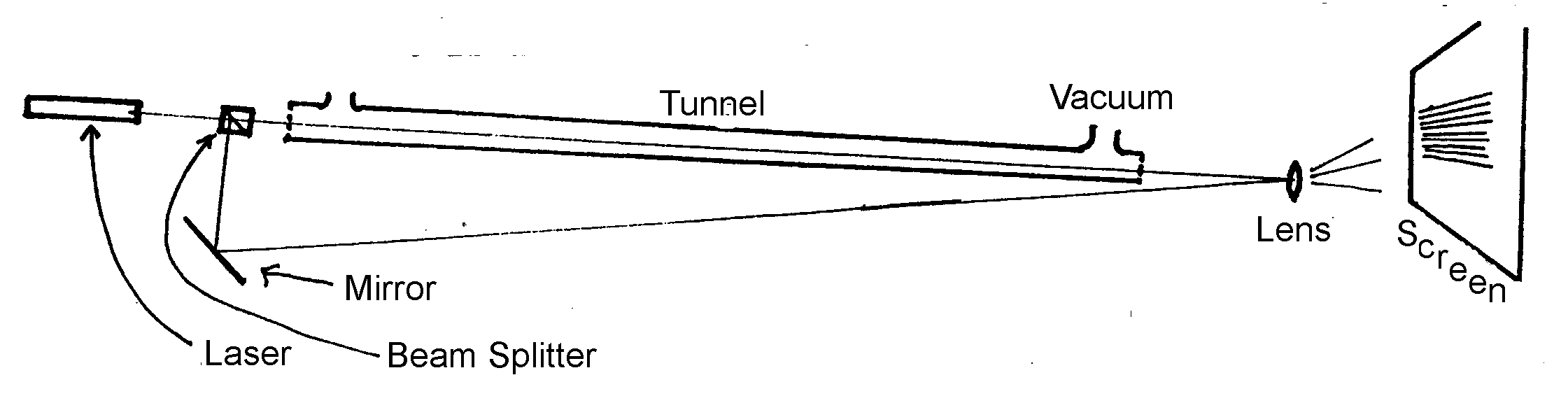
Given this arrangement, I turned on the vacuum cleaner and all the lines vanished at once. I think the whole pattern was destroyed by the turbulence in the system.
What I had hoped, of course, was that turning the vacuum cleaner on would have made the lines move just a little, and turning it off would make them move back. Instead, I found that when I turned the vacuum off, the lines showed up again and then drifted across the screen a short distance before stopping. Some hasty calculations proved that the amount of drift was too great even for the most optimistic estimate of speed of the wind and assuming that speeds add linearly. It was also soon obvious that the lines drifted in the same direction no matter which end of the tunnel the vacuum was hooked up to and the amount of drift was approximately the same in either case. Clearly the vacuum cleaner makes a vacuum in the wind tunnel and that effect was greater than the effect of the wind itself. However, it was possible to measure the amount of drift by counting the number of line widths that the pattern drifted, and by subtracting the drift when the vacuum was at one end from the drift when the vacuum was at the other, the effect of the wind could still be measured.
Unfortunately, the actual speed of the wind becomes a big problem. From the time the vacuum is turned off to the time the interference pattern appears the speed of the air drops steadily. Since it is difficult to measure the instantaneous speed of the air, all we really know is that it is substantially less than what is measured by the time it takes to fill the garbage can. So the amount of shift of the pattern will be less than what it would be if turbulence were not a problem.
The speed of the wind in the pipe was calculated at 1206 em/sec. (maximum)
The distance between the ports in the wind tunnel was about 30 feet or 914 cm.
The laser light had a wavelength of 0.0000633 cm.
The speed of light is about 30,000,000,000 cm/sec.
But in the atmosphere, the speed of light is less. We will take the speed of light in air to be 29,700,000,000. It is probably more.
At rest, there are 14,440,000 light waves in the tunnel if there is a vacuum. If light is slowed down by 1% in air, then there is a 1% increase in the number of waves in the pipe making the total number 14,584,400. So if the atmosphere really did slow light down by 1%, then pumping the wind tunnel down to a hard vacuum should result in the interference pattern moving over slowly by 144,400 bands. Or A SHIFT OF 144,400 BANDS INDICATES A 1% CHANGE IN THE SPEED OF THE LIGHT.
Expected results:
Einstein:
Final speed =
speed of light in air + speed of air
1 + speed of light in air * speed of air
cxc
substituting we get:
Final speed =
29,700,000,000 + 1206
1 + 29,700,000,000 * 1206
30,000,000,000 * 30,000,000,000
Final speed =
29,700,000,000 + 1206
1 + 35,818,200,000,000
900,000,000,000,000,000,000
Final speed =
29,700,001,206
900,000,035,818,200,000,000
900,000,000,000,000,000,000
= 29,700,001,206
9,000,000,358,182
9,000,000,000,000
= 267,300,010,854,000,000,000,000
9,000,000,358,182
Final speed = 29,700,000,024 cm/sec.
This is a .000 000 08 % change. {Maximum possible value.)
Cyrano:
Final speed = speed of light in air + speed of air
This is a .000 004 % change. (Maximum possible value.)
Now a 1% change in the speed of light would move the pattern 144,400 lines, so a .00 004% change should move it 5.8 bands.
According to Einstein, the pattern should move less. It should move about 0.1 bands. Any more movement contradicts Einstein. More than 5.8 bands of shift contradicts Cyrano as well. Less than 0.1 bands of shift would strongly support Einstein.
That, of course, is the difference between still and moving air. The difference between air moving one way and air moving the other would be twice as much. So you proceed thus: make a series of measurements of the amount of drift of the pattern with the air flowing in one direction. Average them. Make the same measurements with the air flowing the other direction. Average them. Subtract the averages, and divide by two. The result is the measured shift.
The whole project, as you see, is not a major undertaking. The availability of a cheap laser makes it duck soup compared to what Fisseau had to do. In all, it would make a nice high school science project, or maybe a lab demonstration. The numbers are a bit big, too big to handle for your home computer. But there is no arcane mathematics, just plain old arithmetic.
Well, I tried it. The shift I measured was 0.54 interference lines. This puts me on the side of Cyrano's machine (which even Cyrano did not propose seriously) and at odds with modern physics. It's the kind of thing that leaves you publishing anonymously in obscure newsletters.
Obviously, this needs to be done in a proper lab with a state of the art laminar flow wind tunnel and professional work all around. The errors that can occur on the living room floor are numerous.
Still, it CAN be done with simple tools and with less mechanical skill than it takes to make a good kite from scratch. So if you are unhappy with the Special Theory of Relativity, you need not content yourself with books; you can check it out for yourself. If you do, drop us a note. And be careful with the laser.
Booty
Editor’s Note:
WILD SURMISE is an occasional newsletter on speculative matter.
Next month, Booty will tackle Love, and then the following month the Weather. We still want to remain anonymous, so give us what help you can in not getting too curious. M learned how to lash a stick to his rock and make an axe, but Booty has told him that the handle is a modern invention, so M is trying to get the lashing undone.
Ed
Ó Copyright September, 1985, WILD SURMISE
MILD SURPRISE
All I could see of the Meriden cliffs was a circle a couple feet across centered on the bridge of my nose. Bill's voice drifted down. "You’re too close to the rock. Get back farther." I was trying to think how I could get closer to it. "Get back, M, so you can see."
I did. I could see better. Down below I could see my boots with toes resting on tiny ledges. In front, my fingertips also rested on tiny ledges. Above, the climbing rope went up out of sight. "Back farther, M."
I straightened my elbows more, and more came into view. Way up there, the rope went over a projection of rock. Way down there, no, never mind way down there. More important, the cliff face came into focus. There was a little projection not a foot above eye level... "Don't reach for it, M. Don't over reach. You'll get extended spread eagle on the rock and not be able to reach OR see." I started to work my way upward by smaller increments.
The pressure of the climbing rope was gentle. Phil was belaying me, sitting secure at the top of the cliff with the rope tight behind his waist, playing the line carefully. There was a pause in the instructions. A conference was going on up there. Bill's voice again, "All right, M. You're going to practice falling."
"I was trying not to fall."
"This is important. It'll give you confidence. Just let go."
"Are you kidding? I weigh a ton." Ten pounds under ideal weight for build. "How strong is this rope?"
"The rope could pull over the whole mountain range. Let go."
"You ready, Phil?"
Phil had the musical voice characteristic of a lot of brave men. "I've got you." The fact that I knew Phil was brave encouraged me. Booty says it shouldn't have.
"All right. Get ready. Here goes. I'm letting go. Right now. Brace yourselves. FALLING!"
I eased the pressure on my fingers and did a back flip off the cliff face. For a moment the serene Connecticut countryside wheeled around me. Then the climbing rope came up hard. The loops bit into my waist, flipped me right way up with astonishing pain and I swung back, kidney first, into the cliff. It was rather pretty, the apple orchard blooming far below, the dwindling hills.
"M," (obscure and complex college profanity) "get back onto the rock!" Bill’s voice was harsh.
I managed to grab the cliff on the next swing and started up. I got no more advice the rest of the way.
At the top, Phil and Bill began silently to pack tools. Extra climbing ropes, pitons, hammers, carbiners, crampons, ice axe, things we had no use for at all. Presently Bill spoke. "When you dived off the cliff like that, you pulled Phil half way off the edge. I had to dive on top of him to keep him from going over."
"But...you...said..."
"Most people when they fall just let themselves slip down the cliff a little." The humor of it was not completely lost on him.
If you run down the trail to the car ahead of the others, you can lie in the grass by the beehives in the orchard, looking at the sky through the branches.
M
Voices Near the Mountain Top
At some point during the centuries that the family has lived in the gentle piedmont country of the Carolinas, the custom developed of retreating from the summer heat to the high mountains. The cabins have sheltered many generations. Rustic and quaint they are, but do not think of them as a hardship. Think, rather, than when Rome was sacked, the Palatine hill was somehow overlooked, and for a few days a year, the old families still return to their ancestral mansions.
Cousin G is sitting at the breakfast table. An enormous man, his physical presence is such that he seems to have just folded his vast arms for emphasis. In fact, he is passing the toast around.
"Why are you writing, Booty?"
"Well, you see, there are these 600,000 Vietnam veterans that died because of the war..."
"But you don’t mean that."
"It's what you get if you subtract the 1980 census from the actual count of the veterans, minus the expected death rate."
"But the overwhelming likelihood is that it's just a statistical fluke, isn't it?"
"Well, I tend to take the numbers seriously. It would be a lot."
"A lot? It would be horrendous."
"And I wrote that conditions like the conditions in indoctrination might..."
"But you can’t be serious. You're kidding with these statistics."
"That would be very bad taste."
"Hmmmm. Well, which way is it? Is it true or not?"
"I don't know. I hope it's not."
"Well, you're just going to have to find out."
In another cabin, Aunt L is inspecting the kitchen.
"0 it's all right when there are people here. But I don't like it alone. I don't like it alone at all."
"Toe quiet, Aunt L?"
"Too noisy." Her eyes twinkle with irony. "Too many ghosts. 0h they're nice ghosts, all of them, but such a racket they make."
A voice from the dark of the next room says cheerfully, "It's worst in the autumn at night, when the walnuts are landing with a crash and rattling down the tin roof..."
Late one night on the porch, Aunt R leans forward and says, "They ought to teach the truth about the Bible." She has spent most of the day strolling the precipitous trails around the cabins.
"I think they should get people to read the thing."
Her eyes are bright under the porch light. "The truth is that the Jews made two mistakes. They made a mistake in the New Testament of course, when they didn't recognize the Messiah. And they made a mistake in the Old Testament. They thought God had chosen them. God didn't choose them. God was right there. They chose God."
Booty