WILD SURMISE
September 1991 #24
AN ALMOST ANONYMOUS INFORMAL NOTE
STARDIAL - GYRO - DOPPLER
Among the many inventions of Edgar Allen Poe is the fiction of the subconscious mind. He described the subconscious in the poem "Ulalume." The narrator and his winged soul roam through a cypress forest beside a lake called Auber in a region named Weir one blustery autumn night. There they disturb a memory that has been deliberately sealed away.
The night wanes and the poet says, "As the night was senescent, and the star-dials pointed to morn, And the star-dials hinted of morn.."
"Star dials" could simply mean the nocturnal drift of stars, which would indicate to anyone sufficiently familiar with them the time of night. But I have often thought of a formal garden with star dials similar to sundials. A star dial, while more difficult to read and more complex to build, would be more accurate than a sun dial, as the sun changes its path through the sky during the course of the year while stars do not.
The star dial should be mounted on a pedestal. Its axis should be aligned with the axis of rotation of the earth. On the axis should rotate a ring marked off in three hundred sixty five segments, each segment marked for one day of the year. A little crank and worm gear advances the ring for each day of the year. The ring advances one segment per turn of the crank, so that the crank can be set approximately as a twenty four hour clock.
Mounted coaxially with the ring are a set of pointing arms, each corresponding to a bright star. Each pointing arm also points to a twenty four hour clock dial inscribed around the ring. There is a peephole mounted on the axis.
Reading the star dial takes a little time. One goes out during daylight and sets the proper day with the crank. That night, if it is clear, one goes out and sets the crank to about midnight. Then one selects an appropriate star. Looking at the star though the peephole, one adjusts the proper pointing arm until a sight on it lines up with the star. Then one reads the time where the pointing arm points to the ring. One then sets THAT time with the crank, sights the star again and reads the time.
The star dial should be a large handsome brass thing. The times on the ring and around the crank should be written in raised numbers so they can be read with the fingertips. The pointing arms should have recognizable symbols so they can be identified by fingertip.
obviously one will need a whole different machine for leap year, when there are three hundred sixty six days. In fact, one will need four machines, one for each year of the leap year cycle. Also, a machine with a peephole suitable for stars near the North Star, will not work for stars that pass close to the southern horizon, so actually a few such machines would be useful.
* * *
A spinning top may look quite still. No mystery there. It is moving too fast for the eye to see the rotation. As the top slows, it may occasionally wobble a bit and then recover its composure. Why it does so, I confess, totally baffles me. How can the top know whether it is wobbling or not? None the less, it seems to be that case that an object must be rotationally symmetrical to rotate in a stable fashion.
I have tried putting a tack in the center of gravity of a board and although the board scratches the ground a little, it does seem to be happy spinning on the tack. Add a weight to one end of the board, move the tack to the new center of gravity and it doesn't spin much worse. Yet there are descriptions of objects "tumbling" in space. It that is anything but simple spinning on an unexpected axis, I am again baffled, but let us see what we can do to understand it.
Imagine a top that is a horizontal weightless beam turning on a weightless point. On the beam are two weights, each weighing two pounds and each five inches out from the axis. (As usual, I use English measure. The metric system is two centuries old and badly needs to be reformed.) I see no reason why this top should not spin in a stable fashion. Move one weight in to one inch from the axis and increase it to ten pounds. It still ought to spin.
But now, assuming the horizontal beam is one inch from the floor, raise the five pound weight to two inches from the floor, bringing its half of the horizontal beam with it of course. The top will still balance, but since the horizontal forces on the axis will be different when the top spins, it will not spin on that axis.
But now reduce the two pound weight to one pound and add another beam and one pound weight two inches above it. Now again it should spin. So although perfect radial symmetry is not needed, there must be a syrrunetry of a kind. Oddly, although rather bizarrely shaped tops would work, I have never seen one for sale as a toy. We will return to top-shaped tops.
As the top starts to tip over, it precesses. Again it is baffling, but it is so obvious and predictable that it seems like it ought to be simple to explain. go to the physics texts and they will at once begin talking about vectors of rotation and vector addition, which makes me think, "cute. And it works. But what's going on in the top itself?"
Let's see. We are looking down at a spinning top. We will call the bottom of the top the "point" and the "top of the top" the vertex. The top is going clockwise; a spot on the top's edge faces first north then east then south then west. We tip the top over a little toward the north. If we tip it enough so the edge touches the floor, the vertex will swing toward the west. But if the edge does not quite touch the floor, the vertex will swing, fairly slowly, toward the east. This is precession.
One would think that what is happening is that the top is spinning along a new axis that does not run exactly from vertex to point, but at a slight angle. If that were true, when we turned gravity off and did not interfere further, the top should go right on, its vertex going from north to east to south, just as a spot on its edge did before. However, when I try that experiment with a precessing top, the precessing stops right away and the top spins along its point-to-apex axis all the way to the floor. It's enough to make you say, "It's vectors" and drop the matter. Some kind of rotational symmetry is needed for the top to spin, but why does it precess?
Suppose we invent a floppy top. The axis is short. From it radiate long flexible but springy spokes with a weigh at the end of each spoke. Now get the thing rotating as before. Now push the vertex toward the north. The spokes bend and exert an downward force on the weights as the pass the north. These weights then start down and continue downward even after they have passed north. The then same time, the south-passing weights are given an upward nudge. This upward impulse is carried to the west. The final result is a tilting of the whole rotating plane of weights toward the east. That tilt tends to pull the axis with it through the spring in the spokes. That is precession.
Here is another idea for a toy. A gyroscopic top is a top spinning it a little frame. Imagine one powered with a little battery driven electric motor. Now imagine a frame with two tops mounted along the same axis spinning in opposite directions. This frame should, to a first approximation, not precess as it tips. Call such a frame a 'bar."
For our toy, make a little hollow plastic creature that stands on two pointy legs, one to left and one to right. Obviously it will fall on its face or its back, so add a "bar' with two powered tops mounted with the axis front to back. Now the creature will not fall over right away.
Add a second bar running obliquely more or less left and right. Fix this second bar in the middle, but arrange for each end to make a circular motion, much as the paddle of a kayak does, but backwards. This motion, too, is powered with an electric motor. As the obliquely placed bar resists turning in space, it must be the little creature that moves. And it will start walking forward on little pointy legs to all appearances in utter defiance of gravity.
* * *
Occasionally, smitten by the fleeting hope I would amount to something, my father would teach me a little physics. He tried to explain that a perpetual motion machine was impossible. I never quite phrased the question, "If everything stops, how come anything is going?" It is a question that modern cosmology persistently ducks. The wild Surmise position is known to many faithful readers.
Once we were standing on the platform at a railway station and the train came by with the diesel horn blaring. I looked up and remarked cheerfully to my father that the engineer had changed the sound of the horn at the exact moment he had passed us. My father explained that the horn had not changed at all. It was the doppler effect. The sound waves of the train coming toward us were compressed and going away were drawn apart making the pitch of the sound change for us.
I shook my head that, as usual, I did not understand.
I have no problem with a bell. When the train goes by ringing its bell, it goes:TINGTINGTINGTANGTANGTANGTONGTONGTONGTUNGTUNGTUNGTUNG
But the whistle or horn goes:
BEEEEEEEEEEEEEEEEEEEEEEEEOOOOOOOOOOOOOOOOOOOOOOOOOOOOOO
Now to my ear, when I listen to a car horn, it sounds different from in front from in back. The lowest frequency (by which we assign pitch) stays the same. But there is more high frequency component. The horn sounds both louder and more strident.
That should not be a surprise. Low frequency sound is less directional than high frequency. Which is a good reason to assign the pitch of the sound to the lowest frequency, so the sound has the same named pitch no matter where the listener is standing.
A whistle, like a horn, is more directional than a bell.
So yes, there is a component of doppler effect the way a train whistle or horn changes as it passes. But when someone starts to explain the doppler effect as being, 'Like a train whistle," reflect that things are more complicated than that.
Editor's note:
Booty came up with a new nutritional concept. "When you look at food, decide whether it would take longer to scrape it off your shoe with a stick if you stepped in it than it would take to eat it; if you wouldn't want to step in it, don't eat it." N tried shifting from gnawing bones to a rough vegetable diet. Said he hated it because it made him go to the bathroom often and it was cold. Booty offered to invent the pre-heated toilet seat, but M said it wasn't the seat.
Ed
Ó Copyright September, 1991, WILD SURMISE
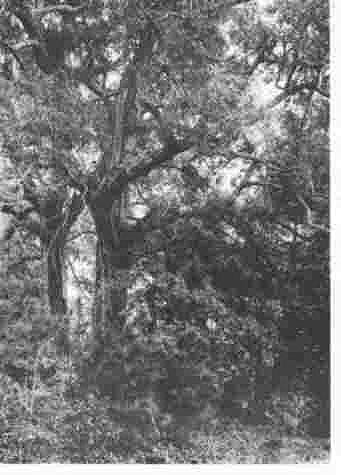
Here once you could stand and see out for miles beneath the canopy of the forest.
_Marching Home
Years ago, when we started this, our only concern was that the combination of the stress of combat in Vietnam plus the churlish treatment of veterans of that war had resulted in unhappiness and even death going on for years after combat ended.
Subsequent studies have revealed that this was, in fact, the case.
This year we fought another war. The ground conflict was brief, resulted in few allied deaths, and the veterans were treated kindly on their return.
As we said at the time, we did not approve of this war. Did not see the need for it and still wish it had not been fought. But fought it was and successfully.
The cost in numbers of Iraqi soldiers killed has not been revealed and apparently will never be revealed. All that can be said is that this, the number of enemy slain, appears to be the highest cost of the war.
Since then, some good things have, admittedly, happened.
For one thing, prior to that war, the two guns regarded as the post appealing were the Russian AK47 assault rifle and the Israeli Uzi. The Uzi is a mere carbine, grossly oversold, useful against unarmed civilians. The AK47 was a serious weapon. But placed along side an M16, the AK47 looks rather shabby.
Since the Desert Storm war, I have not heard a single snigger about the Americans and their M16's. The tool does its job.
In a larger sense the war seems to have settled another controversy. For years there was a stand off, a balance of fear, between the NATO forces that included the U.S. and the Warsaw pact forces that included Russia. Desert Storm pitted Russian machinery an tactics against American machinery and Hungarian tactics. Russia did not do well.
Hungarian? Yes, and thereby is a story. Ages gone by, the East in the form of Muslim expansion was in the process of dominating the world. Do not think for a moment that sheer distance would have prevented them overrunning Europe. The Muslims swept as far a the pacific. They had already taken Turkey and much of Spain.
Europe was saved by the halt of Muslims in the south brought about by Charlemagne and their halt in the east by Dracula. You know the Bran Stoker novel about Dracula the vampire. Well the novel refers to a real historical figure called Vlad Tepes, a count in the Carpathian mountains. I shall not distress you with the unpleasant side of Vlad Tepes, but he seems to have been an aggressive leader. Once, it is said, he led an army against the Turks and lost the whole army, returning alone. One, with headlong valor, he launched a full scale cavalry attack against the Turkish camp in the middle of the night. Swift, unpredictable, ruthless he turned the tide.
Nothing is ever so simple, but it is true that there among the mountains of Eastern Europe the wave of Muslim expansion broke, as had many invasions coming across Asia before.
Well the strategy of Desert Storm was drawn from the army book of how to fight a war. It was standard NATO practice. That practice had been radically changed after Vietnam. The men who wrote the new set of procedures were called the "Jedi Knights," the name inspired by the movie STAR WARS.
The old procedure had been centered around the idea of a slow and grudging retreat, making the enemy attack again and again at terrible cost, backing away and waiting for another attack.
The strategy of the Jedi Knights was based on the concept of the "decision loop." In combat, you observe the situation, orient yourself, formulate a plan, execute the plan and then observe again. If you can accomplish your loop before the enemy can, you are "inside his loop." What he is doing may have little to do with what the situation really is. Sound familiar? It is like the Confederate cavalry under General Nathan Bedford Forrest that could keep three Union armies tied up at once.
The new strategy in action was Desert Storm. Notice how headlong the attack was, how indifferent to time of day. Dracula launches his cavalry at midnight. That's right, the man who led the Jedi Knights was the eldest son of a Hungarian count, from the same part of the world. Another count from the Transylvania turns back the East.
I hasten to add that this newer fellow is a perfect gentleman with none of the evil tendencies that marked Dracula.
So American men and allies defeated Russian design and planning so thoroughly as to discredit them. That is no small thing. We have, in the past fifty years, spent a lot of time and energy for nothing more than containing Russia.
The biggest single fear I had about Desert Storm, beyond the threat to friendly forces, was that the sight of aggressive United States wielding power and waging needless war to achieve ends however lofty (assuming they were) , would produce a backlash in Russia. That eastern forces would not feel safe dropping whatever guard they had managed to raise against us and the reform and moved toward breaking up of the Soviet Union would stall because of the outside threat.
Well we got our backlash all right, but it was so puny, so inept that it only served to hasten the process that was already in motion. The Soviet Union is breaking up.
If this process was secured by Desert Storm, then perhaps one might even say it was a necessary war. I think rather that Desert Storm only ran the risk of stopping the process, but because of its rapid conclusion did not have much effect. But who can say?
For now it is enough to welcome home the troops and pray that war never comes again.
SPORTS:
Last fall the WILD SURMISE marathon runner finished the New York State marathon. Last month the WILD SURMISE women's softball team won the St. Petersburg league. Last night the WILD SURMISE beach volleyball team came in second in its league. The WILD SURMISE newsletter continues to be fabulously obscure.
RING OUT WILD BELLS
Three hundred million Russians are free.
Think about it. Seventy years of communist despotism in the Soviet Union have come to an end. An assemblage of three hundred million people, they have now seized their own destiny. It is the boldest stroke for freedom in two hundred years. If you consider the numbers and consider the degree of restrain they were under, it is the boldest stroke for freedom ever.
You have lived to see it. This year the world became free, free as it has never been before. Unrestrained joy is in order.
The darkness and horror of those communist years are incredible to contemplate. According to one estimate scrawled on the wall of the Kremlin, the cost of communism was over one hundred twenty million human lives. Call it a conservative one million killed each and every year.
And it is over. Without Russian power and energy behind it, Communism will never again be the world dread that it was for most of living memory.
Prosperity, peace, joy and spiritual rebirth. These are the things we can expect from this deliriously happy event. There is humor in it too. Just look at the grudging, nay-saying, timorous response of American commentators, both liberal and conservative. Let us first look at why both ends of the political spectrum cringe. Then let us count our blessings.
Since the 1950's in the United states, there has been a revolutionary change in the distribution of money. It used to be that the farmer on a family farm, the doctor that he visited, the tradesman he dealt with, the banker he worked with, the preacher his listened to, the president he elected, the athlete he admired, the man who owned the company that built his car all made more or less the same amount. 0 surely some people made several times the average and some a fraction. But it wasn't that bad.
Contrast a fictitious little kingdom in the middle ages. Say out of a population of a hundred thousand the king controls ten percent of the wealth of the land. The kind controls the wealth of ten thousand people. There was no such disparity in the 1950's. An income of two hundred thousand would have been incredible. And income of one thousand would have been quite lean. The rich were perhaps a hundred times as rich as the poor. That was a vast improvement over ten thousand times as rich.
Now, at least before the breakup of the Soviet Union, it was estimated that ninety percent of the wealth of the world was controlled by a thousand people. Say there are five billion and eighty percent of the wealth is controlled by four thousand. Then the very rich are one million times as rich as the very poor. This is an incredible shift of wealth. The numbers may be orders of magnitude off and it is still an enormous change.
The remaining liberals mutter about the dirty secret that there is a class system in the United States. It is far worse than that. What there is should be called "enclosure." In a class system, every person has a place in society where he can expect to be protected by the system. So it was once in Britain, when the peasant tilled the soil and lived from its produce but the baron 'ruled'. the peasant and collected taxes from him. Then the "nobles" found it was possible to borrow money, hire troops, chase the peasants off "enclose" the fields in fences and raise sheep.
The dispossessed was peasants no longer. They were destitute and utterly without resource. The land produced less actual wealth than before but since there were fewer people sharing that wealth, the net effect on the nobles was an increase in cash. Enclosure was a most ignoble act.
Our own enclosure movement is more subtle, but the effect is the same. If you have been working making clothes in New York, your employers can hire cheaper immigrant labor or take the whole operation out of the country. Either way your field has been enclosed and you may, if you are not lucky enough to find other work, wind up homeless on the street. But the owner is richer.
At the same time as wealth has become concentrated in few hands, power has become concentrated. Every penny the U.S. Congress decides the spend is a penny that some taxpayer loses control over. You must pay your taxes Or they come after you with guns. When money is spent by congress your taxes must cover it or the interest on it. when a law is passed that does not spend money, that law restricts you in some other way. And congress has never offered to stop increasing the budget or stop passing new laws,
When the old line Communists staged their recent coup in Russia, the press cheerfully referred to them as "conservatives" or "right wing." So far as I can tell, this just means that the press did not like them.
We do have two movements in this country, liberal and conservative, and here is how they break down: The liberal expects to see increasing concentration of political power; Bigger government controlling more people more completely. The conservative expects to see increasing concentration of wealth; more money (or at least economic initiative) in fewer hands.
Listen closely now: These two things are the same process.
The concentration or political power and the concentration of economic power go together. Followed to their logical conclusion they lead to an annual day when the World President and the World Owner get together for a cup of tea and chat about how each can help keep the other in power.
So do not be surprised to hear on all sides squeaks of horror that the Soviet Union is "disintegrating" and major force brought to bear to strap it together. The notion of dividing up power is as foreign as the notion of dividing up wealth. People who crave these things crave them in vast amounts.
And now on the blessings. First we may expect prosperity. With no Soviet Union to arm against, we can spend a lot less money on armed forces. I no longer see any need for a nuclear arsenal at all. And we can reduce our conventional forces too. That will save money. It will more importantly free bright and able people to undertake work that somebody might want done.
There might even develop trade between us and the countries that have been the Soviet Union, trade that would benefit everybody, but I would not expect much of it.
Of course between now and our prosperous future, there stands a winter when the Russian people try to feed themselves with their new and untried freedom. I imagine they will work it out just fine, but it is proper for outsiders to stand by prepared to help if it looks like people will go hungry.
Our second blessing will be peace. of course there is the end of the Cold War, the nerve stretching arms race between East and West. But the cold war was not all that bad as wars go. There were deaths indeed but nothing like those of a hot war. More importantly, it must be remembered that the soviet Union is breaking up into free republics. And free republics do not start wars with each other. There is, of course, the one great exception to that rule. Abraham Lincoln led the North to attack and destroy the south: both were free republics. Yes there was the slavery issue, but the South made more progress in its four years in freeing them then the Union had made in its first forty.
Other than that, republics to not fight each other. So the peace we may expect will not be the fragile peace of a treaty but a peace born of the very structure of the societies that enjoy it. Such a peace can last a long long time.
Our third blessing is joy. Joy is a shared thing. You can be happy by yourself. But to have joy you must have it with others.
As the Soviet Union breaks up into its constituent nations, each nation will be able to go its own way, establish its own sovereignty, own laws, on rules of behavior. They will be different the one from the other. This fills the nay-sayers with bad feelings.
But it is a good thing. A wise and gentleperson should want freedom for everybody. A free state for the French Canadians, a free state for Scotland, a free state for Ulster, a free state for Catalonia. Freedom for Kashmir, for the Tamils, for the Sikhs, for the Kurds, for the south, for the African Americans, for the Basques, for that little tribe in the north of Japan, for the Israelis, for the Palestinians, for the Eritreans, for the Baltics, for the Balkans, for every race and every language.
And among all these little free nations there should be free trade. And everybody should be able to leave when he wants to. Ah, but getting INTO a country on anything but a temporary basis: there is the problem. Each country must be able to restrict access. Otherwise there is either no sovereignty or no free vote.
The nay sayers get hysterical when they talk about the difficulties of dividing up a country into two others. Hut if people want it, it can be done. It seems to me that the first thing to do is to draw the line as nearly as possible to divide the two new nations by ethnic group rather than by geographical landmarks. Inevitably there will be people on the wrong side of the line on both sides. Then you make some little offer like: If you will move to the country where you belong, you will pay no taxes there for ten years. Thus it will be in both sides' interest to draw the line as fairly as possible.
And there will be joy.
People like being with people they are like. There has recently been a rash of hate jokes directed toward blondes. Such jokes are generally regarded as harmless. But look at them a little closer. One thing implicit in such jokes is that all blondes are female. The proposition will not stand inspection, but it is never challenged. Another thing implied is that blondes are promiscuous; but it takes two to be promiscuous, every single time.
Such digs are not new. Consider the phrase, "Tall, dark and handsome." It is a traditional description of a male. The implication is that it is unmanly to be blond. Take the phrase, "Dumb blond." That is not new either. The implication is that all blondes are dumb, presumable the (effeminate) male ones as well.
Why? Well people, except other blondes, hate blondes. Always have. Always will. Yes they may seek relationships, but not all relationships are good. There may be envy, hatred or cruelty at the bottom.
And if something as trivial as hair color can provoke over centuries persistent malice and ill will, what about a real difference, like race or language? A good and strong person will suppress the negative impulses such things arouse, but they are there.
Break the world properly into nations. Let birds of a feather flock together, and joy will abound far and wide and for long years to come.
Our fourth blessing will be spiritual rebirth.
Communism was essentially a materialistic philosophy. It took as axiomatic that there was nothing to life but material loss or gain. The United States at the time of the American Revolution took as axiomatic that there was nothing to life but the gain or loss of freedom.
Faced with a profound and persistent materialistic challenge, the United States took the posture, 'well of course if you wish you are free to try to get material things too." For most of the past seventy years, it was the tension between these two philosophies that shaped the destiny of the world. In other words, materialism was the biggest single issue of the century. There had never been a similar century before.
Now we are free to think about other things again.
Surely there are material issues. Just as, at the time of the enclosure movement there was need for land reform, a need to assure that a peasant could not be removed from his land, so now there is a need for wealth reform. Economic power and initiative need to be divided more evenly throughout the earth. Just how that is to be accomplished is not clear. (Although I imagine the changes already in process will do much and most of the rest will come when the message of the AIDS virus is appreciated: Regulate your sex life or die.) It will be easier perhaps to reform wealth distribution if people care about it a little less.
But accepting that material wealth is but a minimum condition of life, like having air to breathe, and assuming that condition is vouchedsafed everywhere, we will be free to raise or thoughts to other things. Each in his own way, in his own culture, in his own land to seek his own answer to the question of what it is to be human, and what the best way to be human.
Booty
MILD SURPRISE
Father was free from superstition. So it is with many brave men.
When I was perhaps five Father picked up a dog. The dog was tree of course. Father was too frugal actually to pay money for a dog. Older Brother named to dog Bill.
Like Older Brother Bill was handsome, vigorous, aggressive, cheerful, and had a good appetite The little dog could go through a box of dry dog food in a very few days.
Now it was more true then than it is now, but it is still true that a big box of dog food costs less per dog meal than a little box of the same food. Father did a little arithmetic and decided that the cheapest of all was the fifty pound sack.
Now fifty pounds is a lot of dog food to lift, but father did and we wound up with a fifty pound sack on the back porch.
The next day Bill was run over by the milk truck.
So we were dogless until the Florida roaches had so reduced the sack that it was discarded. But finally the day came when anther free pooch turned up and we went and got it.
Trixie I named the animal, confidant that I should be able to teach her all sorts of tricks. She learned how to bark and how to eat all right, but that was about it. still Trixie was a most satisfactory dog, content to stay at home and bark and showing no inclination to snap at the front wheels of moving milk trucks.
Well the dogfood bills piled up and at last it became painfully obvious that although a fifty pound sack of dogfood is an Invitation to insects and very inconvenient, it is cheaper and there is no getting around that.
So we got a fifty pound sack again.
Next day Trixie got distemper and soon died.
The almost full sack contained some kind of fish meal and I thought it tasted awfully good until one careless day when I mentioned to Father just how good it was. The next day my
Cornucopia of free munchies was gone.
The third dog Flash, of whom the stories are as numerous as the tales of Scheherazade, took a special liking to Younger Brother.
Early on it became apparent that Younger Brother was blessed with a physical development and coordination that were exceptional.
One day, soon after he was able to walk, Mother had left him in a play pen in the yard where he could get some fresh air and sun.
The dog stood guard.
Presently the phone rang. It was a neighbor some blocks away calling to say that Younger Brother had been standing in the middle of the biggest highway around with cars rushing by on
Either side. Mother assured the neighbor that Younger Brother was in the play pen and it must be some other heedless person's
Neglected infant. A glance at the yard, however, revealed the play pen to be empty. That little child could really climb.
So Mother went to collect Younger Brother, whom the neighbor had brought in off the road. Flash, it turned out, had followed
Younger Brother, and when the two were found the dog was walking in circles around the child barking furiously at the cars that sped past.
For the fifteen years of the dog's life no fifty pound sack of dog food ever crossed the door.
M
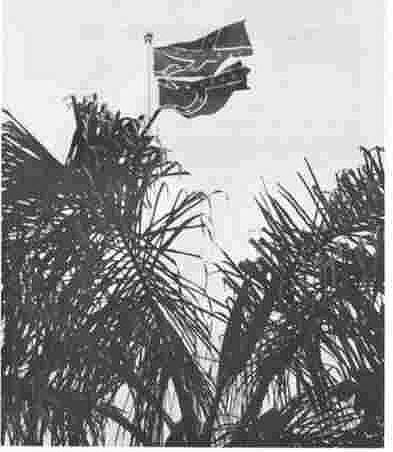
According to the tenth amendment, those powers which are not otherwise mentioned in the constitution (and secession is not) belong to the people and to the states.