WILD SURMISE
September 1987 #15
AN ALMOST ANONYMOUS INFORMAL NOTE
VALUES: NON NEGOTIABLE
There are values we exchange freely for other things of worth, such as cash, and there are values we never give up, such as never breaking a promise. As events unfold, we find we are somewhat more reluctant to give up the cash and less reluctant to give up our word of honor than we thought we were, but the distinction remains. We will be talking about the kind of values that are not intended to be exchanged freely for specie.
There are great thinkers who have provided lists of values of this permanent sort. Here are a few.
Moses: Worship no pagan god, make no picture or statue nor gaze upon them, utter no blasphemy, rest on the seventh day, honor parents, kill not, commit no adultery, steal not, lie not, covet not.
Franklin: Temperance, silence except for a purpose, orderliness, resoluteness, frugality, industriousness, sincerity, justice, moderation, cleanliness, tranquility, chastity, humility.
Marcus Aurelius: Good morals, good temper, modesty, manliness, piety, generosity, abstinence from evil deeds and thoughts, simplicity, study at home, be not deeply involved in spectator sports, endurance, work with the hands, gossip not, worry not about trifles, have no superstition, breed no fighting quails, freedom of speech, philosophy, a plank bed, discipline, modesty, study deeply, be both resolute and lenient, accept favors without being humbled or letting them pass without notice, good humor, tactful resistance to abuse of the language, observation, not to use "I have no time11 as an excuse, love your children, love your family, love truth, justice, equal rights for all, freedom of the governed, generosity, cheerfulness, dignity, do not laugh to disguise vexation, courage, take no glory in honors, overcome any passion for little boys.
Notice that these men are not only writers. Every one of them was a political power house. Also notice that each of these men was writing for a specific group of people: Jefferson was Scotch Irish, Moses was an Israelite, Franklin I suppose was Anglo Saxon, Marcus Aurelius was Roman patrician. Not a one of them mentions loyalty. For the most part, they were revolutionaries. But beyond that, my guess is that a fundamental loyalty to their own people was so deeply ingrained in them and those about them that the existence of it never crossed their minds.
Still, the world that these men consider consists of: me, my God, my nuclear family, my friends, all the rest of humanity. The tone is ME!, ME, Me, me, me, mememe.... Perhaps that is what it takes to be a GREAT THINKER.
Let us take these lists, arbitrary and incomplete as they are, and try to put them in some sort of order, lumping duplicate ideas where we can. For instance, pursuit of happiness can be considered a consequence of liberty.
Life, freedom, equality, piety, do not spend your life as a spectator, rest on the seventh day, work the other days, mate once for life, steal not, lie not, covet not, temperance, silence except for a purpose, orderliness, courage, frugality, justice, cleanliness, tranquility, humility, modesty, manliness, generosity, simplicity, study deeply, work with the hands, be both resolute and lenient, protect children, love your family, love truth, cheerfulness, dignity.
There are no "Christian" virtues on the list as it stands. That is because there are no "Christian" virtues at all. Those who use the term generally seem to do so in order to attack an idea of their own creation. To get at the notion of where "Christian" and "virtue" intersect, I will propose a list of questions. These are not designed to confound the opposition, so to speak, merely to get at the intersection, like finding our way in a strange city. Therefore, please answer each question "yes." Do you think there is a real, abiding, authentic difference between right and wrong? Do you try, really try, to do what is right? Does it matter to you, really matter at the gut-level-up-all-night-pace-the-floor-stand-on-the-cold-battlements-wrapped-in-your-bed-sheet-lose-friends-cry-till-you-throw-up-work-till-you-drop level? Do you fall short? Does that bother you a teeny bit? Have you read the Bible cover to cover? Did you find there a promise that the problem could be resolved by a personal relationship between yourself and God through Jesus Christ? Have you found that relationship? Stop. Stop. Stop. Sorry, don't answer that last question if you don't want to. That question is the intersection itself. Beyond, it is between you and God.
There are no Christian virtues, nothing one learns to be right or wrong as a Christian. What was right before is still right. What was wrong still wrong. The Christian presupposes an absolute standard of right and wrong available to all; it is only his relationship to that standard that sets him apart. A glance back over our list of values seems to support such an underlying standard. These men, linked by similar careers but separated by thousands of years, made very similar lists. Two were Christians, one an Israelite (not a Jew; the tribes of Judah and Benjamin were not yet divided from the whole of Israel) and one a pagan Roman.
Let us go back to our doctored list of virtues, for instance, and try to put some numbers on things If there is a permanent fundamental right and wrong, we ought, in principle, to be able to rank them.
Let us say that a year has about three hundred days and three years about a thousand. In sixty years, sorry if it seems too short but that's life, we have about twenty thousand days. So if we give one day a point, a life is twenty thousand points.
Let us say that a day is worth twice as much if it is free. Freedom is half as valuable as life. So we have life, 20,000 points, freedom, 10,000. Equality is a dream, a good one, but a dream, 1,000 points. Piety, as important as freedom, 10,000 for a lifetime's worth. A day spent as a spectator, watching television or violent sports, minus one point. Rest on the seventh day, plus one point per day. Work the other days, one point per day worked. Mate once for life, IN A WORLD IN WHICH NO DISEASE LIKE AIDS CAN POSSIBLY EXIST, out weighs freedom, say 15,000 points. Stealing, say stealing one day's work worth of value, minus 30 days. Lying, say 30 days negative per lie. Coveting, minus two points per day spent coveting. Temperance, say a quarter of a point per day or 5,000 points in a life time. Silence, the same. Orderliness, 1,000 points. Courage, 10,000 for a lifetime. Frugality, one point per day's work saved. Justice, closer to freedom than to equality, give it 7,000. Cleanliness, same as orderliness, 1,000. Tranquility, the same as temperance and silence. Humility and modesty the same. Manliness and generosity rank up there with courage. Simplicity with cleanliness. Deep study ranks high, along with freedom at 10,000. Working with the hands, right in there with simplicity, being both resolute and lenient ranks with courage. Protecting children ranks with life itself at 20,000. Loving family and truth, right behind at 15,000 points each. Cheerfulness and dignity go right along with humility and simplicity.
There are problems with the list that could be dealt with simply. Not only loyalty but kindness seems to be conspicuous by its absence. Perhaps, depending on your definition, you would prefer to drop "manliness," change its value or add a corresponding "womanliness." I believe in a good self image for everybody, so suit yourself. Change the values on any of the others as you will. Add virtues and vices.
Once you have the list to your liking, some things become obvious. For one thing, it is clear why it is possible to make choices. Some things are more important than others. For another thing, it is no longer stunningly strange that people do, on occasion, sacrifice their lives. Pile up enough points and almost anyone will find there is a point where he is willing at least to take a substantial risk with his life to gain some other good things.
But there is a least one irremediable flaw in such a list of virtues. There is always some point at which such a system breaks down. Here is an analogy.
Early this century, a mathematician named Go~del proposed a theorem, an idea. He not only proposed it, he proved it. I have not seen the proof, nor do I imagine I could fathom it were I to see it. I once had a glimmering of it in a calculus class. The professor had just written an equation on the blackboard, one of many square yards of equation he had developed during the hour. You could hear a general gasp in the classroom as a dozen highly gifted students smelled the same rat at the same time. Someone stammered, "But you can't DO that."
The professor favored us with a twinkle of his eyes. "I'm just trying to get you worried." He had snatched the foundations out from under the very thing he was trying to prove. At that moment I had the eerie feeling that the whole edifice of mathematics lay in a vast quagmire. That its stones were based not on hard formations unseen below the peat moss, but on the hands of imponderable living things that swam forever in the slime sustaining their place by straining their vast and soggy limbs.
What Gbdel said, I am led to believe, is this: For any mathematical system complex enough to permit you to do arithmetic, to add and subtract, there will always be things that are true about the system but cannot be proved about the system.
For instance, pi is a universal constant equaling 3.141.... If you take a table that has parallel lines an inch apart over its entire surface, and a toothpick one inch long, when you drop the toothpick on the table, it will either lie across a line or lie not touching a line. It you drop the toothpick many times, it will cross a line pi out of ten times. It seems silly, of course, but things like this lie around in mathematics, waiting for someone to prove them or disprove them. G6del says you can never prove everything that is true. And he proved it.
Now I will state my idea: It is at least as hard to decide what is right and wrong as it is to do arithmetic.
I hold this to be true whether one considers an individual's own ethical code or one considers a legal system however modest its size. I will make the statement stronger. Not only are there things about right and wrong that cannot be proved, there are things about right and wrong than cannot be stated explicitly. To phrase it another way, "Any system can be abusede" Happily the man who enunciated this for me, and who I thought undertook systematically to put it into action, has gone mellow with age.
Any system can be abused. Any system stands on realities that are true but are not stated. Any system of behavior is incomplete in written or spoken form. Things only work if we want them to work. Understanding why things work is beyond us.
At first blush, one retorts, "Ah, but not for the Christian. At least the Christian is able to state just where he puts that reliance which is beyond understanding. He leaves it with God."
Nice, but noŁ quite. According to the logic we followed, the right and wrong was there, was perceptible, before the presence of God was acknowledged. Right and wrong do not change.
And thereby lies another problem with our list of virtues. It is all so revoltingly relative. The very idea that you can sit down and dicker with principles, can say, "All right, for one generous act, four days of hard work, and a letter to Mother, I'll swap you the theft of a waste basket from the job plus three hours of liquifying my brain with rock music. By the time one is willing to think like that, one is already a moral degenerate.
So I restate my theorem. There is, in any personal moral code, some point at which a person plays for keeps. There are some transactions that cannot be recalled.
This is not a new idea. When Darius was king of the Persians, he had a rule called the Law of the Medes and the Persians. It was a sublimely stupid rule. The rule was that such a law could never be changed. You can guess how it came about. There had been countless conversations between the king and his vizier that went by this form:
Neb: Why did you do it?
Neb: But I told you not to.
Viz: I thought you might change your mind ... again.
Hence the rule. Needless to say, the king soon found he had made a law that he regretted. Decide with the utmost care just at what point you must play for keeps.
Despite the great age of ideas of permanence, such ideas were probably less thoroughly appreciated in the past. In a relatively primitive construction of reality, change is manifest everywhere. For the primitive mind, the creative forces, whatever they were, were just as capable of doing the job all over again as ever. No matter what was destroyed, creative energy would slap together a new one just as good as the old.
The more sophisticated, and highly lamentable, debate between creationism and evolutionism reflects this. Creationism admits to far more plasticity in the universe than evolutionism. For the creationist, there are only a few thousand years of existence to account for. The evolutionist happily concedes the stability of the human form over such a brief period, actually believes in a far more stable world.
To get back to the theorem, we have a paradox. We have laid hold of a fair sized pile of moral precepts and found that they were all relative in value, some more some less, but a plausible argument could be made that they could be compared. On the other hand, we insist on some basic fixed points, are sure that they are around somewhere. Where could they be, if not in the principles by which people behave?
J.R.R. Tolkien was one of the greatest scholars of the English language. He read deeply in myth and legend and created his own fantasy, his master work the RING TRILOGY. Beneath the TRILOGY, supporting it and supplying a context for it, was a work he did not publish during his life time. It was called the SIMARILLION, the legend of the gems. It is not so much fun to read as the TRILOGY, but it establishes the universe for the more popular work. The books are deeply involved with Good and Evil, as the tragedy is played out, but Good and Evil are not terribly persuasive; it is more that they are a way of keeping score, of telling who the players are, than being a real moral force. Instead, there is another element: At one critical moment, one character says, "Even for those who are mightiest under Il'uvatar there is some work that they may accomplish once, and once only." And another, "For the less even as for the greater there is some deed that he may accomplish but once only." And so the tragedy is complete. Neither the Simarils nor their source can be restored.
Tolkien's was a thoroughly modern mind. He knew what he was talking about. At the deepest level of any system, some things are for keeps.
To be sure, religion had offered up ideas of "eternity" for a long time. There were objects of meditation like the imaginary iron ball the size of the earth. Every thousand years an angel comes down and touches the ball with a feather. When the ball is totally worn away, the first day of eternity has passed. But such models were always entertained in the context of a God, who made that ball, instructed the angel, and could change it all in the twinkling of an eye if His divine will were to alter, as it often did. No, it was the physical sciences that really gave birth to ideas of permanence.
Geology was one thing that started to enlarge our definition of time. "Geological time" is a synonym for the long passage of time, beyond what the mind can properly be expected to encompass. Similarly, "astronomical distances" are beyond thought. The world is reckoned to be some five billion years old. The universe is thought to be between ten and twenty billion years old. Think about it. The uncertainty of the estimate is six orders of magnitude greater than the absolute maximum the best minds were once willing to concede to be the greatest age of the universe. Surely it is the contemplation of such vast sweeps that gives the modern world its somber tone so eloquently painted by Tolkien.
But no, there is one thing more likely to throw one into romantic fits of melancholy, and that is the study of life itself, specifically, classical evolution. I do not want, at this point, to get into the evidence for and against evolution, far less to get into the subtle pressures brought to bear by modern methods. Surely we will know a lot mcre in the near future than we do now. What I speak of is the implications of classical evolution, once the idea is understood.
Evolution holds that species diversify and change over time. Considering but a single species, that species will occupy a "niche." It will have a way of getting food, have a way to deal with predators, have a place to be and have a way of reproducing itself. Within any species there is inheritable variation. This variation means some individuals produce more offspring and grand-off spring than other individuals, chances in the environment being equal. The result is a natural selection that results in successive generations being better adapted to the niche. In time, new niches may open, old ones close, competition appear and vanish. The end result is a change in the average composition of the species. There is always new genetic material being formed by a process called "mutation", an error in the transfer of genetic information from one generation to the next. These mutations occur at random.
It takes time. Lots of time. Geological time. But that is not the real time in question. The real time is, "How long would it take evolution to make the same thing again?" The same series of mutations and changes in the available niches must be repeated, if not exactly or in the precise same order, generally the same. It would, of course, take much longer. Toss a penny ten times and get a sequence of heads' and tails'. You will probably toss the coin many times before the same sequence repeats.
For evolution to repeat, there is simply not enough time. It must first go through countless blind loops before stumbling upon the combination you want. Each loop requires a billion years. The stars will burn out long before a single life form is restored once it has been lost. That is modern, state of the art, permanence. The Simarils, once lost, can never be recovered.
Now of course for animals the case will not remain so bleak forever. Already sophisticated means are being used to preserve endangered species. The day may well come when it will be possible to refer to a gene library where, say the cockroach, long since extinct, is recorded in all its genetic detail. Alternate genes will be given, with descriptions of how they affect the roach, records of what the gene frequencies were over the distribution of the cockroach and how they changed for many years up until the decision was made to release the virus that snuffed them out. Decide what roach you want, ask the right lab, and in a few weeks they will deliver it hungry, hairy, smelly and frantic. You will be the hit of the party.
For the time being, however, the extinction of a life form is permanent, permanent in a way not understood before the beginning of this century.
Matters are now worse. We examine a highly relative human value scale, with nothing more significant than a mere life and compare it with values, like the existance of life forms, reflected in times that outreach the universe. How can we reconcile the two?
Of course, as has been said, people consist of their heredity and their environment. I would leave a goodly chunk of free will in there also, but let it slide. Neither heredity nor environment is particularly enduring. Heredity can be rewritten in a single generation. Starting with a population half black and half Indian, you can in theory arrive at a population all Zabo in a single year; they'll all be kind of young, and there won't be that many of them, but you could do it.
Environmental influences were once thought to be even more ephemeral, more transient. There are two extreme positions about education, or perhaps two extreme possibilities for education. At the one extreme, education is understood as an adventure that takes the whole life time. That successive waves of maturity, reflection and growth follow episodes of living through acts better informed, better considered, better controlled and thus better able to yield insight as their effects unfold. This is the meditative life with action, the good books reading life, the unhurried study in the cloister, the learning as if one would live forever.
At the other extreme, life is learned anew, rewritten on a blank tablet, every few years. Marcus Aurelius pointed out that every living person went through every significant life crises and personal emotional transaction every few years. This is what people are really saying when they make such a remark as, "Science proves that half the atoms in your body are replaced in two months, so in six months you are a completely new person." Utter hogwash, of course. The numbers are easy enough. If you eat and drink two and a half pounds a day and weigh one hundred fifty pounds, indeed, some of your atoms are turning over at a high rate. Not all your atoms do so; a tattoo will stay around a life time. But what atoms are being used is really an irrelevance. What matters is your information content, the results of your heredity, your environment and your choices.
Recently, in line with the notion of the retrainable mind, it was seriously proposed that a person could be isolated and subjected to sufficient environmental conditioning to rewrite completely his personality and convictions in as little as two months. The experience with returning veterans after Vietnam has proved this to be less than true. Years later these men are different, as expressed by their death rate, from those who did not face combat. Conditioning does not expunge all prior experience. Yet environmental influences must be renewed every generation. They are not permanent.
Just how much of a person is heredity and how much environment is a matter of extended and difficult study. It seems to me that popular wisdom recently was that heredity contributed nothing at all save humanness; it was all conditioning. Much the same group of people seem now to be condemning the breeding of pit bull dogs on the basis of the conviction that these dogs are inherently savage. Well I'm sorry; you can't have it both ways. If personality is genetic in a dog, it's genetic in a person.
The resolution of the paradox is, of course, the community. Although neither heredity nor environment is assured of permanence, it is true that the combination is at least capable of extended survival. In fact, it is in the potential long term survival of his family or his community that the briefly surviving human has his only hold on permanence.
And communities really are different, one from another. I had an acquaintance who spent a couple weeks revisiting the country of his birth. When he returned, I asked him about his trip. His first remark was one of contempt for the place he had just been. I prodded him a little, suggesting that I would be quite happy to hear something nice about his home. Suddenly he warmed to the subject and blurted out, "You can have anything. Sex. Gambling. Drugs. Liquor. It is a paradise."
Well I don't doubt for a moment that a lot of those things are available in this country. But his idea of paradise and mine remain different.
On a more gruesome note, a friend of a friend married a fellow from some island off somewhere east of Suez in the general direction of Mandalay or Sumatra. On their honeymoon, they went to his home country. Once, when they were coming out of a bank (I don't think that her husband was poor.), an old man was knocked off a bicycle and run over. For the next several minutes, three things went on. She continued to scream and gesture. He continued to insist that she come away. And the traffic continued to drive over what was left of the old man.
She simply had no concept of the indifference the thing she had married was capable of, nor he any concept of what a poor sense of when to make a scene she possessed. Now I am sure you are quite capable of being relative about all this and seeing it a large perspective, how the woman's behavior was as rude as it would have been to make the same scene in a hospital where a child had just died because of the lack of availability of a highly sophisticated technology that the community simply could not afford. On the other hand, objectivity is only a relative value too. And there comes a time when you would rather give up your notion of cultural relativity than your compassion.
Your culture can go on far beyond what the life of the old man would have been, far beyond your own life. You cannot assign a number value to it the way you can for strictly personal goals and values. And your culture is different from other cultures; it includes a specific group of people and thus has a specific genetic structure, and those people live in a specific environment so the culture can be said to have an environment. Whether a culture makes choices or the people in the culture make choices is a matter for consideration elsewhere.
Certainly, there are those who claim people are the same. Freud did a very serious study of neurotic, vain, idle, Victorian, Viennese women and discovered that (1) people have childhood experiences (true), (2) these experiences are very important to the development of the personality (bravo!) and (3) the experiences of infantile sexual lust for the mother followed by guilty fear of the father followed by an attempt to identify with the father is universal for all people (oops). You begin to think Freud was another Great Thinker, trying to impose his own mental construct on a world he had mostly never even met. If Freud failed to insist that everybody fit the same mould, that defect has been filled most amply by his devoted followers.
And that psychoanalytic school, blind from the start to cultural differences, has been most insistent that there are no permanent values, that all things are negotiable.
When dealing with permanent values, people do pretty well. Take nuclear war, for instance. In the last forty years, the number of lives lost to nuclear weapons ignited in anger has been identically equal to zero. None. Nobody. These ferociously destructive weapons ave been contained with total effectiveness. And contained by whom? By authorities, by the Big Boys, by politicians. The same frenzied folks who have given you wars in Vietnam and Afghanistan, who were responsible for Chernobyl and the Shuttle, who set up the system under which KAL flight 007 was shot out of the sky and who simplified income tax. Those very same men have spent four decades holding onto nuclear weapons and haven't fired a one. In handling nuclear weapons, people are persuaded that they are playing for keeps. They are convinced that, "A nuclear war would end civilization as we know it," and they have responded with due caution. What they are not convinced of, but what is equally true, is that there are a fair number of other things that could end civilization as we know it. They - we - believe that everything besides nuclear war is negotiable. It is not.
Concern for negotiable value dominates much of our culture. It is often said that we are overly materialistic. This is true only in a rather special way. we are not all that eager to make money. We are eager to spend it. Were we, or a fair proportion of us, really eager to make money, a lot of things would be easy. You could get your car fixed or things about your home repaired with a single phone call. Instead, you spend a day at it. The car, you drop off at the garage, and then you make your own arrangements about how you will get along without it. A home repair, you ask someone to take care of it and then you spend a day waiting for the person to show up. There just are not that many people out there falling all over each other to get a chance to earn your money.
But spending money, there people, present day Americans, are inspired. A wrist watch, a car, a condominium, an ornament, for this kind of thing money is spent beyond any reasonable estimate of value received. Yet people are not disgusted by such displays, people are thrilled. It is as if there were a logic people wanted to believe in that went, "There is so much negotiable value around that non-negotiable values are not important."
Among the permanent issues that could destroy our society as radically as a nuclear war is the question of what people do with their private lives. Paradoxically, during the years that public officials have done so commendable a job dealing with nuclear weapons, the nuclear family has blown up.
You know how a nuclear bomb works. A nucleus is the tight, dense, almost indestructible core of an atom. You can add a neutron to a nucleus and increase its atomic weight. You can add a proton to a nucleus and increase its atomic weight ad also its atomic number, thus changing it from one element to another - as hydrogen to helium or platinum to gold. By judiciously adding particles, you can create a nucleus which is quite large, with an atomic weight in the hundreds. Eventually the moment arises when the addition of but a single neutron is capable of making the nucleus unstable, so that it disintegrates in a destructive fashion, showering the area with fragments, some of which are capable of producing instability in neighboring atoms.
With the human family, it is different. It is not the number of elements that causes the family to disintegrate, but the diversity. Further, when a family disintegrates, the fragments are human beings, often feeling unbearable guilt and shame for a process that was not entirely of their own creation.
In the United States, there are four conspicuous concepts of family, two new and two old. The first of the old concepts was the English family, assumed to be sort of natural law by the Anglo Saxons. it was based on the very successful model of the English noble house, in turn based on free enterprise.
Vikings were freebooters, private entrepreneurs. A Viking rowed his boat as he sat, not on a bench, but on a chest for holding the things he captured during the voyage. Each man was in the enterprise on his own account. The last great Viking raid on Britain was in invasion by William the Bastard. Reducing it to essentials, in 1066 William conducted a raid on England so successful that he pushed the Viking way to its logical limit. The Bastard stole the whole country. Like any other Viking chief, he then divided England up among his men. The right to the land then passed, father to eldest son, for many generations. At the time of the American Revolution, such families were still a substantial force in England. This was the English noble house: it was bound to the land, it was legally instituted, it was patrilineal, it was hierarchical, it commanded great wealth and prestige. Although the protestant Roundheads opposed the noble houses politically, demanding power for a parliament elected by all the citizens rather than only loyalty to the king, the Roundheads did not redefine the English concept of family.
Like the Anglo Saxons before them, the Norman Vikings failed to gain complete control of Scotland, Ireland and Wales. These were the people, Pictish and Celtic, who gave rise to the Scotch Irish.
The Scotch Irish definition of family was different. The basic pattern was the clan, an extended family formally led by a clan chieftain and identified by a tartan in some ways similar to an English coat-of-arms, the logo of a noble house. But the clan was a more primitive, less formalized institution. It was not tied to a specific piece of land, was not looked over by a professional college of heralds, not so rigidly patrilineal, not so hierarchical. Wealth was of less significance. Personal loyalty was far more important.
Whence came the clan structure is another puzzle. Pictish or Celtic? Like red hair, the clans are most conspicuous in Scotland, where the last Picts, and they were not few in number, made common cause with the Scots, a Celtic tribe.
The Scotch Irish were no highlanders, but they would have thought of the clans as being natural law, just as the English would have looked to the noble houses.
The American Revolution was a resounding defeat for the English. Although the Anglo-Saxons, Roundheads and Cavaliers together probably outnumbered the Scotch Irish, the constitution was written expressly forbidding the establishment of patents of nobility in the United States. The Scotch Irish family concept was the one accepted as proper. And indeed, so it has been.
The American family has been flexible, tied to no piece of ground, centered around no mass of wealth. The "head" of the family has often been a middle aged male as in much of the world, but frequently a household has been led by a woman, a child or a grandfather, whoever had the strength. The family was held together by individual family ties and personal commitments rather than by a generally acknowledged formula. Indeed, many if not most of the Scotch Irish can point to a coat-of-arms to which they, however poor and however without personal vainglory, might lay legitimate claim. But that coat-of-arms is not a legal document. It is merely a proof of how far back the family goes; proof of the robustness of this highly individual, very private sort of relationship. It indicates that the family is very old.
There are two newer concepts of the familye One is the nuclear family. When the term was coined, it was hoped that the nuclear family, parents plus children, was the unit that could hold together against all forces. Already the extended family had undergone decay. Increasing mobility had scattered the members. Varying experiences had rendered them unable to sympathize with each other. The nuclear family, once thought to be the unit of natural law, proved to be a transient stage in the evolution of the Scotch Irish extended family into the modern single parent home.
The change has been swift, like the rapid acceptance of the automobile after it became available, so swift that it is hard to understand the forces that kept the family together over so many centuries as documented by coats-of-arms and probably for millenia before. The forces were, of course, the fact that people wanted them to hold together, the fact that with respect to his family, the American and the cultures he arose from played for keeps.
It seems, from a glance at the numbers, that the American plays for keeps no longer. The family is only one of many commitments he may make and break as convenience and whim dictate. The situation is described most movingly and disturbingly by Allan Bloom in The Closing of the American Mind. In it, he describes the condition of college students in Chicago, who he asserts are the same as youth throughout the nation. (Do you sense another GREAT THINKER?) Perhaps it is not so simple, but the Chicago he describes is a spiritual wasteland. Unwed teenagers live together in brief dispassionate affairs. All activities are tolerated. No major exertion is expected. The only thing that is condemned is the act of believing in something. Minorities are accepted in a bland homogenization of cultures, themselves deprived of any strong hold over the emotions. Mr. Bloom calls for a return to principles of enlightenment and a return to reading great books as a way of bringing some valuable life to the intellectual waste.
The fact that he demands a return to the very principles that produced the conditions that distress him is a paradox that does not escape him.
His description seems true. No principles seem to he held with resolution. There was a time when the intellectual was a person who believed in the life of the mind. The motto of Harvard University is VERITAS - Truthe Yet I have seen within the past month a statement from Harvard University that there was no point in a person getting tested for AIDS virus because there was no statistical evidence that knowing the test results improved his behavior. Think about that. An institution dedicated to truth advocating ignorance. That is not an isolated event. By and large, it is the educated people who have stood up against testing and screening programs for this terrible plague. That constitutes abject intellectual cowardice. This wanting not to know about an issue of monumental importance. In this regard, to the extend that the American educated people resist the investigation of this disease and its spread, to that extent they betray themselves as anti-intellectuals, who have no trust of the mind nor of knowledge.
The word "conservative" generally is regarded as meaning "liking things to be the way they just were," "liberal" as meaning "liking things the way they are going to be." The definitions become tricky when a social trend reverses itself. I would say the liberal mind values the present and near future only. The conservative mind values also the near past and, to a lesser extent, the far past and far future.
However you phrase it, it has always been the conservative position to avoid catastrophic debt. One would expect the conservative to be FOR education, parks and conservation and AGAINST rapid economic growth, preferring even good things to come in good time. Instead, a conservative government has just run up a debt the likes of which the world has never seen, is attacked repeatedly for callousness both toward education and and conservation, and has led us to wealth on a scale beyond the dreams of Midas. Conservative? Conserve what? Like the intellectual, the conservative has betrayed his own principles.
The liberal, rather caught off balance by the double cross the conservative has worked upon himself, is in a crisis of his own causing. He has pretty much got all the things he ever wanted and now mostly seems to be looking for some new way to be martyred. Doing things to hurt the government of South Africa seems to be an appealing thing, but South Africa doesn't have a way to hit back, so it's sort of hard to feel good about it all. Besides, anti-government forces in South Africa have a habit of lighting their enemies on fire, the kind of thing liberals always said they didn't like. Well, you can't call a man a coward if he has just won every fight and can't find another.
But there was once an issue. Fairly recently, a man was deported from the United States for having been a Nazi. No one spoke in protest, even though his life would be in danger where he was going, and in danger for political reasons. At the same time, the wood pile is thick with aliens who have been smuggled into this country by liberals on the basis of the belief that their lives would be in danger for political reasons at home. So where were the liberals? The Nazis were defeated decades ago in a time that, by liberal standards, never existed. But the notion of trying to protect a sick old man in the near future did not outweigh a grudge from the distant past. In that respect, if in no other, the liberal failed his own principles.
So how are we getting along in this new and different age of no principles? An age accused of having escaped from all permanent values except a hatred for any permanent value? In some ways we have got along quite well. In the last forty years we have accepted a tremendous number of new people to our shores. Although this entails problems which may very well destroy us in the end, there is no denying that this tremendous immigration has had some advantages for the immigrants. You can make a lot more money in the U.S. than you can where a lot of them came from. And, of course, in the short run, it has made some money for us. Skilled and aggressive men who might have been using their energies to deal with population pressures and poverty at home are here picking fruit at sub-standard wages. That saves somebody money. The fact we have a rural depression in the country, that our native born who expect to pick fruit can't find work shouldn't come as much of a surprise, of course. We really didn't want a lot of the aliens, of course. We had laws on the books to keep them out, but were too cowardly to enforce them. Still, the advantage of cheap fruit picking is undeniably there.
We have made money in other ways by the general decay of our families and other institutions. The economy has created jobs for most of the enormous number of women who have entered the job market. Unquestionably, this has been a tremendous accomplishment. At the same time, when we increased our work force to almost double without increasing the number of people we have had to feed, it is no surprise that our average income has gone up. The disintegration of the home, whatever its long term pain, has resulted in more money in somebody's pockets.
And at the same time, we have managed to keep some of our basic freedoms. You must read the constitution most closely and be willing to stretch a point or two to see where it guarantees you the right to marry whom you want, live where you want and enter any public building you choose.
But the most superficial reading will show your right to run a printing press, to own a gun and to drink alcohol. Freedom of the press and the right to bear arms were guaranteed when a press turned out one page at a time and flint lock musket was a jolly good firearm. Now, with presses able to run off pages faster than you can count them and rapid fire, dependable, convenient firearms, we have managed to hold onto the same rules. We have made progress while standing still. Freedom to travel by horseback has become freedom to travel by private jet as if the only problem was with the availability of the jet. And age of "no rules" enjoys unprecedented freedom of personal initiative.
On the other hand, we have some problems. For one thing, our teenage suicide rate has gone up. Since the 1950's, every other age group in the country has had a fall in their death rate. The teenagers have had a rise. And the increased deaths are due to suicides, drug abuse and generally poor life choices. That is a warning, a tremendous warning. A teenager is able to become very very unhappy before it kills him. Anybody who has been one knows that. Well there are a lot of very unhappy teenagers out there. For them, the fifties really would have been a better time to be alive. These teenagers are the very people who are entering this new and self indulgent society. They do not like it. I do not know just why, but I suspect it is because they feel they do not have people who care for them or a future that appeals to theme That matters. In every system of behavior, there is some principle for which the play is for keeps.
Another danger sign is, of course, the AIDS epidemic. For a long time, the virus was tripling its infection rate every year. I do not know whether that has ceased, but the fact is that the virus is capable of such explosive growth. Perhaps the epidemic will be brought under control. If not, there will be few people in the nation by the end of the century and few in the world in another decade after that. If the epidemic does cease, it will have proved one thing. A slow virus with lethal results years after infection is able to spread rapidly through a population by venereal contact. next time we may not be so lucky, if, indeed, we get lucky this time.
Mate once for life. From the stand point of the individual, the value of the principle can be measured as something worth what his life is worth to him or perhaps for many people rather less. From the stand point of the family, the value of the principle mate once for life may exceed the value of the individual, since the family is capable of long term endurance. From the stand point of the survival of the human species, the value cannot be calculated.
Anything that entails a risk of exterminating all human life, and I mean all members of the species, not "civilization as we know it," must be compared with the value of humanity. Barring a single hint of an artefact on Mars, there is not the slightest evidence for other intelligent life in all of space. Nor is there time for such life to evolve by natural means. Intelligence is no more a direct goal of evolution than is a vermiform appendix. Granting intelligence may have arisen once by chance, the only reasonable assumption is that it could never do so againe The value of the human race is the value of the universe. If you believe in some divine cause for life, you may arrive at the same conclusion more directly.
And AIDS, or some other slow virus, could eliminate the species. Venereal spread turns out to be an excellent way for a virus to spread. Of course any factor, be it air travel, free trade, extensive tourism, mass migration, any factor that makes all of humanity available to an infectious process, must be balanced in value against the chance of transmitting some final plague.
In a world in which the AIDS virus is already known to exist and know to be transmissible by venereal contact, mate-once-for-life becomes a command of the strictest sorte We have been warned.
A third sign of trouble, rather more subtle, is the way we are reacting to the crisis. We are acting like the irredeemable drunk or dope fiend, who responds to the pressure of realizing he is destroying himself by clutching his poison ever tighter. No serious thinker can look upon American life without detecting a crisis.
If you take an acid solution and add to it just a few drops of phenolphthalein, you will get a colorless solution. If you now add an alkali, the solution will begin to turn bright red just where the alkali is pouring in. Eventually the point will be reached where the addition of a single drop of alkali turns the whole solution red. Now, if you just shake the container with the solution, it will turn clear again. You may do this again and again, a drop and a shake, a drop and a shake. The solution goes clear, red, clear, red. But ultimately, the time will come when the solution turns red and stays red no matter how long you shake
it. The thing to realize at that point is that the solution is red, not because you have not shaken it enough, but because you have added too much alkali.
So it is with the nation. We have, over the past two centuries, added enormous numbers to our nation, numbers of people who were neither English nor Scotch Irish. More recently, the numbers have increased and the newcomers have brought more and more different preconceptions. The idea that had always worked before was to assimilate them - shake the solution until it turned clear again. That, from high and low, continues to be the call. No one seems to concede that the solution, however well shaken, the population, however thoroughly it integrates with the newcomers, must forever be changed.
There is one exception. One force solidly, explicitly and confidently scorns to be destroyed, will not fuse in the melting pot, despite deliberate pressures brought to bear on it to make it do so. Like Prester John, come unlooked for out of Africa to save us from Gog and Magog the frost giants, a fellowship of some of the oldest American families still stands in defiance. They are the Blacks.
The Blacks, for various reasons, have long been most generous in taking to themselves the unwanted, the half breed, the mulatto. To him who could claim no family, the Black said, "Brother, you are one of us." Blacks did this so regularly that it was, in the days of racism, institutionalized in law. A child half White and half Black was Black for legal purposes, because the Blacks - on whom he had no greater claim - were the ones most willing to accept him. This law has been called, in what I think was one of the most churlish and unfair gestures of a graceless time, the law of "hypodescent." The word implies that if your parents were of different races, you were assigned to the "lower" race. Of course, you smell the Anglo Saxon influence. Among the English noble houses, there was a strict ranking, a hierarchy. This was so thoroughly accepted that it was occasionally remarked with surprise that a "lower" family might be prouder than a "higher" family simply because the "lower" family traced its way back farther or simply because the "lower" family consisted of better, more able and more honorable people.
The Scotch Irish never conceived of the ranking of families. Families were different, yes, but were not to be set in any scheme of superiority. Many families were older than any such scheme and expected to endure after any such scheme had passed.
Generous the Blacks have been, even to their own disservice. But when asked to assimilate with the white culture, they want none of
it. Now, they say, you are not asking for generosity; you are asking for suicide. Suicide we will not commit, simply for your convenience. We have more pride in ourselves than that.
It came as a shock to the liberals. The Southern Whites had alwaystold them, "But these people do not want to be White. They want and deserve a better and better break for themselves, but they neither desire nor need to be White. Nor is it possible."
To this, the liberal integrationists said, "Either the Negro was lying to you, or you are lying to me, because what you just said does not make the first ounce of sense." Well, now we know. The Black does not want to become a White. And he is strong enough to make that point stick. He is not suffering from culture shock. He has lived in this country longer than the average White.
People really are different. if you doubt that, ask some people about it. In Ceylon, there have been troubles between Hindu and Buddhist elements. Dismiss from your mind the notion that oriental mysticism and meditation are ways to universal peace and brotherhood.
In the Punjab, I understand the fighting is between Hindu and Sikhs. I used to think they were different parts of the same group, castes are something, but no, they are killing each other. Iran and Iraq, neighboring countries with similar names. I once thought they were like Tweedledee and Tweeedledum, but they are Arabs and Persians, and they hate each other.
You might think you could gain peace by taking two warring countries and making one country of them, by making the Persians and the Arabs live under the same government. But Lebanon tried to incorporate too much diversity and at last, when challenged with an invasion by Israel, like a nuclear bomb or a nuclear family, blew itself to smithereens.
Certainly there are exceptions. Switzerland has managed to keep civil peace and at the same time encompass citizens who speak four different languages. But Switzerland is a land of mountains. Mountains keep people apart. Kept apart, they keep the peace. Yet even so, at a private level, Switzerland is not free from tensions between its language groups.
France, the greatest republic of all. If we are dedicated to life, liberty and the pursuit of happiness, France is dedicated to liberty, equality and brotherhood. If you consider the United States tobe a single republic, then you must declare that there is no other republic that is a world power of the same magnitude that has such a long history of commitment to democratic ideals. If you consider the United States to be an alliance of 50 little republics, then you must say that France has a longer history of democracy than any comparable world power. And France puts an emphasis on brotherhood that the United States do not.
Alas for brotherhood, some forty or fifty years ago, France was overrun by the Germans. Many French resisted the occupation, many cooperated with the Germans, taking them to be the duly constituted law of the land however loathed. When the allies finally drove the Germans out, the people of Paris rose up against the German sympathizers, killed them and threw them into the Marne. There were so many bodies that they choked the bridges and lay in rafts for many days, and none was so bold as to go down and take the bodies up for burial. Do not believe for a moment that due process was observed, nor that every one of those miserable people had even been a German sympathizer, not merely denounced by unscrupulous enemies. Feelings ran high. The hostility to the Germans overshadowed all else. If France can feel such unreasoning rage, anyone can, yea, me and thee, when events crowd in on where we play for keeps.
There is a feeling, a dream, I'm sure you know well. The idea is that all people should settle their differences and live together in one united, harmonious, tension-free world. Beneath a gaudy but brittle surface, it is not a pretty dream. It would' mean the destruction of countless cultures, each far more precious than a large number of wild animal species and impossible to restore even in theory by some clever laboratory cloning trick. Further, that dream, if accomplished, would leave humanity so vulnerable to plague that the appearance of that plague would be a virtual certainty. Yet many and many are the good people drawn by that dream.
For the most part these days, cultures keep their distance by a kind of mild mutual contempt. The Protestant, in his inmost soul, thinks the Catholic is an idolator. The Catholic thinks the protestant is a self-deluding heathen. The Latin notices that AIDS in the U.S. is spread by homosexuality and I.V. drug use rather than by heterosexual intercourse as it is in Africa and confirms his notion that the Gringos are effeminate. The Northern European extraction American listens to the Latin attitude toward women and concludes that the Latin male does not really like women, only likes his own image to be enhanced by women, and thus the Latin male is no true mane Orientals move effortlessly through Western society, to all appearances free of any illusion brought on by seeing the world through an ethnocentric filter, but beneath the urbane manner, the Oriental may not be admiring all he sees.
Travel around the world and find out about other people. Go without a companion, a notebook or a camera. Sleep in their ditches, work in their cities, court their women, eat their food, learn their languages. But most of all go alone. Few who have done so return with the burning desire to settle all differences. Because if you live that closely with them, you cannot fail to pick up some of their own attitudes, particularly the attitude that they are special in their own way.
Court their women, and you will get the clear cut message Get Out. Perhaps the message will be delivered by a very large and very black Barbasian man who, perhaps mistakenly, thinks you have been sleeping with his girlfriend. You may use all your wits to avoid getting into a fight with him, wondering the while whether he has a knife on him. By the time you have prepared yourself for a knife fight with a man, you have looked into his mind with the utter honesty with which you decide which of two burning flights of stairs is most likely to take you safely out of a doomed and empty building. If in his mind you find something that makes you say, "He has a point," you will not forget it.
In colder climes and more sophisticated cities, the message may be more subtle. Perhaps the girl herself will say, "We should not talk when we walk trough this part of town, because these are uneducated people, and they will be angry if they see me with an American." And you hold your tongue, as disgraced as if she had locked you in the trunk of her car to drive through the neighborhood.
Or perhaps, among sweet and gentle people, you will hear, "Come stay with us. Talk with us. Take our sixteen year old daughter, for she is of mixed background and no one else will look at her."
Or most subtle and most devastating of all, at some gathering of the educated, the brilliant, the mighty of the land, truly caring people will say to you, "0 you are an American. How wonderful. There is a woman here who is an American, who married one of us forty years ago. Won't you go talk with her?" And you will read beneath that the plea, "Won't you do something for her? Speak to her grief. Speak to her loneliness. Speak to her terrible sense of strangeness." And you will speak and find nothing you have to offer, nothing to say but, "This should never have happened." And you will hear the message again, "Get Out."
It is at the highest levels, of course, that we have the greatest differences. What all humans share with each other, they also share with the beasts - certain biological functions and certain emotive reflexes. But the world's greatest harpist has spent time with the harp as the world's greatest tennis player has spent time with tennis and the greatest scholar time with books. These three paths, none shared by any animal at all, each leads away from the others, each excludes the others along with a host of careers, interests, opportunities and choices. Indeed, all great harpists have something in common, even if they like each other about at well as great tennis players do. But it is in the refinement of the mind that the mind grows most different from other minds.
The educated person has a duty to the group he represents and that duty is at least as compelling as his duty to his field of studye That the duty of the mighty to the humble is about the most consistently neglected duty around is irrelevant. Any society needs the loyalty of its intellectuals as much as it needs the loyalty of its laborers. There was a soccer player once who was declared a national monument in his own country so that he could not be sold to another country. Surly the best mind of a nation or culture group is as vital as its best pair of feet.
The mind is a remarkable device. The casual observer notices that the mind is capable of believing very silly things. I once saw a little statue, thought to date back to the stone age. The expert describing it suggested that it was a fertility goddess because of the exaggerated size of the breasts, buttocks and thighs. In fact, what I was looking at was a fair and honest depiction of a normal healthy woman. There was nothing odd about her body at all. She was just a very fat woman. The archaeologist had been so taken in by his own culture's preconception of what a woman looks like that he didn't notice that the artef act looked pretty much like people who are around all the time. The stone age carver had drawn truth, and the scholar was blind. I am sure that with the most gentle prodding, the archaeologist would have rephrased it, that the artist had "emphasized" rather than "exaggerated" the anatomy.
Some opinions are harder to change. Never make an important decision on the telephone or in conversation. All you can do under such circumstances is to rephrase decisions you have already made or accept information for which you have already prepared yourself. most mammals simply do not process information in real time. Duckbill platypuses and spiny anteaters, apparently, never sleep. Whatever information comes in gets incorporated or forgotten right away. But for the rest of us mammals, we sleep. We go through the day carrying on with what we do, and at night we re-process the information, building up a new program, a new set of principles by which we will live through the next day into the foreseeable future. This goes on while we are unconscious. We cannot both go on doing things and reconsider the fundamental basis on which we decide what we are going to do. Deciding how to live, except for platypuses, is more difficult than arithmetic. There will always we things about the system that are true but cannot be proved.
That is why students are falling asleep all the time. Something new turns up, the student falls asleep, incorporates the new idea into his mental processes, wakes up, finds he has missed a point. Then he hears something new, now totally out of context, falls asleep again and so forth. It is the only way to learn. If the student is aggressive, he will attempt to read over the lecture material the night before. Now he falls asleep because he was up all night.
Unfortunately, the sleep routine cannot handle everything. If something happens during the day that is too important and too unhappy, the brain will not be able to incorporate it.
A spelling check program on a computer is a good analogy. The operator sits at the keyboard writing out an essay. The computer is "awake" collecting new information. The operator hits a couple of buttons, and the computer runs a spelling check, picking out words it is not familiar with. During this time, the computer asks the operator for guidance, what to do about a word that seems misspelled, but it is not "awake," not open for more writing. When the spell check is complete, or if the operator interrupts, the computer "wakes up" again.
With some spell check programs, you can sabotage the program by inventing a word that is very very long. The spell check program tries to copy the word but does not have sufficient room to put it in the right place. The machine then sits there, doing nothing. It is not just depressed, it has had the computer equivalent of a complete psychotic break. Often there is no cure for this electronic catatonia but to turn it off and start over.
The mental equivalent is a depression. An event happens in the course of the day that is very important and very unhappy. The person responds by going into a sort of a daze. At the end of the day, the mind tries to incorporate the new information. if the new information is not acceptable, the program simply announces that it cannot function and wakes the person up again. Obviously, the program is far superior to the computer equivalent. The person does not, generally, need to be unpluged. But it can be most unpleasant and, more important, there is a definite limit to the extent to which the sleep mechanism is able to respond to new and unacceptable information. In that case, other adjustments will have to be made.
Here is where playing for keeps occurs on a personal level. Here is why people under stress, particularly novel stress, do not always behave rationally. The conscious mind is unable to deal with radically new material and the unconscious mind refuses to accept it. A person cannot move effortlessly from one mental world to another, may not be able to change at all, even if changing would be, in rational terms a good play. And pity the child who grows up with parents whose backgrounds are so different that even in the course of a day the child may need to make such a change more than once. Pity that child when, as a teenager, he must begin to take the responsibility of presenting a coherent self image to the world.
In all likelihood, a developed, mature, self conscious culture probably has genetic as well as learned information that gives it its form and permits it to survive. But it really does not matter. Neither genetic nor leaned information can be altered past a certain point without catastrophic consequences.
Like the Romans, Americans have missed this point. The Romans gave their loyalty to the city, to is geography, its language, its dress, its laws and its customs. Anyone who came to Rome and was willing to adopt the dress and customs, learn the language and obey the law was a Roman. He might be a plebeian or, if adopted by a powerful family, a patrician, but he would be Roman, and Rome needed no more than such people in order so survive, or so it was believed.
The belief was manifestly untrue. There were in the Roman scheme of things, as in any scheme of things as complex as arithmetic, unknowables. There were unwritten laws. there were things people thought and did without knowing that there were alternatives -and those alternatives, when ultimately acted out, destroyed the republic and later destroyed the empire. What Rome needed, what any culture would need, was a sympathy that reached from the slave to the consul and back. That sympathy, once it existed needed steadfastly to be maintained.
The differences between people also need to be guarded, because if differences are not guarded, one of the unwritten rules may be uncovered by events and rise up with terrible destruction.
Let us make up a story.
Once there were two good little boys, Protestants, who always did what they thought was right, and neither they nor any of their children even acted outside of their conscience or harbored a prejudice against anyone. One good little boy grew up, married and had two sons and two daughters. One son died. The other son grew up and had one son who married a Catholic and raised the children as Catholics, which wasn't a problem, because these were real salt-of-the-earth people who didn't care. It was sort of the end of the male line, but it is not the end of the story. The other good little boy grew up, got married and had four sons, two died, one married and had a son and a daughter. The son married a Catholic and raised Catholic children, but of course these were salt-of-the-earth people and nobody cared. The last son of the second good little boy grew up, got married, in fact he married one of the daughters of the other good little boy, (it never pays to forget about the female line) and had three sonse The first one married and had a daughter and a son who had a Catholic girl friend. Another one was engaged to a Catholic. That left only one grandson of the original two good little boys. Only he wasn't a good little grandson. He wasn't salt-of-the-earth. He was only average. Not the kind of person who would turn out for a riot, but the kind of person who understood what is meant by "self righteous snob."
In our story, let's say that the bad little grandson of the two good little boys is unhappy. And that, alas, he admits as much to his brother.
The content of the conversation between the two would be of no importance. Nor would the matter of what Protestants and Catholics are really like, or even whether the story is about Protestants and Catholics or about White and Black or Buddhist and Hindu. The fact is that in such a situation there would be nothing either could say that would make a fundamental difference in what the other thought. Two unwritten laws have been broken. The one, "Do not drive your brother to distraction" and the other "Do not presume to have an opinion about your brother's wife." Or equivalently, "In order to be truly tolerant, you must be tolerant of your brother's own tolerances" and "In order to be truly tolerant, you must be tolerant of your brother's intolerances."
Once such an impasse has been reached, things cannot go back to being the way they were. All unwilling that it should happen, the two will have lost their basic sympathy. Will regard each other only with melancholy incredulity, incapable of understanding each what is in the other's mind.
"For the less even as for the greater there is some deed that he may accomplish but once only."
I know of no protection against this sort of thing. Whatever code of conduct you follow, be sure it includes a rule to be loyal to your own, for otherwise you may do harm beyond your imagining. Be sure it includes a rule to be kind to all with whom you deal, for the person you deal with may be backed up against an unchangeable standard and have far fewer choices than you can believe.
If a person denies that he has any permanent conviction, that all his beliefs are relative to the current situation, feel free to doubt that. It is a physical impossibility. If he truly does not know at what points he is unable to change, fear for him. If you are in a community in which the majority are unable to say just at what point their beliefs are fixed, fear for the whole world, for they are fixed, just as surely as sleep is needed for health.
And finally, no not expect yourself or anyone else to be able to list all his values and beliefs and show how they follow logically from some reasonable set of assumptions. It cannot be done for arithmetic. Yet arithmetic follows a remorseless logic of its own.
Editor's Note: WILD SURMISE is an occasional newsletter on speculative matter. Initially intended to encourage people to look into the results of the Vietnam War on veterans since they returned home, WILD SURMISE ended its useful life a few months ago with the publication by the Communicable Disease Center in Atlanta of an investigation of just that question. We may come out with another issue this year, but have no firm plans. M, who seems to be able to spin yarns without end, thinks he may have a Christmas story, so we shall see. No promises.
Moneybags' new Buick arrived. Very masculine, like all Buicks. It has a bulge on the hood that makes it look a little like Spuds the Bull Terriere Perhaps that is why the beautiful official laboratory assistant likes it.
M decided to join the Clearwater Triathlon. He didn't have a bicycle, so Moneybags offered to lend him one. We inspected it and had a big debate in which Cooter frowned at the color, Booty babbled about what technical improvements had been made in bicycles over the last forty years since that one was built, and M thought that a heavy weight one speed bike with a coaster brake might be a little hard to pedal. Moneybags pointed out that anything else would cost money. In the end, M entered the race with the one speed against a field of five hundred and didn't have any problem: unless you call finishing last a problem.
~copyright September, 1987, WILD SURMISE
BEING AN EDITOR
Now having spent a couple years putting this thing together for you, and not being sure I'll do it again, I thought I'd tell you a little bit about what it's like. First, of course, you have to put up with your artist Cooter sticking your picture all over the magazine, like on the front page of this issue. Second, you have to put up with all sorts of temperamental geniuses, who think they deserve as much consideration as a washing machine repairman in being allowed to do their own work as the see fit. Third, you don't get any help with your spelling, because an editor is supposed to know about all that sort of thing. And fourth, you have to believe in a fee press, because all editors are supposed to believe in a free press.
Here are an editor's duties:
He is responsible to the language. He must do his best to see that it is not abused to the point where it does not serve its purpose.
He is responsible to his writers, the poor slobs who are willing to put their egos on the line and say what they think for all the world to hear. He must be sure he honestly prints what the writers say.
His third duty is to the readers, not knowingly to feed them false or deceptive information. No wait, I think this comes before his duty to the writer.
His fourth duty is to the magazine itself, to give it an acceptable appearance and substantial content. This is the equivalent of the show biz principle, "The show must go on." Actually, this is more important than principle one, but not, on occasion principle three.
His fifth duty is to his employer, to the business of the magazine itself, because if the institution does not survive, then nothing survives, so this is more important, usually, than principle three but not one and four.
His sixth duty is to save money, which Moneybags says outweighs everything, but of course that is taking a narrow view.
His seventh duty is to his own set of moral scruples, which includes having principles at all and what order they come in.
Obviously, with all these demands on him, the editor just can't be expected to include "duty to the state" as one of his rules. It just gets too confusing.
O yes. Sometimes you get to state your own opinion, generally just before looking for a new job.
Ed.
THE MANATEE
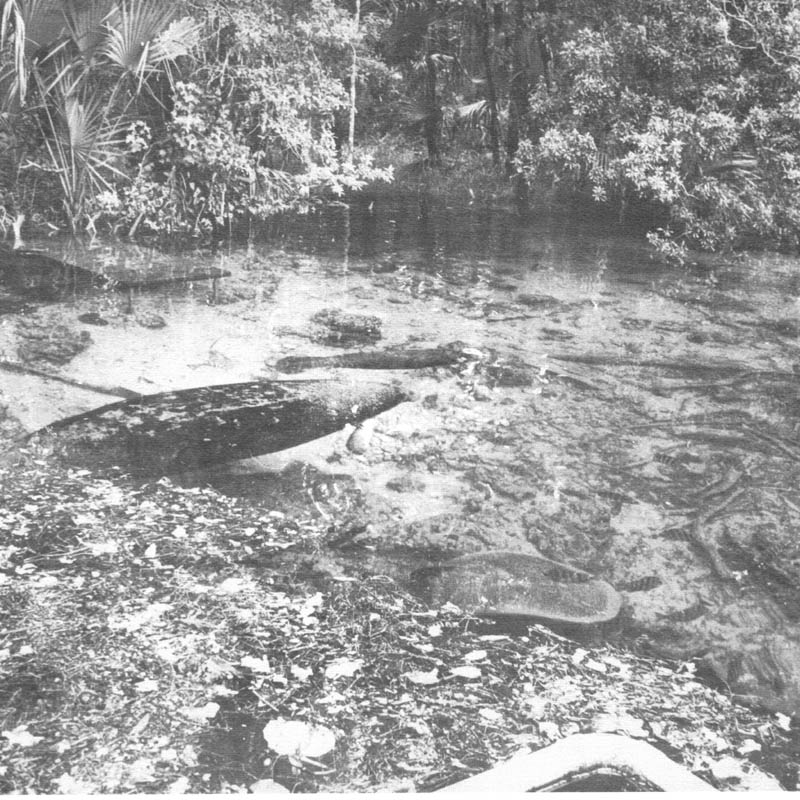
Sea cows, the gentle denizens of Florida springs and off shore waters, have been likened to mermaids. The are large animals, as big as a large bear. And they are, some of them, friendly. The will take an interest in swimmers, coming up to look at then with neither anger nor feare Manatee have their breasts under their front flippers, so a nursing manatee puts its nose up under its mothers flipper. Occasionally a manatee will come up and put its nose under a swimmer's arm. It is a kind and sociable thing among them, as a child might lay his head on a woman's bosom.
Unlike most wild animals, who avoid each other except when in rut or nursing, the manatee maintain acquaintances and generally hang about together, at least in the confines of the springs. The are not known to attack, even in self defense.
Now it is a wonderful thing about these great and harmless creatures that they go about in the sea, a sea dominated by sharks and killer whales, and you would think that sea cow would make a convenient meal for the first shark he met, but it is not so. Somehow the sea cow goes untouched. Nor does the miracle end there, for the west coast of Florida is the safes sea front in all the world. Shark attacks on humans are a tiny fraction of what they are in other areas. The sharks, the same sharks, are there in abundance, but their teeth are not for the swimmer. Somehow these mindless devourers have learned that a large, slow moving air breathing form is not to be touched nor interfered with. Perhaps they learned it from the manatee. Woe to the swimmers of the world should these mermaids ever vanish.
But most wonderful of all is this: you may explore the deeps of space, and you will not discover life though you travel with the speed of the wind for generations. You may scour the forest and plumb the sea, and though you find life, very little of it knows you are there, and what does notice you does so with fear. Some few animals may be taught to come to your hand and permit themselves to be touched, but only if they are pets, only if they have been fed by humans.
The manatee seeks you out, knows you are there, likes to have you nearby, and asks no favor in return. Some heartless writers have said, because the manatee has no hard lines nor brilliant colors, that it is ugly. But I hold that, other than people, the manatee is the only beautiful thing beneath the stars.
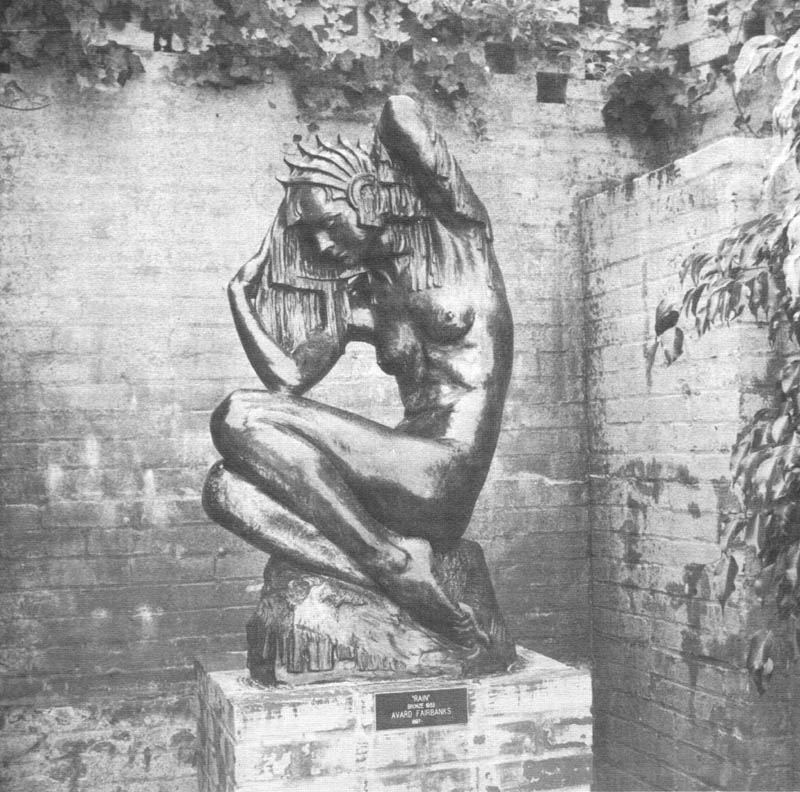
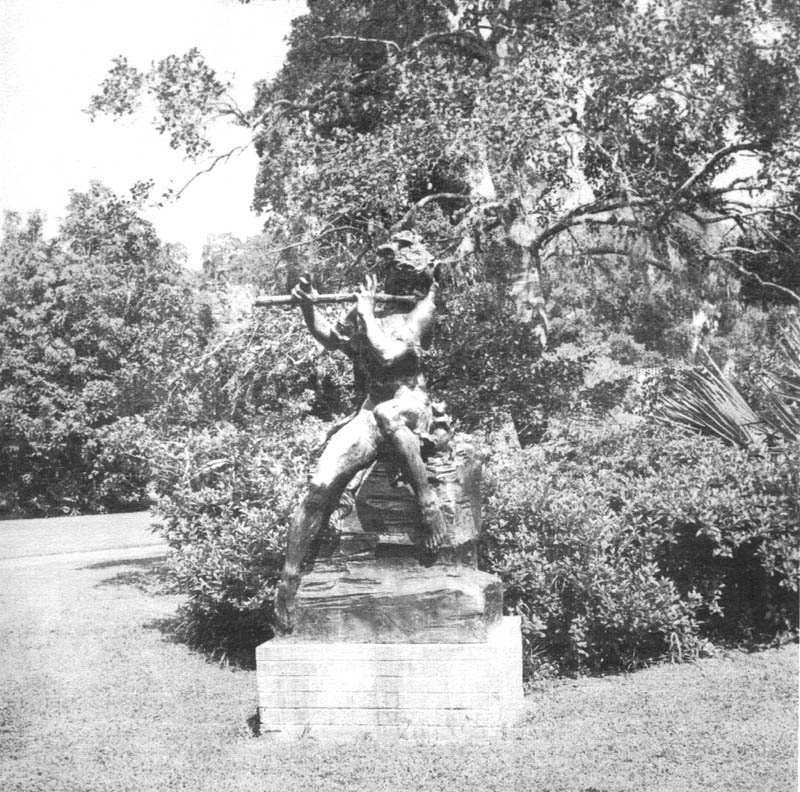
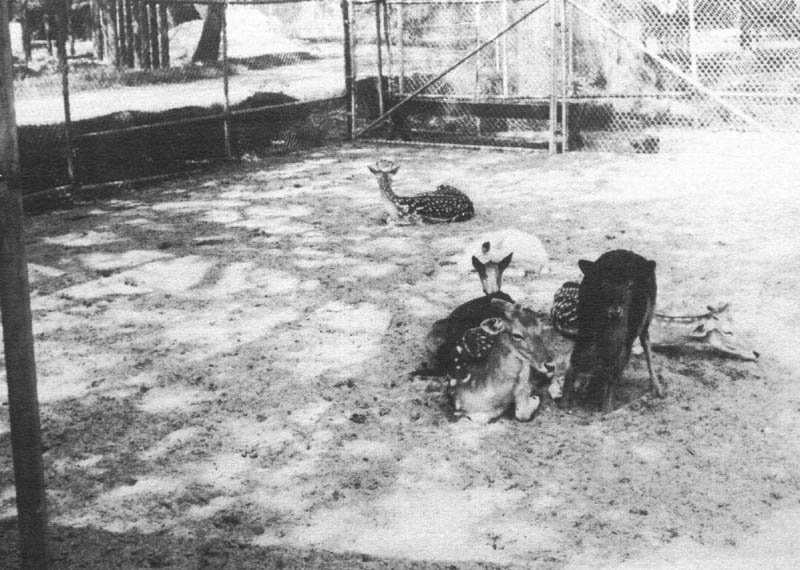
MILD SURPRISE
I was scared in the cave, and I was scared in the pantry, but I think I was scared more in the pantry.
Ordinarily I am not afraid of the dark. To be sure, many of my favorite memories are memories of light. There is the memory of warm orange flickering fire light while Father used to read to us in the l~ving room. The flames threw phantasmagoric shadows and little sparks would eat patterns in the soft velvet soot of the brick back of the fireplace. But the real light was the light of the story.
He read us Homer and I shall never forget the sun drenched plains of Troy where strong men did battle in a shadowless and featureless land. Hector was my hero. Honored by the gods. Fighting with fierce courage against dreadful odds to protect the only home he knew. Hector bursting the Greek gates with a spear in each hand. There was a shadow over the tale that I did not see. A child I did not notice that Hector scolded everyone he knew, that in the end he was destroyed because one of his brothers deserted him because of his ceaseless scoldings. I saw only a shadeless land soaked in sunlight.
There were summer lanes, dirt roads, leaf dappled where Younger Brother and I would explore all the way to Newberry, bicycle tires churning the soft sand. Treacherous that spotted light. I rode right past a coachwhip snake as long as a man is tall and bold on the road so that younger brother had to buck his bike to miss it. Delicious and cool were the bursts of shade on the hot dusty road. And far and clear could the eye reach among the illuminated fields.
Then there was work in the swamp, helping Older Brother build an antenna for the Radio Astronomy department. The light was steamy, moist, more heat than light. The clay, the sledge hammer, the bailing wire, the two by fours, you felt them more than saw them. We started work early, before the heat became tyrannical, and we took long lunch hours. But the shimmering misty light was always the same. Often thunder showers came over, grey storm light added to the white swamp light and the wet rain falling through the wet air onto the wet ground.
And there was softer light. Many a westering road growing dim in the gloaming seemed to beckon one to wander forever. And there were nights to roam the lawns of a golf course with a girl to watch the silver moonlight, to hide among the trees.
But I wasn't afraid of the dark. And the cave was dark.
My friends picked me about ten in the evening. I said it seemed a bit late, but they said the cave would be dark anyway. We drove far off into the woods and stopped on a bend in a dirt road like any other. We carried ropes and lamps through the woods and the first thing I noticed was that we were between sandy banks with tree roots sticking out, for all the world like an illustration of Dante entering hell.
Since I did not know the cave, and a very dangerous one it was, they put me in the middle. We were well below ground level before we entered what could be called a cave door. The passage way had a high top, was narrow and the floor was sandy. They spoke with intensity of "the drop" and assured me that the little three and four foot ledges we were hopping down did not count. At last the passage stopped in dead space. The ceiling had already vanished above. Abruptly the floor and both walls gave way to empty black space. This was the point where any number of young people had stepped off into eternity.
Prepared, my friends produced an enormous rope, secured it and tossed the rest into the darkness. We shinneyed down a long long way to the bottom. The bottom was packed earth. The shape of the cave was like an impossibly tall thin cathedral. We had entered by the apse. Transepts led left and right and the high nave led straight ahead. Thither they led, along a long cleft with walls that did not go vertically up, but lay in parallel billows, so that the top could not be seen even with a search light. At the end of the cleft, at the front door of the cathedral, so to speak, we climbed a long incline and located a tiny crevice. They proposed to make their way through the crevice. It was then that I noticed for the first time how small all my friends were.
The crevice was narrow. You had to go through on one shoulder. And it was so tight that you could not move without first blowing out all your air. Then, with a major effort from muscles you usually don't remember having, you could squidge ahead a couple inches before stopping to gasp for breath. At the other end of the crevice was a passage tall enough to stand in. Some brave soul had fastened a steel wire in the passage, and we proposed to follow the wire.
The wire must have gone for miles. At one time we passed a little room where you could feel the night air coming down from the roof, so I thought the cave must have another entry. And once a terrified bat passed us. But mostly the cave just went on and on getting narrower and narrower until we were slithering on our bellies. The others decided to turn back. I thought it was a pity not to explore farther, a side passage perhaps. They insisted that the time to turn back was before you got lost, but they said they would wait if I wanted to try it. I produced a ball of string, tied it to our steel wire, and slithered off down a side passage. They decided that it would be much more fun if they untied the string.
I found them again, but by the time I did I was so disoriented that I thought the was farther in was the way out. They had quite a time persuading me, because nobody is going to have much faith in a bunch of guys who untied his string. By the time we reached the room with the draught, I realized how disoriented I had been, and by the time we reached the crevice again, I was quite ready to get out of the cave. I got lost in the crevice. I angled up when I should have stayed on the bottom and got quite stuck. One of the others who had gone before crawled back and found me. I squirmed backwards and finally dropped into the right part of the crevice. It was about then that we noticed the smoke.
Someone, it seemed, had come to the cave and thrown fire works in. It fell my lot to go back and tell them not to do it again. I started back along the cleft, the high curving cleft that let back to the transepts. In my eagerness, I did not notice that I was not walking on the bottom of the cleft, but was moving along bracing myself between the two walls. They were quite close together, so that was quite easy. As I went, I was angling upward. Of course, when I reached the transepts, I could go no farther forward. I called and heard distant voices. The fireworks throwers had realized someone was in the cave and were taking their departure.
There I was, braced between two stone wall, surrounded by smoke, with no floor, no ceiling and no way forward. The obvious thing seemed to be to jump. The floor could not be far away. Instead, I started working my way down. I went down and down until it became obvious that jumping would not have been a good idea at all. Down and down, more smoke, more rock. My light had dimmed to a faint yellowglow. The batteries were giving out. At last I perched an a little ledge and turned the light out. I could not get down any farther.
There I sat on my heels until my friends caught up. They couldn't see me, but they could see my light when I turned it on. One of them still had a light that worked fairly well, so I dropped mine and used his light to make my way on down. By comparison, getting back up the rope was no problem.
Afterwards I recalled as a child looking down the toilet as it was being flushed and wondering where it all went to. I used to imagine standing in the toilet and flushing myself down in order to find out. Or was that some vague threat from Older Brother? Either way, I decided next time I had the urge to explore a cave I would instead flush myself down the toilet.
The toilet and Uncle and Aunt's house was off the kitchen. The kitchen included a glassed in porch with the breakfast table, and aunt had somehow got hold of a department store mannequin of a woman that she had dressed as a maid which sat up at the breakfast table staring disconsolately over a cup and saucer.
The proper bedrooms and master bath were in a wing a half flight of steps up from the main hall. I had been given strict instructions not to use the master bath at night for fear of awakening somebody. I was sleeping on a couch in the family room a half flight down from the main hall.
Thus it was that when I awoke, as I rarely do, with an urgent need to visit the bathroom, I first decided to go back to sleep. The master bathroom was up two half flights, the kitchen was at the other end of the house, and it could not be denied that there was something just a little bit spooky about the house anyway. Father, who had as vivid an imagination as anybody needs, had confessed to feeling spooked there once, right up there on the landing. Just remembering that was enough to make me curl back up and wish for morning light.
But an urge to go to the bathroom has a way of making itself felt and a mild case of anxiety is not a cure for it. I lay there more and more awake, but more and more tired and in more and more urgent need. Finally, I put my cold feet on the floor and stood up.
The trip up the first flight of stairs was easy enough. Then it was just a matter of turning left down the hall and not right and up the other flight of stairs. The hall ended in an entryway, which in turn led to the dining room, where there was just enough starlight to see well enough not to knock over the side board, dump out all the silverware and bring Pandemonium down around my ears.
Silently, deftly I edged out of the dining room and into the kitchen, ducked through the other door and pulled it to behind. I reached for the lights.
Now I confess that I always did have a little phobia about reaching for the light switch in the dark. Somehow I always supposed that it would be just the moment when I expected to touch the switch when a huge hairy claw would grab me by the wrist and drag me off to fate unknown. Why the claw was going to wait for the last moment, I could never fathom. It was only that my anxiety would go up just at the moment when security seemed real.
Closed in the dark room, my hand reached, not a hairy claw but a jar of apricot preserves. There is no mistaking a jar of your aunts apricot preserves. It is one of the eternal verities of life. I would have been prepared for a hairy claw, but no, not for apricot preserves. I put them back and came away with a can of coffee. In the dark I could practically smell the coffee through the metal. Perhaps the hairy claw was mocking me, handing me odd things to get me confused. I gave it back the coffee, and it handed me a pile of brown paper grocery bags.
Taking a firm hold on my nerves, not to mention the imperious summons of my bladder, I said to myself very slowly. This isn't the bathroom. That's right, the bathroom is the second door. This is the pantry. All I need to do is go back out of the pantry and take the next door.
I opened the pantry door. By this time, my eyes were thoroughly adjusted to the dark. The starlight lit the room just enough to identify things. A human figure was sitting at the breakfast table. Sitting in absolute silence. Sitting impossibly still. But impossibly definitely there. For a moment before remembering the mannequin, I was very much afraid.
M